Recuerdo la primera vez que alguien en una reunión corporativa dijo “nuestros usuarios son nuestro activo más valioso.” Yo trabajaba en datos entonces, construyendo modelos de segmentación para campañas de marketing. Sonaba bien. Humanizador, incluso.
Tardé un rato en entender lo que realmente estaban diciendo.
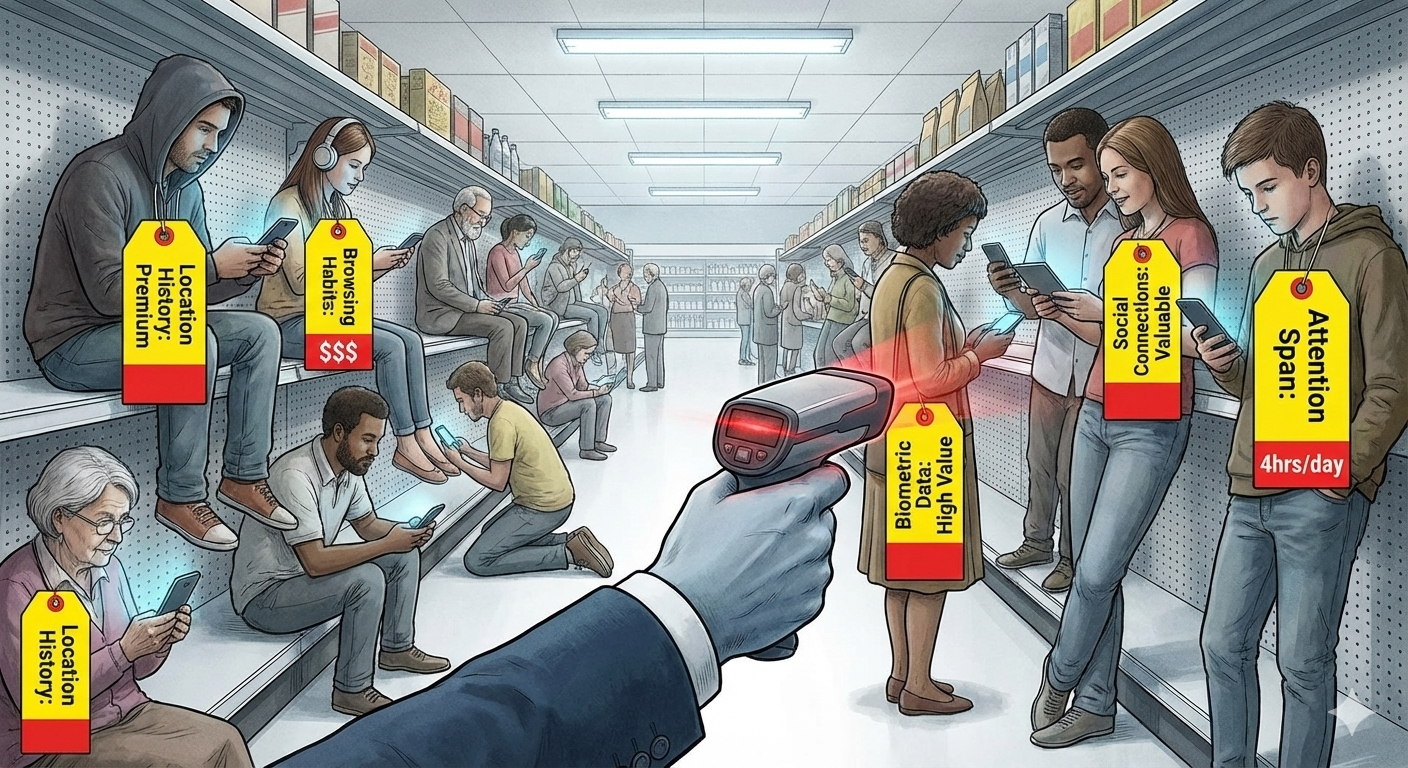
No “activo” como en “valoramos a nuestros clientes.” Sino activo como en balance general. Como en materia prima que se extrae, se procesa y se convierte en ingreso. Los usuarios no eran el fin. Eran el insumo.
Esa lógica, que vi operar desde adentro de las corporaciones, es exactamente lo que Shoshana Zuboff llamó capitalismo de vigilancia: un modelo económico donde el producto no es el servicio que usas — el producto eres tú.
Marx tenía razón sobre la alienación del trabajador. Pero se quedó corto.
Ya no solo estamos alienados del producto de nuestro trabajo. Ahora nosotros somos el producto. Y la mayoría ni siquiera se ha dado cuenta del intercambio.
Del trabajador explotado al recurso natural
Marx identificó que el trabajador fabril estaba alienado: hacía una tuerca repetitivamente sin comprender el motor completo, sin conexión con el resultado de su labor. Eso era la alienación del siglo XIX.
Hoy somos engranajes en máquinas que no solo no comprendemos — ni siquiera sabemos que existen. Usamos redes sociales sin entender que entrenamos sistemas de manipulación de comportamiento. Compramos en plataformas digitales sin percibir que cada búsqueda afina modelos predictivos de consumo. Firmamos contratos que no leemos y cedemos derechos que no sabíamos que teníamos.
Es alienación clásica, amplificada exponencialmente.
Pero hay algo peor, algo que Marx no pudo prever: en el mundo digital, dejamos de ser trabajadores para convertirnos en materia prima. En recurso natural a extraer.
Cada vez que abres Facebook, Gmail, TikTok o cualquier app “gratis”, no estás usando un servicio. Estás siendo extraído. Como petróleo del suelo. Excepto que el recurso eres tú: tu atención, tu comportamiento, tus relaciones, tu psicología, tu existencia cuantificada.
La trampa magistral de lo gratuito
Pregunta honesta: ¿cuándo fue la última vez que leíste los Términos y Condiciones antes de clickear “Acepto”?
Nunca. Nadie lo hace. Las empresas cuentan con ello.
Investigadores de Carnegie Mellon publicaron en 2012 un paper que calculó que leer todas las políticas de privacidad que un usuario promedio de internet encuentra en un año tomaría 76 días laborales — 15 semanas de trabajo de ocho horas leyendo únicamente letra pequeña. Normalizado para toda la población de EE.UU., eso equivale a 53,800 millones de horas anuales perdidas. (McDonald & Cranor, 2008; citado en TIME, 2012)
Es deliberadamente imposible. Esos contratos no están ahí para informarte. Están ahí para protegerlas legalmente mientras te despojan de todo lo que eres.
En esos documentos que no lees, cedes: tu ubicación en tiempo real, tus contactos, tu historial de navegación completo, tus búsquedas e intereses, tus conversaciones “privadas”, tu comportamiento de compra, patrones de sueño (si usas wearables), tu voz (si usas asistentes), tu rostro (reconocimiento facial), tu salud y biometría.
A cambio de qué: de “servicios gratuitos.”
Pero nada es gratis. Solo que no pagamos con dinero — pagamos con nuestra existencia cuantificada, empaquetada, procesada y vendida al mejor postor.
El modelo oculto: capitalismo de vigilancia
Aquí está la parte que más debería indignarte: estas empresas no venden tus datos directamente (aunque a veces lo hacen). Es más sofisticado y más rentable.
Venden la capacidad de modificar tu comportamiento.
El proceso tiene cuatro fases precisas:
Extracción: Recolectan no solo lo que publicas — también lo que no publicas. Los posts que escribes y borras. Las fotos que subes e inmediatamente eliminas. Cuánto tiempo pausas en cada imagen. Qué te hace scrollear más rápido. Qué te detiene.
Análisis: Algoritmos procesan billones de puntos de datos buscando patrones. Construyen modelos predictivos de tu comportamiento: qué te hace feliz, triste, enojado, ansioso; qué te hace comprar impulsivamente; qué hora del día eres más vulnerable.
Predicción: No predicen solo qué harás. Predicen qué te hará hacer algo. Qué mensaje, qué imagen, qué emoción disparada maximiza la probabilidad de que compres, compartas, votes, te quedes 5 minutos más en la app.
Modificación: Venden a los anunciantes no acceso a ti, sino la capacidad de cambiarte. “Paga X y podemos hacer que usuarios como este compren tu producto con Y% de probabilidad.” No es publicidad. Es ingeniería de comportamiento.
Eres simultáneamente: la mina de donde extraen la materia prima (tus datos), el producto que refinan (tu perfil psicológico) y el mercado donde venden (tu comportamiento modificable).
Meta Platforms no vale $1.6 trillones de dólares (capitalización al cierre de 2025) porque tiene servidores bonitos. Vale eso porque puede modificar el comportamiento de 3.58 mil millones de personas diariamente — la familia completa de apps de Facebook, Instagram, WhatsApp y Threads — con precisión industrial.
La ignorancia no es accidental, es el modelo
La mayoría de las personas no sabe que es el producto. Y eso no es casualidad. No es que “la gente es tonta” o “no le importa la privacidad.”
Es diseño deliberado. Inversión estratégica en tu ignorancia.
Las empresas tech gastan miles de millones en hacer invisibles sus procesos de extracción. El diseño de experiencia de usuario te hace sentir en control mientras cada interacción alimenta el sistema de vigilancia. Esa “configuración de privacidad” con 180 opciones distribuidas en 14 menús, con lenguaje deliberadamente confuso y defaults todos configurados para máxima extracción — no es incompetencia. Es diseño hostil.
Los “dark patterns” — técnicas de manipulación de interfaz — son el brazo ejecutor de esta estrategia: el “Roach Motel” (un click para registrarte, 14 pasos para salir), el precio señuelo, el “confirmshaming” (“No, prefiero pagar precio completo como un tonto”), las solicitudes de permisos innecesarios que el 99% acepta por inercia.
Cada permiso innecesario es extracción adicional. Cada menú confuso es una barrera diseñada.
El experimento que nadie consintió — y la consecuencia que llegó tarde
¿Sabías que Facebook realizó un experimento masivo de manipulación emocional en sus usuarios?
En enero de 2012, Kramer, Guillory y Hancock modificaron los feeds de 689,003 usuarios de Facebook sin su consentimiento. A algunos les mostraron más contenido positivo, a otros más negativo. Midieron si podían inducir estados emocionales específicos. Funcionó. El estudio fue publicado en junio de 2014 en PNAS — Proceedings of the National Academy of Sciences.
Cuando se descubrió, hubo indignación. Facebook “se disculpó.” La Federal Trade Commission impuso una multa histórica de $5,000 millones de dólares en 2019 — el mayor castigo a una empresa tech por violaciones de privacidad hasta entonces. Cambridge Analytica fue investigada y cerrada.
¿Cambió algo fundamental en el modelo de negocio?
No.
Cambridge Analytica cerró. Pero su modelo no solo sobrevivió — se perfeccionó, se normalizó, se legalizó con mejor lenguaje. Ahora se llama “publicidad política segmentada” o “personalización de mensajes” o “engagement optimization.”
Las herramientas de manipulación psicológica masiva siguen ahí. Solo aprendieron a esconder mejor sus intenciones detrás de mejores relaciones públicas — y de acuerdos con reguladores que no cambian la arquitectura de extracción.
La ignorancia no es un bug del sistema. Es su feature más rentable.
No puedes salirte del sistema completamente. Necesitas email para trabajar, GPS para moverte, WhatsApp para comunicarte con tu familia. El mundo digital no es opcional en 2025.
Pero puedes dejar de ser ingenuo. Puedes dejar de pretender que el intercambio es justo.
Cada vez que algo es “gratis”: ¿qué estás pagando realmente? ¿Qué parte de ti cedes? ¿A quién beneficia este intercambio?
Cada vez que una app pide un permiso: ¿realmente lo necesita para funcionar? ¿O te están extrayendo?
Marx te diría: el primer paso para liberarte es entender que estás encadenado.
Y encadenado, en este caso, significa aceptar que la arquitectura digital dominante no fue diseñada para servirte. Fue diseñada para extraerte.
Bienvenido a la conciencia incómoda. Es el lugar más honesto donde puedes estar.
¿Tú qué opinas?
REFERENCIAS Y FUENTES
- McDonald, A.M. & Cranor, L.F. “The Cost of Reading Privacy Policies.” I/S: A Journal of Law and Policy for the Information Society, 2008. (Citado en TIME: “You’d Need 76 Work Days to Read All Your Privacy Policies Each Year”, 2012-03-06. URL: https://techland.time.com/2012/03/06/)
- Kramer, A.D.I., Guillory, J.E. & Hancock, J.T. “Experimental evidence of massive-scale emotional contagion through social networks.” Proceedings of the National Academy of Sciences (PNAS), Vol. 111, No. 24, 2014-06-17. URL: https://www.pnas.org/doi/10.1073/pnas.1320040111
- Federal Trade Commission (FTC). “FTC Imposes $5 Billion Penalty and Sweeping New Privacy Restrictions on Facebook.” FTC Press Release, 2019-07-24. URL: https://www.ftc.gov/
- Wikipedia / multiple news sources. “Facebook–Cambridge Analytica data scandal.” Documentado: 87 millones de perfiles comprometidos, 70.6M en EE.UU. URL: https://en.wikipedia.org/wiki/Facebook–Cambridge_Analytica_data_scandal
- MacroTrends. “Meta Platforms Market Cap.” Consultado mayo 2026. URL: https://www.macrotrends.net/stocks/charts/META/meta-platforms/market-cap
- Meta Platforms, Inc. “Q4 2025 Earnings Results.” Meta Investor Relations, 2026-01-29. (3.58 mil millones DAP reportados.)
- Zuboff, Shoshana. “The Age of Surveillance Capitalism: The Fight for a Human Future at the New Frontier of Power.” PublicAffairs, 2019. ISBN: 978-1610395694.
- NextBillion. “Nobody Reads Privacy Policies: Why We Need to Go Beyond Consent to Ensure Data Privacy.” NextBillion.net, 2022-10-27. URL: https://nextbillion.net/beyond-consent-for-data-privacy/
- Deloitte. (Encuesta citada en NextBillion): 91% de consumidores acepta Términos y Condiciones sin leerlos; 97% de los de 18-34 años. URL: referenciado en NextBillion, 2022.
I remember the first time someone in a corporate meeting said “our users are our most valuable asset.” I was working in data at the time, building segmentation models for marketing campaigns. It sounded good. Humanizing, even.
It took me a while to understand what they were actually saying.
Not “asset” as in “we value our customers.” Asset as in balance sheet. As in raw material that gets extracted, processed, and converted into revenue. Users were not the end goal. They were the input.
That logic — which I saw operate from inside corporations — is exactly what Shoshana Zuboff called surveillance capitalism: an economic model where the product is not the service you use. The product is you.
Marx was right about worker alienation. But he fell short.
We are no longer just alienated from the product of our work. Now we are the product. And most people haven’t even noticed the exchange.
From exploited worker to natural resource
Marx identified that the factory worker was alienated: making a nut repetitively without understanding the complete engine, without connection to the result of their labor. That was 19th-century alienation.
Today we are cogs in machines we not only don’t understand — we don’t even know they exist. We use social networks without realizing we’re training behavioral manipulation systems. We shop on digital platforms without perceiving that each search refines predictive consumption models. We sign contracts we don’t read and surrender rights we didn’t know we had.
It is classic alienation, exponentially amplified.
But there is something worse, something Marx could not foresee: in the digital world, we stopped being workers and became raw material. A natural resource to be extracted.
Every time you open Facebook, Gmail, TikTok, or any “free” app, you are not using a service. You are being extracted. Like oil from the ground. Except the resource is you: your attention, your behavior, your relationships, your psychology, your quantified existence.
The masterful trap of free
Honest question: when was the last time you read the Terms and Conditions before clicking “I Agree”?
Never. Nobody does. Companies count on it.
Carnegie Mellon researchers published a paper in 2012 calculating that reading all the privacy policies an average internet user encounters in a year would take 76 work days — 15 weeks of eight-hour days reading nothing but fine print. Across the entire US population, that equals 53.8 billion hours annually. (McDonald & Cranor, 2008; cited in TIME, 2012)
It is deliberately impossible. Those contracts are not there to inform you. They are there to protect companies legally while they dispossess you of everything you are.
In those documents you don’t read, you surrender: your real-time location, your contacts, your complete browsing history, your searches and interests, your “private” conversations, your purchasing behavior, sleep patterns (if you use wearables), your voice (if you use assistants), your face (facial recognition), your health and biometrics.
In exchange for: “free services.”
But nothing is free. We just don’t pay with money — we pay with our quantified existence, packaged, processed, and sold to the highest bidder.
The hidden model: surveillance capitalism
Here is the part that should outrage you most: these companies don’t sell your data directly (though sometimes they do). It is more sophisticated and more profitable.
They sell the ability to modify your behavior.
The process has four precise phases:
Extraction: They collect not just what you post — also what you don’t post. The posts you write and delete. The photos you upload and immediately remove. How long you pause on each image. What makes you scroll faster. What stops you.
Analysis: Algorithms process trillions of data points looking for patterns. They build predictive models of your behavior: what makes you happy, sad, angry, anxious; what makes you buy impulsively; what time of day you are most vulnerable.
Prediction: They predict not just what you will do. They predict what will make you do something. What message, what image, what triggered emotion maximizes the probability that you buy, share, vote, stay 5 more minutes in the app.
Modification: They sell advertisers not access to you, but the ability to change you. “Pay X and we can make users like this buy your product with Y% probability.” This is not advertising. It is behavioral engineering.
You are simultaneously: the mine from which they extract raw material (your data), the product they refine (your psychological profile), and the market where they sell (your modifiable behavior).
Meta Platforms is not worth $1.6 trillion (market cap at end of 2025) because it has nice servers. It is worth that because it can modify the behavior of 3.58 billion people daily — the full family of Facebook, Instagram, WhatsApp, and Threads — with industrial precision.
Ignorance is not accidental, it is the model
Most people don’t know they are the product. And that is not coincidence. It is not that “people are dumb” or “don’t care about privacy.”
It is deliberate design. Strategic investment in your ignorance.
Tech companies spend billions making their extraction processes invisible. User experience design makes you feel in control while every interaction feeds the surveillance system. That “privacy settings” page with 180 options distributed across 14 menus, with deliberately confusing language and defaults all configured for maximum extraction — that is not incompetence. It is hostile design.
“Dark patterns” — interface manipulation techniques — are the execution arm of this strategy: the “Roach Motel” (one click to sign up, 14 steps to leave), decoy pricing, “confirmshaming” (“No thanks, I prefer to pay full price like a fool”), unnecessary permission requests that 99% of users accept by inertia.
Every unnecessary permission is additional extraction. Every confusing menu is a deliberate barrier.
The experiment nobody consented to — and the consequence that came late
Did you know that Facebook conducted a massive emotional manipulation experiment on its users?
In January 2012, Kramer, Guillory, and Hancock modified the news feeds of 689,003 Facebook users without their consent. Some were shown more positive content, others more negative. They measured whether they could induce specific emotional states. It worked. The study was published in June 2014 in PNAS — Proceedings of the National Academy of Sciences.
When discovered, there was outrage. Facebook “apologized.” The Federal Trade Commission imposed a historic fine of $5 billion in 2019 — the largest penalty against a tech company for privacy violations at that time. Cambridge Analytica was investigated and shut down.
Did anything fundamental change in the business model?
No.
Cambridge Analytica closed. But its model not only survived — it was perfected, normalized, legalized with better language. Now it is called “segmented political advertising,” or “message personalization,” or “engagement optimization.”
The tools for mass psychological manipulation remain. They just learned to better hide their intentions behind better public relations — and agreements with regulators that do not change the extraction architecture.
Ignorance is not a bug of the system. It is its most profitable feature.
You cannot exit the system completely. You need email to work, GPS to get around, WhatsApp to communicate with family. The digital world is not optional in 2025.
But you can stop being naive. You can stop pretending the exchange is fair.
Every time something is “free”: what are you really paying? What part of yourself do you surrender? Who benefits from this exchange?
Every time an app requests a permission: does it really need it to function? Or are you being extracted?
Marx would tell you: the first step to freeing yourself is understanding that you are chained.
And chained, in this case, means accepting that the dominant digital architecture was not designed to serve you. It was designed to extract you.
Welcome to uncomfortable awareness. It is the most honest place you can be.
What do you think?
REFERENCES AND SOURCES
- McDonald, A.M. & Cranor, L.F. “The Cost of Reading Privacy Policies.” I/S: A Journal of Law and Policy for the Information Society, 2008. (Cited in TIME: “You’d Need 76 Work Days to Read All Your Privacy Policies Each Year”, 2012-03-06. URL: https://techland.time.com/2012/03/06/)
- Kramer, A.D.I., Guillory, J.E. & Hancock, J.T. “Experimental evidence of massive-scale emotional contagion through social networks.” PNAS, Vol. 111, No. 24, 2014-06-17. URL: https://www.pnas.org/doi/10.1073/pnas.1320040111
- Federal Trade Commission (FTC). “FTC Imposes $5 Billion Penalty and Sweeping New Privacy Restrictions on Facebook.” FTC Press Release, 2019-07-24. URL: https://www.ftc.gov/
- Multiple sources. “Facebook–Cambridge Analytica data scandal.” Documented: up to 87 million profiles compromised, 70.6M in the US. URL: https://en.wikipedia.org/wiki/Facebook–Cambridge_Analytica_data_scandal
- MacroTrends. “Meta Platforms Market Cap.” Accessed May 2026. URL: https://www.macrotrends.net/stocks/charts/META/meta-platforms/market-cap
- Meta Platforms, Inc. “Q4 2025 Earnings Results.” Meta Investor Relations, 2026-01-29. (3.58 billion DAP reported.)
- Zuboff, Shoshana. “The Age of Surveillance Capitalism: The Fight for a Human Future at the New Frontier of Power.” PublicAffairs, 2019. ISBN: 978-1610395694.
- NextBillion. “Nobody Reads Privacy Policies: Why We Need to Go Beyond Consent to Ensure Data Privacy.” NextBillion.net, 2022-10-27. URL: https://nextbillion.net/beyond-consent-for-data-privacy/
- Deloitte. Survey referenced in NextBillion (2022): 91% of consumers accept Terms and Conditions without reading them; 97% among 18-34 year olds.