Durante años, la conducción autónoma ha sido vendida como la respuesta definitiva al error humano en las calles. Las tecnologías de cámaras, sensores y LiDAR prometen reducir los miles de accidentes que ocurren diariamente por distracciones, fatiga o negligencia humana. La industria nos ha repetido incansablemente que los algoritmos no se cansan, no se distraen, no manejan ebrios. Que son, en esencia, superiores a nosotros.
Mientras tanto, las startups de vehículos autónomos capturan rondas de inversión multimillonarias mostrando avances deslumbrantes. Waymo, propiedad de Alphabet, opera más de mil robotaxis en seis ciudades estadounidenses. Tesla promete “supervisión” autónoma completa. La narrativa es consistente: estamos en el umbral de una revolución que eliminará el elemento más impredecible de la ecuación del tránsito: el ser humano.
Pero existe un debate que la industria prefiere mantener en segundo plano: el dilema ético de las decisiones imposibles. El experimento del Moral Machine del MIT reveló que diferentes culturas tienen diferentes expectativas morales sobre cómo un vehículo autónomo debería comportarse ante dilemas fatales. ¿A quién debe proteger el algoritmo cuando el accidente es inevitable? ¿Al pasajero? ¿Al peatón? ¿Al niño sobre el adulto? ¿Al joven sobre el anciano?
La industria no ha resuelto este dilema. No puede resolverlo. Y mientras tanto, esos vehículos “autónomos” ya circulan en nuestras calles.
Ahora sabemos por qué.
El escándalo que nadie esperaba
El 4 de febrero de 2026, durante una audiencia en el Senado de Estados Unidos convocada después de que un Waymo atropellara a un niño en Santa Monica, California, el Chief Safety Officer de Waymo, Mauricio Peña, hizo una admisión reveladora: cuando los vehículos “autónomos” de Waymo encuentran situaciones que no pueden resolver, llaman a operadores humanos remotos. Y algunos de esos operadores están en Filipinas.
El senador Ed Markey presionó hasta obtener la confirmación. Peña no pudo proporcionar cifras exactas de cuántos operadores están en Estados Unidos versus en el extranjero, pero confirmó que trabajadores filipinos “proveen guía” a los vehículos cuando enfrentan escenarios complejos. Insistió en que “no manejan remotamente los vehículos” — el vehículo, según él, siempre mantiene el control de las tareas de conducción.
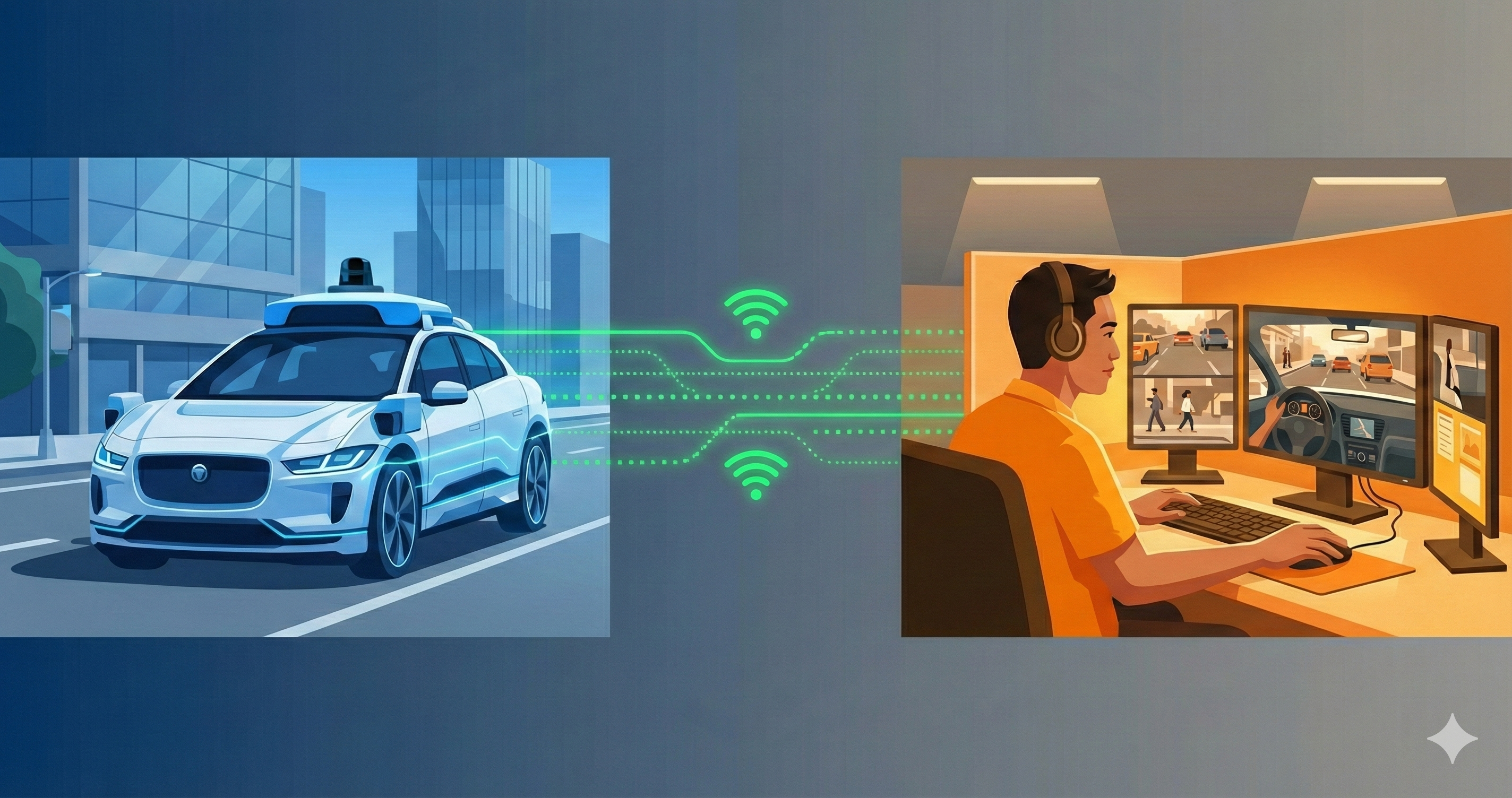
Es una distinción técnica conveniente. Los operadores ven feeds en tiempo real de las cámaras del vehículo. Determinan qué carril debe elegir el robotaxi. Proponen rutas. Contextualizan el entorno. ¿Eso no es conducir? Depende de cómo definas “conducir.”
Tesla también admitió usar operadores remotos similares durante la misma audiencia.
Esta revelación no es un caso aislado de tecnología que falla. Es un patrón reconocible.
El patrón invisible
En 2024, Amazon cerró su sistema “Just Walk Out” — supuestamente IA revolucionaria que permitía comprar sin cajeros. Resultó depender de mil trabajadores en India revisando videos de las cámaras.
Facebook emplea más de 15,000 moderadores de contenido globalmente, muchos de ellos en Filipinas, Kenia e India, pagados tan poco como $1.50 por hora. Estos trabajadores ven cientos de imágenes y videos perturbadores cada día — decapitaciones, pornografía infantil, suicidios — en turnos de 8 horas, con apenas 60-70 segundos para tomar cada decisión. Cuando intentan organizarse para exigir mejores condiciones, son despedidos y deportados.
OpenAI subcontrató la “limpieza” de datos tóxicos de ChatGPT a trabajadores en Kenia que recibían menos de $2 por hora.
La lista continúa. TikTok, Google, Amazon, Microsoft — todos siguen el mismo modelo: vender “inteligencia artificial” mientras ocultan el trabajo humano, offshore, mal pagado, que sostiene la ilusión.
Waymo es simplemente el siguiente capítulo de esta historia. La diferencia es que esta vez, las consecuencias del error no son una Coca-Cola cobrada de más o un post ofensivo que no se eliminó a tiempo. Son vidas humanas en riesgo.
Las preguntas que nadie quiere responder
Si los operadores remotos en Filipinas están “guiando” decisiones de vehículos que circulan en San Francisco, Los Ángeles o Phoenix, surgen preguntas fundamentales que Waymo no ha respondido satisfactoriamente:
¿Quién certifica que estos operadores sean conductores competentes? Waymo afirma que pasan verificaciones de antecedentes, exámenes de manejo y conocen las reglas de tránsito locales. Pero no hay verificación independiente de estos procesos. No sabemos si tienen licencias estadounidenses. No sabemos qué entrenamiento reciben realmente.
¿Cómo se garantiza la latencia y estabilidad de las conexiones de red entre Filipinas y Estados Unidos? Un segundo de retraso en una intersección puede ser la diferencia entre esquivar a un peatón o atropellarlo. No existen estándares públicos sobre tiempos de respuesta aceptables.
¿Quién supervisa las condiciones laborales de estos operadores? ¿Cómo se asegura Waymo de que no estén fatigados después de turnos extenuantes, distraídos en sus ambientes de trabajo, o bajo influencia de sustancias? La ventaja del modelo offshore es el bajo costo. Pero el bajo costo viene con baja supervisión, contratos opacos y una zona gris legal donde la responsabilidad civil se diluye entre continentes.
Cuando un vehículo Waymo causa un accidente mientras recibe “guía” de un operador en Manila, ¿quién es legalmente responsable? ¿Waymo? ¿El operador? ¿La empresa subcontratista filipina? ¿El algoritmo?
Estas no son preguntas abstractas. Son fundamentales para la seguridad pública. Y nadie está proporcionando respuestas.
La ironía del extractivismo digital
Filipinas, como gran parte de América Latina, se ha convertido en el “back office” invisible del mundo tecnológico. Mientras Silicon Valley captura riqueza vendiendo “automatización” y “autonomía,” los trabajadores del Sur Global cargan con el peso invisible de mantener esa ilusión funcionando.
En América Latina, donde aproximadamente 130 millones de trabajadores operan en la economía informal — casi el 50% del empleo no agrícola en la región — conducir taxi o trabajar para plataformas digitales como Uber, DiDi y Cabify se ha convertido en una válvula de escape para millones de personas. En México, 14 millones de trabajadores de plataformas digitales —lo que la industria llama “gig economy” o economía de plataformas— representan el 33% de la fuerza laboral. En países como Guatemala, el 73.6% del empleo es informal; en Bolivia, el 85%.
Para muchos, manejar un taxi o trabajar para Uber no es una carrera aspiracional. Es la diferencia entre tener ingresos o no tenerlos cuando el mercado laboral formal no ofrece alternativas. Es lo que haces cuando te despiden, cuando tu negocio quiebra, cuando no tienes más opciones. Es, literalmente, una de las últimas redes de contención en economías donde la seguridad social prácticamente no existe.
La automatización de estos trabajos no “libera” a nadie. Simplemente elimina una de las últimas válvulas de escape en economías ya precarias.
Y ahora resulta que los “robotaxis autónomos” que amenazan con desplazar a esos conductores… dependen de otros conductores. Solo que estos están más lejos, ganan menos, y tienen aún menos protecciones.
Seguimos insistiendo en etiquetar todo como “autónomo,” “inteligente,” “de nueva generación.” Pero nos negamos a aceptar las implicaciones de los experimentos en tiempo real que se desarrollan en nuestras calles. Experimentos donde los errores no se miden en dinero perdido o en productos defectuosos, sino en vidas humanas.
La paradoja es brutal: en nombre de eliminar el error humano del tránsito, hemos creado un sistema donde seres humanos toman decisiones de vida o muerte desde miles de kilómetros de distancia, con conexiones de internet que pueden fallar, en condiciones laborales que no podemos verificar, bajo contratos que diluyen responsabilidades, mientras las empresas maximizan ganancias de accionistas vendiendo una “autonomía” que no existe.
¿Realmente necesitamos desplazar trabajos que emplean a personas reales, con familias reales, que necesitan ingresos reales para sobrevivir? ¿O hemos llegado al punto donde la automatización es un fin en sí mismo, una narrativa tan poderosa que su simple promesa justifica cualquier costo humano?
La pregunta ya no es si podemos construir vehículos autónomos. La pregunta es si lo que estamos construyendo es realmente autónomo, o simplemente otra capa de extractivismo digital donde la tecnología es el teatro y los trabajadores invisibles son el telón de fondo que nadie quiere ver.
Mientras la industria tech sigue capturando miles de millones en inversión prometiendo futuros sin humanos, tal vez deberíamos preguntarnos: ¿por qué estamos tan desesperados por sacarnos a nosotros mismos de la ecuación?
REFERENCIAS Y FUENTES
Caso Waymo-Filipinas:
Newsweek - “Waymo Reveals Remote Workers in Philippines Help Guide Its Driverless Cars” (Febrero 2026)
- Audiencia del Senado de EE.UU. el 4 de febrero de 2026
- Testimonio de Mauricio Peña, Chief Safety Officer de Waymo
- Declaraciones del Senador Ed Markey sobre seguridad y ciberseguridad
San Francisco Chronicle - “Waymo says its robotaxis get help from remote workers in the Philippines” (Febrero 2026)
- Operadores filipinos ven feeds en tiempo real de cámaras
- Proceso de background checks y drug screening (sin verificación independiente)
- Waymo opera en 6 ciudades estadounidenses
Phil Koopman (Carnegie Mellon University) - “Waymo Tap-Dances about Overseas Remote Drivers” (Febrero 2026)
- Análisis de lenguaje corporativo evasivo de Waymo
- Argumento sobre transición temporal de Level 4 a Level 2
- “All Robotaxis Have Remote Drivers”
Futurism - “It Turns Out That When Waymos Are Stumped, They Get Intervention From Workers in the Philippines” (Febrero 2026)
- Tesla también usa operadores remotos similares (Lars Moravy, VP)
- Agentes pueden determinar carriles y proponer rutas
- Preocupaciones sobre ciberseguridad
Moderación de Contenido (Patrón de “IA” con humanos invisibles):
TIME Magazine - “Inside Facebook’s African Sweatshop” (Febrero 2022)
- Moderadores en Kenia pagados $1.50 por hora
- Más de 15,000 moderadores de contenido globalmente
- Descripción como “neo-colonialismo” y “esclavitud moderna”
Rest of World - “The despair and darkness of people will get to you” (Abril 2023)
- Meta emplea más de 15,000 moderadores globalmente
- Meta pagó $52 millones a moderadores estadounidenses, excluyó a trabajadores asiáticos
- Más de 1.2 millones empleados en BPO en Filipinas e India
International Journal of Law in Context - “Resisting Meta: content moderation in Kenya” (Agosto 2025)
- Daniel Motaung: despedido y deportado por intentar organizar huelga
- Trabajadores engañados (les dijeron “call center agents”)
- Trauma psicológico severo documentado
Coda Story - “In Nairobi’s Silicon Savanna, African workers are taking on Big Tech” (Agosto 2025)
- 180+ moderadores demandan a Meta por $1.6 mil millones
- Primer caso donde Meta enfrenta corte en Sur Global
- Trabajadores ven 600-700 piezas de contenido por turno
Institute for Human Rights and Business (IHRB) - “Content moderation is a new factory floor of exploitation” (Noviembre 2025)
- Meta, Google, Microsoft, TikTok, OpenAI usan subcontratistas en Kenia, Filipinas, Colombia
- Google, Amazon, Microsoft vinculados a trabajos pagando $1.77 por tarea
- Violación de ILO Violence and Harassment Convention 2019
Economía Informal y Plataformas Digitales en LATAM:
International Labour Organization (ILO) - Datos 2023
- 130 millones de trabajadores informales en LATAM y Caribe
- Bolivia: 85% informalidad; Guatemala: 73.6%; Costa Rica: 30.7%
- 63% de jóvenes (15-24 años) en trabajo informal en LAC
Inter-American Development Bank (IDB) - “Who drives on ride-hailing platforms in Latin America?” (2024)
- Promedio conductor usa plataforma 19 horas/semana
- 62% dejaron trabajos anteriores para trabajar en plataformas
- Solo 53% de conductores son dueños del vehículo que manejan
Payment Consulting & Market Intelligence (PCMI) - “Gig Economy in Latin America” (Junio 2025)
- México: 14 millones trabajadores de plataformas (33% fuerza laboral)
- 46 millones de latinoamericanos en economía de plataformas
Mauve Group - “How the gig economy is shaping LATAM” (Septiembre 2023)
- Ecuador: 70% repartidores trabajan 70 horas/semana sin días libres
- 60% reportan caída en ingresos por cambios en términos de plataformas
European Parliament Research Service - “Latin America’s informal economy” (2021)
- Empleo informal representa casi 50% del empleo no-agrícola
- Crisis COVID penalizó trabajadores informales desproporcionadamente
Casos Adicionales de IA con Trabajo Humano Oculto:
Varios medios - Amazon Just Walk Out (2024)
- 1,000 trabajadores en India revisando videos de cámaras
- Sistema vendido como “IA revolucionaria sin cajeros”
The Guardian / TIME - OpenAI moderación de contenido en Kenia (2023)
- Trabajadores pagados menos de $2/hora
- Limpieza de datos tóxicos para entrenamiento de ChatGPT
For years, autonomous driving has been sold as the definitive answer to human error on the roads. Camera technologies, sensors, and LiDAR promise to reduce the thousands of accidents that occur daily from distraction, fatigue, or negligence. The industry has repeatedly told us that algorithms don’t get tired, don’t get distracted, don’t drive drunk. That they are, in essence, superior to us.
Meanwhile, autonomous vehicle startups capture multimillion-dollar investment rounds showcasing dazzling advances. Waymo, owned by Alphabet, operates over a thousand robotaxis in six U.S. cities. Tesla promises complete “unsupervised” autonomy. The narrative is consistent: we’re on the threshold of a revolution that will eliminate the most unpredictable element from the traffic equation: the human being.
But there’s a debate the industry prefers to keep in the background: the ethical dilemma of impossible decisions. MIT’s Moral Machine experiment revealed that different cultures have different moral expectations about how an autonomous vehicle should behave when facing fatal dilemmas. Who should the algorithm protect when an accident is inevitable? The passenger? The pedestrian? The child over the adult? The young over the elderly?
The industry hasn’t resolved this dilemma. It can’t resolve it. And meanwhile, those “autonomous” vehicles are already circulating on our streets.
Now we know why.
The scandal nobody expected
On February 4, 2026, during a U.S. Senate hearing convened after a Waymo struck a child in Santa Monica, California, Waymo’s Chief Safety Officer, Mauricio Peña, made a revealing admission: when Waymo’s “autonomous” vehicles encounter situations they cannot resolve, they call remote human operators. And some of those operators are in the Philippines.
Senator Ed Markey pressed until obtaining confirmation. Peña could not provide exact figures of how many operators are in the United States versus abroad, but confirmed that Filipino workers “provide guidance” to vehicles when facing complex scenarios. He insisted they “do not remotely drive the vehicles” — the vehicle, according to him, always maintains control of driving tasks.
It’s a convenient technical distinction. The operators see real-time feeds from the vehicle’s cameras. They determine which lane the robotaxi should choose. They propose routes. They contextualize the environment. Isn’t that driving? It depends on how you define “driving.”
Tesla also admitted using similar remote operators during the same hearing.
This revelation is not an isolated case of technology failing. It’s a recognizable pattern.
The invisible pattern
In 2024, Amazon shut down its “Just Walk Out” system — supposedly revolutionary AI that allowed shopping without cashiers. It turned out to depend on a thousand workers in India reviewing camera videos.
Facebook employs more than 15,000 content moderators globally, many of them in the Philippines, Kenya, and India, paid as little as $1.50 per hour. These workers view hundreds of disturbing images and videos daily — beheadings, child pornography, suicides — in 8-hour shifts, with barely 60-70 seconds to make each decision. When they try to organize to demand better conditions, they’re fired and deported.
OpenAI outsourced the “cleaning” of toxic data for ChatGPT to workers in Kenya who received less than $2 per hour.
The list continues. TikTok, Google, Amazon, Microsoft — all follow the same model: sell “artificial intelligence” while hiding the human, offshore, poorly paid work that sustains the illusion.
Waymo is simply the next chapter in this story. The difference is that this time, the consequences of error aren’t an extra charged Coca-Cola or an offensive post that wasn’t removed in time. They’re human lives at risk.
The questions nobody wants to answer
If remote operators in the Philippines are “guiding” decisions of vehicles circulating in San Francisco, Los Angeles, or Phoenix, fundamental questions arise that Waymo hasn’t satisfactorily answered:
Who certifies that these operators are competent drivers? Waymo claims they pass background checks, driving tests, and know local traffic rules. But there’s no independent verification of these processes. We don’t know if they have U.S. licenses. We don’t know what training they actually receive.
How is the latency and stability of network connections between the Philippines and the United States guaranteed? One second of delay at an intersection can be the difference between avoiding a pedestrian or running them over. No public standards exist for acceptable response times.
Who supervises the working conditions of these operators? How does Waymo ensure they’re not fatigued after exhausting shifts, distracted in their work environments, or under the influence of substances? The advantage of the offshore model is low cost. But low cost comes with low supervision, opaque contracts, and a legal gray zone where civil liability dissolves across continents.
When a Waymo vehicle causes an accident while receiving “guidance” from an operator in Manila, who is legally responsible? Waymo? The operator? The Filipino subcontracting company? The algorithm?
These aren’t abstract questions. They’re fundamental to public safety. And nobody is providing answers.
The irony of digital extractivism
The Philippines, like much of Latin America, has become the invisible “back office” of the technological world. While Silicon Valley captures wealth selling “automation” and “autonomy,” Global South workers bear the invisible weight of keeping that illusion running.
In Latin America, where approximately 130 million workers operate in the informal economy — nearly 50% of non-agricultural employment in the region — driving a taxi or working for digital platforms like Uber, DiDi, and Cabify has become an escape valve for millions of people. In Mexico, 14 million workers on digital platforms —what the industry calls the “gig economy”— represent 33% of the workforce. In countries like Guatemala, 73.6% of employment is informal; in Bolivia, 85%.
For many, driving a taxi or working for Uber isn’t an aspirational career. It’s the difference between having income or not when the formal labor market offers no alternatives. It’s what you do when you’re fired, when your business fails, when you have no more options. It’s literally one of the last safety nets in economies where social security practically doesn’t exist.
The automation of these jobs doesn’t “liberate” anyone. It simply eliminates one of the last escape valves in already precarious economies.
And now it turns out that the “autonomous robotaxis” threatening to displace those drivers… depend on other drivers. Except these are farther away, earn less, and have even fewer protections.
We keep insisting on labeling everything as “autonomous,” “intelligent,” “next generation.” But we refuse to accept the implications of the real-time experiments unfolding on our streets. Experiments where errors aren’t measured in lost money or defective products, but in human lives.
The paradox is brutal: in the name of eliminating human error from traffic, we’ve created a system where human beings make life-or-death decisions from thousands of miles away, with internet connections that can fail, under working conditions we can’t verify, under contracts that dilute responsibilities, while companies maximize shareholder profits selling an “autonomy” that doesn’t exist.
Do we really need to displace jobs that employ real people, with real families, who need real income to survive? Or have we reached the point where automation is an end in itself, a narrative so powerful that its mere promise justifies any human cost?
The question is no longer whether we can build autonomous vehicles. The question is whether what we’re building is truly autonomous, or simply another layer of digital extractivism where technology is the theater and invisible workers are the backdrop nobody wants to see.
While the tech industry continues capturing billions in investment promising futures without humans, perhaps we should ask ourselves: why are we so desperate to remove ourselves from the equation?
REFERENCES AND SOURCES
Waymo-Philippines Case:
Newsweek - “Waymo Reveals Remote Workers in Philippines Help Guide Its Driverless Cars” (February 2026)
- U.S. Senate hearing on February 4, 2026
- Testimony of Mauricio Peña, Waymo Chief Safety Officer
- Senator Ed Markey’s statements on security and cybersecurity
San Francisco Chronicle - “Waymo says its robotaxis get help from remote workers in the Philippines” (February 2026)
- Filipino operators view real-time camera feeds
- Background check and drug screening process (no independent verification)
- Waymo operates in 6 U.S. cities
Phil Koopman (Carnegie Mellon University) - “Waymo Tap-Dances about Overseas Remote Drivers” (February 2026)
- Analysis of Waymo’s evasive corporate language
- Argument about temporary transition from Level 4 to Level 2
- “All Robotaxis Have Remote Drivers”
Futurism - “It Turns Out That When Waymos Are Stumped, They Get Intervention From Workers in the Philippines” (February 2026)
- Tesla also uses similar remote operators (Lars Moravy, VP)
- Agents can determine lanes and propose routes
- Cybersecurity concerns
Content Moderation (Pattern of “AI” with invisible humans):
TIME Magazine - “Inside Facebook’s African Sweatshop” (February 2022)
- Moderators in Kenya paid $1.50 per hour
- More than 15,000 content moderators globally
- Described as “neo-colonialism” and “modern slavery”
Rest of World - “The despair and darkness of people will get to you” (April 2023)
- Meta employs more than 15,000 moderators globally
- Meta paid $52 million to U.S. moderators, excluded Asian workers
- More than 1.2 million employed in BPO in Philippines and India
International Journal of Law in Context - “Resisting Meta: content moderation in Kenya” (August 2025)
- Daniel Motaung: fired and deported for trying to organize strike
- Workers deceived (told they’d be “call center agents”)
- Severe documented psychological trauma
Coda Story - “In Nairobi’s Silicon Savanna, African workers are taking on Big Tech” (August 2025)
- 180+ moderators sue Meta for $1.6 billion
- First case where Meta faces court in Global South
- Workers view 600-700 pieces of content per shift
Institute for Human Rights and Business (IHRB) - “Content moderation is a new factory floor of exploitation” (November 2025)
- Meta, Google, Microsoft, TikTok, OpenAI use subcontractors in Kenya, Philippines, Colombia
- Google, Amazon, Microsoft linked to jobs paying $1.77 per task
- Violation of ILO Violence and Harassment Convention 2019
Informal Economy and Digital Platforms in Latin America:
International Labour Organization (ILO) - 2023 Data
- 130 million informal workers in Latin America and Caribbean
- Bolivia: 85% informality; Guatemala: 73.6%; Costa Rica: 30.7%
- 63% of youth (15-24 years) in informal work in LAC
Inter-American Development Bank (IDB) - “Who drives on ride-hailing platforms in Latin America?” (2024)
- Average driver uses platform 19 hours/week
- 62% left previous jobs to work on platforms
- Only 53% of drivers own the vehicle they drive
Payment Consulting & Market Intelligence (PCMI) - “Gig Economy in Latin America” (June 2025)
- Mexico: 14 million platform workers (33% workforce)
- 46 million Latin Americans in platform economy
Mauve Group - “How the gig economy is shaping LATAM” (September 2023)
- Ecuador: 70% delivery workers work 70 hours/week with no days off
- 60% report income drop due to platform terms changes
European Parliament Research Service - “Latin America’s informal economy” (2021)
- Informal employment represents nearly 50% of non-agricultural employment
- COVID crisis disproportionately penalized informal workers
Additional Cases of AI with Hidden Human Work:
Various media - Amazon Just Walk Out (2024)
- 1,000 workers in India reviewing camera videos
- System sold as “revolutionary cashierless AI”
The Guardian / TIME - OpenAI content moderation in Kenya (2023)
- Workers paid less than $2/hour
- Cleaning toxic data for ChatGPT training