Hay una reflexión en la que no puedo dejar de pensar. La divulgadora científica mexicana Carolina Jefillysh —Química Farmacobióloga por la UNAM, con más de un millón de suscriptores en su canal Ciencia Simplificada— apunta con frecuencia a una herida generacional muy clara: hicimos todo lo que nos dijeron. Estudiamos. Nos esforzamos. Seguimos las reglas. Y al final del camino nos encontramos con rentas impagables, deudas estudiantiles y mercados laborales diseñados para extraer, no para construir. Es la ruptura de un contrato social. Y tiene razón.
Yo seguí ese mismo contrato. Doctorado. Años construyendo modelos de machine learning para multinacionales. El tipo de carrera que se suponía era la promesa cumplida. Lo fue, por un tiempo. Pero hoy, desde este lado de la mesa, escribiendo sobre los sistemas que ayudé a construir, veo algo que no esperaba: la generación que viene detrás de mí no está rota. Está recalculando.
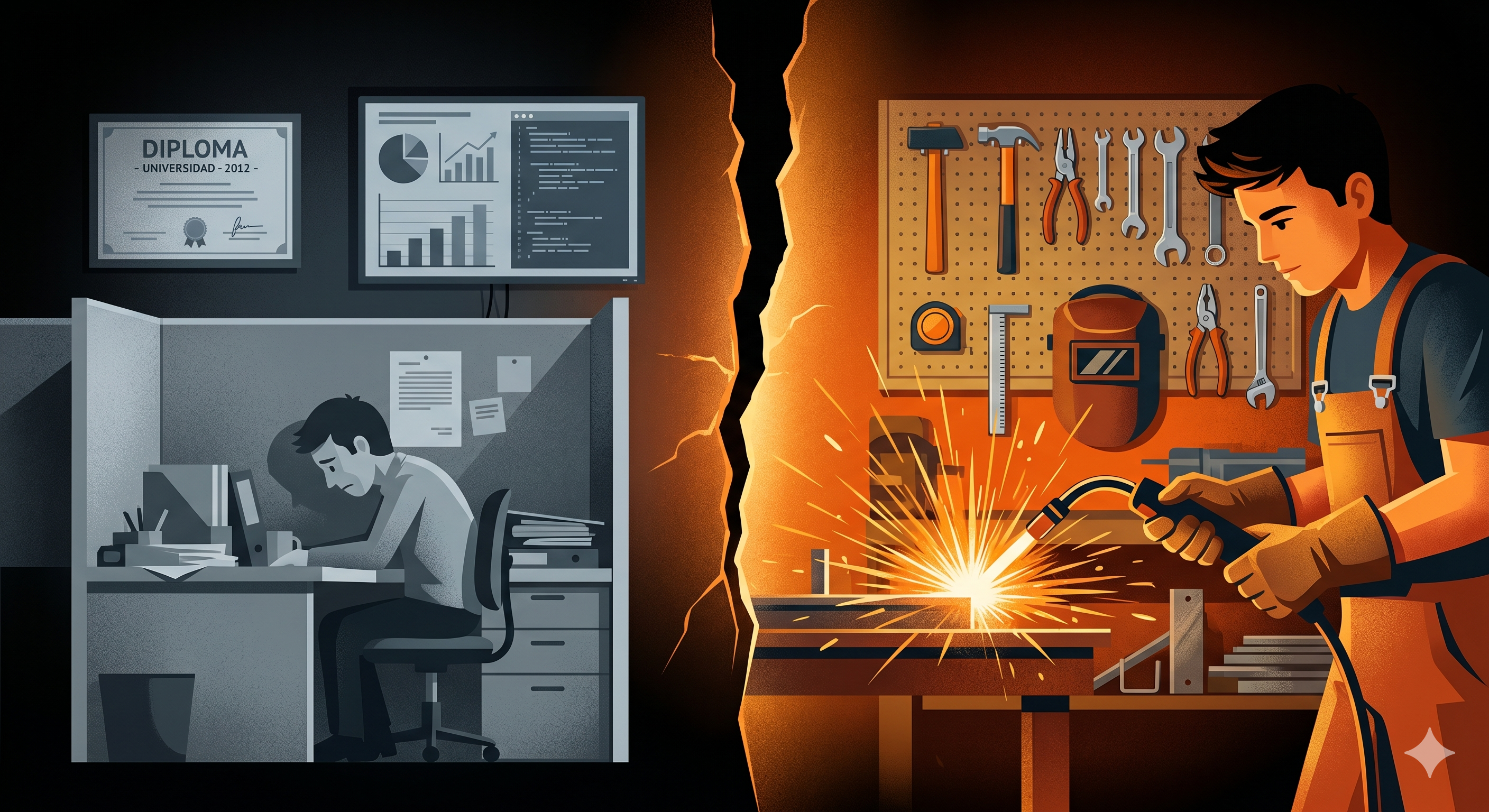
Y está recalculando hacia el taller.
El ascensor no solo se detuvo. Alguien le cortó los cables.
Durante décadas, el contrato fue claro: educación universitaria igual a movilidad social. En México, la UNAM. En Argentina, la UBA. En Brasil, la USP. En Colombia, la UNAL. Estas instituciones no eran solo universidades — eran la materialización de una promesa colectiva. El Estado te decía: esfuérzate, y la sociedad te abre puertas.
Hoy esa promesa colisiona con una realidad brutal. Un estudio de Stanford documentó que los profesionales de 22 a 25 años en ocupaciones altamente expuestas a la IA vieron caer su empleo un 13% en promedio desde la irrupción de ChatGPT (Stanford Digital Economy Lab, 2024). Los datos de Goldman Sachs confirman que el desempleo entre trabajadores de 20 a 30 años aumentó casi tres puntos porcentuales desde principios de 2024. En México, la CEPAL advierte que el 41.4% de los empleos presenta alto riesgo de automatización para 2030.
El ascensor no se detuvo por negligencia. Lo desconectaron deliberadamente, y le instalaron un sistema de inteligencia artificial en su lugar.
La revolución que nadie vio venir
Frente a este colapso, la Gen Z no está llorando sobre el contrato roto. Está firmando uno nuevo — en los términos que el sistema nunca anticipó.
En Estados Unidos, los jóvenes de 18 a 24 años representan casi el 25% de todas las nuevas contrataciones en industrias de oficios calificados, pese a ser solo el 18% de la fuerza laboral (Gusto, 2024). Las inscripciones en programas vocacionales crecieron un 16% en un solo año — el mayor aumento registrado desde que el National Student Clearinghouse comenzó a rastrear estos datos. En el Reino Unido y Alemania, el fenómeno replica con igual intensidad: los programas de aprendizaje artesanal tienen listas de espera que las universidades ya no conocen.
Esto no es un fenómeno del Sur Global resignado a sus limitaciones. Está pasando en el corazón del primer mundo. Y eso cambia todo.
En América Latina, el 59% de los centennials considera que la automatización podría llevarlos a buscar oficios manuales menos vulnerables a la tecnología (ManpowerGroup, 2025). No es ignorancia tecnológica — es cálculo estratégico. Y en México, donde ManpowerGroup documenta una escasez histórica de electricistas, soldadores y mecánicos, esa apuesta tiene nombre y dirección: oportunidad.
Minimalismo profesional como acto político
Pero hay algo más profundo que los datos no terminan de capturar. Una encuesta de Glassdoor a más de 1,000 profesionales en 2025 reveló que el 68% de la Gen Z afirma que el liderazgo corporativo no es su meta. No porque sean conformistas — sino porque son lúcidos.
“No es que la generación Z rechace el trabajo”, escribe Chris Martin, director de investigación de Glassdoor. “Rechaza una versión obsoleta del trabajo que se les ha vendido.”
Solo el 6% de la Gen Z considera el liderazgo como objetivo indispensable, según Deloitte (2025). El 72% ha renunciado o considerado renunciar a un empleo por falta de flexibilidad (LinkedIn, 2024). Están construyendo un vocabulario nuevo: minimalismo profesional, quiet quitting, toolbelt generation. Detrás de cada término hay una misma pregunta: ¿por qué sacrificar mi vida entera a una corporación que me desechará cuando le resulte conveniente?
La respuesta que está dando la generación más vigilada de la historia es radical en su sencillez: no lo haré.
La paradoja que el sistema no sabe resolver
Aquí está el giro que Silicon Valley no anticipó. La inteligencia artificial fue diseñada para automatizar el trabajo repetitivo y “liberar” el potencial humano hacia tareas cognitivas de alto valor. Lo que nadie calculó es que esas tareas cognitivas — análisis, redacción, programación básica, diseño — son exactamente las que la IA también está devorando.
El plomero no puede ser reemplazado por un modelo de lenguaje.
El electricista no puede ser despedido por una actualización de software.
La soldadora no puede ser sustituida por un agente de IA.
Y la Gen Z, con el pragmatismo feroz de quien creció viendo a sus padres perder trabajos “seguros”, lo entendió antes que los expertos en mercado laboral.
No sé si esta revolución silenciosa del overol va a rediseñar el capitalismo o simplemente va a crear un nuevo estrato de trabajadores que el sistema terminará precarizando de otras formas. El tiempo lo dirá.
Lo que sí sé es esto: una generación que decide construir su autonomía con sus propias manos — literalmente — en lugar de entregársela al monstruo corporativo a cambio de un salario que no alcanza y una promesa que nunca llegó, merece algo más que condescendencia académica.
Merece ser leída como lo que es: el primer acto de desobediencia masiva contra una economía que prometió el cielo y entregó precariedad algorítmica.
La revolución no viene de las aulas. Viene del taller.
REFERENCIAS Y FUENTES
- Jefillysh, Carolina. Ciencia Simplificada (Podcast / Canal de YouTube). Divulgación científica y análisis de impacto sistémico y salud mental generacional. México. URL: https://www.youtube.com/@jefillysh
- Stanford Digital Economy Lab. “AI Exposure and Youth Employment”. Stanford University, 2024.
- Goldman Sachs Research. “The Potentially Large Effects of AI on Economic Growth”. Goldman Sachs, 2024.
- CEPAL. “Perspectivas económicas de América Latina 2024: Transformación digital para una recuperación activa e inclusiva”. CEPAL, 2024.
- Gusto Payroll. “Gen Z in the Workforce: 2024 Report”. Gusto, 2024.
- National Student Clearinghouse Research Center. “Vocational Enrollment Trends 2022-2023”. NSCRC, 2023.
- ManpowerGroup. “Barómetro de Talento 2024-2025”. ManpowerGroup México, 2025.
- Glassdoor / Chris Martin. “Gen Z and Corporate Leadership Survey”. Glassdoor, 2025.
- Deloitte. “Global 2025 Gen Z and Millennial Survey”. Deloitte, 2025.
- LinkedIn Workforce Report. “Flexibility and Gen Z: 2024 Insights”. LinkedIn, 2024.
There is a reflection I cannot stop thinking about. Mexican science communicator Carolina Jefillysh — a Pharmaceutical Chemist and Biologist by training from UNAM, with over a million subscribers on her channel Ciencia Simplificada — frequently points to a very clear generational wound: we did everything we were told. We studied. We worked hard. We followed the rules. And at the end of the road, we found ourselves with unaffordable rents, student debt, and labor markets designed to extract, not to build. It is the rupture of a social contract. And she is right.
I followed that same contract. A PhD. Years building machine learning models for multinational corporations. The kind of career that was supposed to be the fulfilled promise. It was, for a while. But today, from this side of the table — writing about the systems I helped build — I see something I did not expect: the generation coming behind me is not broken. It is recalculating.
And it is recalculating toward the workshop.
The elevator didn’t just stop. Someone cut the cables.
For decades, the contract was clear: university education equals social mobility. In Mexico, UNAM. In Argentina, UBA. In Brazil, USP. In Colombia, UNAL. These institutions were not just universities — they were the materialization of a collective promise. The State told you: work hard, and society will open doors for you.
Today that promise collides with a brutal reality. A Stanford study documented that professionals aged 22 to 25 in occupations highly exposed to AI saw their employment drop by 13% on average since the rise of ChatGPT (Stanford Digital Economy Lab, 2024). Goldman Sachs data confirms that unemployment among workers aged 20 to 30 increased by nearly three percentage points since early 2024. In Mexico, CEPAL warns that 41.4% of jobs face a high risk of automation by 2030.
The elevator did not stop out of negligence. It was deliberately disconnected, and an artificial intelligence system was installed in its place.
The revolution nobody saw coming
Faced with this collapse, Gen Z is not crying over the broken contract. It is signing a new one — on terms the system never anticipated.
In the United States, young people aged 18 to 24 represent nearly 25% of all new hires in skilled trades industries, despite being only 18% of the workforce (Gusto, 2024). Vocational program enrollments grew 16% in a single year — the largest increase recorded since the National Student Clearinghouse began tracking this data. In the United Kingdom and Germany, the phenomenon replicates with equal intensity: artisan apprenticeship programs have waiting lists that universities no longer know.
This is not a phenomenon of a Global South resigned to its limitations. It is happening at the heart of the first world. And that changes everything.
In Latin America, 59% of centennials believe that automation could lead them to seek manual trades less vulnerable to technology (ManpowerGroup, 2025). This is not technological ignorance — it is strategic calculation. And in Mexico, where ManpowerGroup documents a historic shortage of electricians, welders and mechanics, that bet has a name and an address: opportunity.
Professional minimalism as a political act
But there is something deeper that the data does not quite capture. A Glassdoor survey of more than 1,000 professionals in 2025 revealed that 68% of Gen Z say corporate leadership is not their goal. Not because they are conformists — but because they are lucid.
“It’s not that Gen Z rejects work,” writes Chris Martin, Glassdoor’s director of research. “They reject an outdated version of work that has been sold to them.”
Only 6% of Gen Z considers leadership an indispensable goal, according to Deloitte (2025). And 72% have quit or considered quitting a job due to lack of flexibility (LinkedIn, 2024). They are building a new vocabulary: professional minimalism, quiet quitting, toolbelt generation. Behind each term lies the same question: why sacrifice my entire life to a corporation that will discard me when convenient?
The answer being given by the most surveilled generation in history is radical in its simplicity: I won’t.
The paradox the system cannot solve
Here is the twist Silicon Valley did not anticipate. Artificial intelligence was designed to automate repetitive work and “free” human potential toward high-value cognitive tasks. What nobody calculated is that those cognitive tasks — analysis, writing, basic programming, design — are exactly what AI is also devouring.
The plumber cannot be replaced by a language model.
The electrician cannot be fired by a software update.
The welder cannot be substituted by an AI agent.
And Gen Z, with the fierce pragmatism of those who grew up watching their parents lose “safe” jobs, understood this before the labor market experts did.
I don’t know whether this silent revolution of the overalls will redesign capitalism or simply create a new stratum of workers the system will eventually precarize in other ways. Time will tell.
What I do know is this: a generation that chooses to build its autonomy with its own hands — literally — instead of handing it over to the corporate monster in exchange for a salary that doesn’t stretch and a promise that never arrived, deserves more than academic condescension.
It deserves to be read for what it is: the first act of mass disobedience against an economy that promised the sky and delivered algorithmic precarity.
The revolution does not come from classrooms. It comes from the workshop.
REFERENCES AND SOURCES
- Jefillysh, Carolina. Ciencia Simplificada (Podcast / YouTube Channel). Science communication and systemic impact analysis. Mexico. URL: https://www.youtube.com/@jefillysh
- Stanford Digital Economy Lab. “AI Exposure and Youth Employment”. Stanford University, 2024.
- Goldman Sachs Research. “The Potentially Large Effects of AI on Economic Growth”. Goldman Sachs, 2024.
- CEPAL. “Latin American Economic Outlook 2024: Digital Transformation for an Active and Inclusive Recovery”. CEPAL, 2024.
- Gusto Payroll. “Gen Z in the Workforce: 2024 Report”. Gusto, 2024.
- National Student Clearinghouse Research Center. “Vocational Enrollment Trends 2022-2023”. NSCRC, 2023.
- ManpowerGroup. “Talent Barometer 2024-2025”. ManpowerGroup Mexico, 2025.
- Glassdoor / Chris Martin. “Gen Z and Corporate Leadership Survey”. Glassdoor, 2025.
- Deloitte. “Global 2025 Gen Z and Millennial Survey”. Deloitte, 2025.
- LinkedIn Workforce Report. “Flexibility and Gen Z: 2024 Insights”. LinkedIn, 2024.