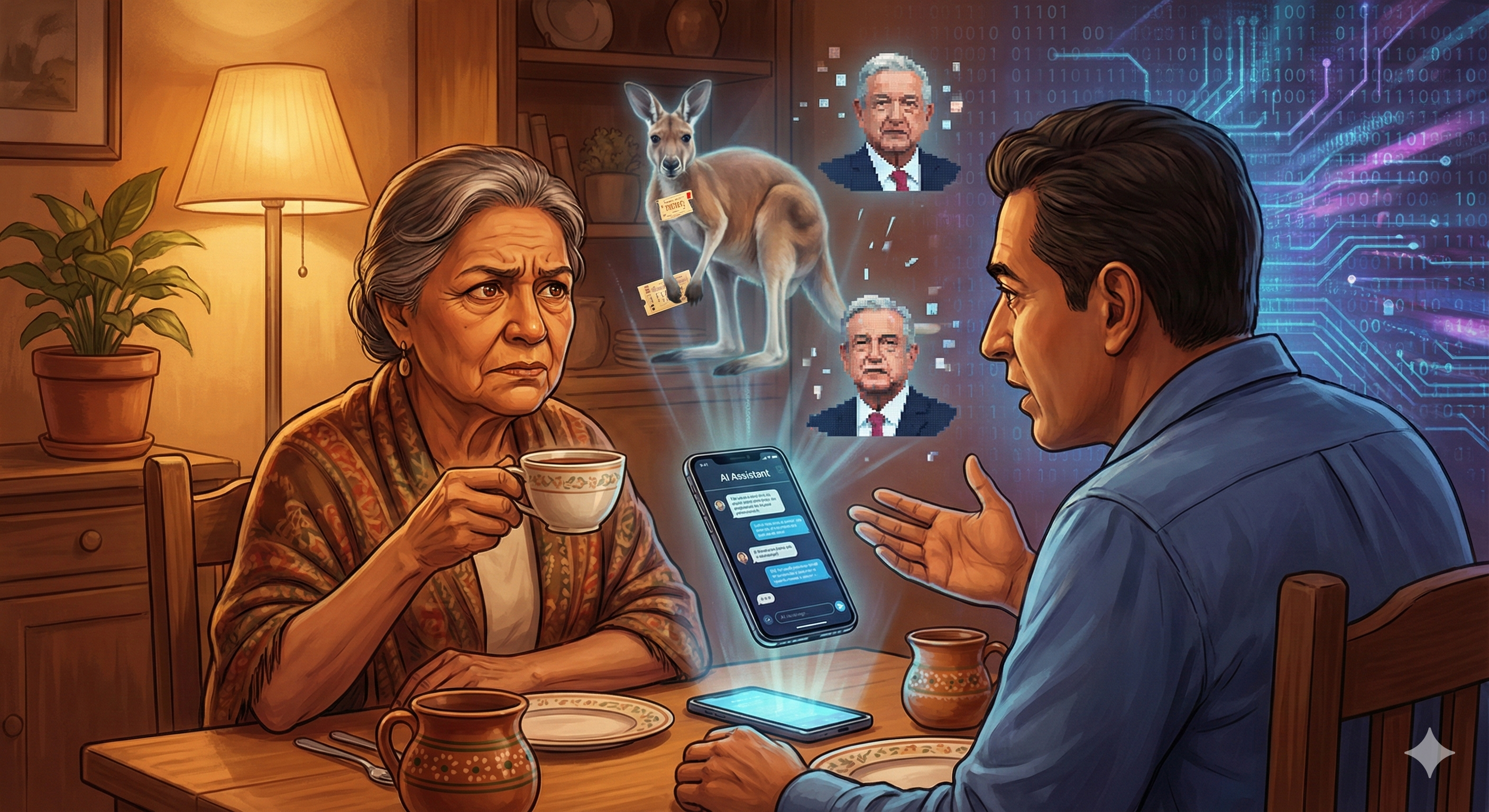
Hace unos meses, durante una de esas conversaciones largas de sobremesa con mis padres—personas que viven relativamente alejadas de este tsunami tecnológico que nos consume—compartí con ellos algunos de los fenómenos más extraños del mundo tech. Les hablé de personas que se enamoran de sus asistentes de IA. De aquellos que han convertido a ChatGPT en su mejor amigo, en una cámara de eco que valida cada pensamiento con entusiasmo algorítmico. De quienes no pueden tomar una decisión, por mínima que sea, sin consultarle a la máquina primero.
Mi madre me miró con esa mezcla de escepticismo y preocupación que solo una madre puede perfeccionar. “¿Estás inventando una película de ciencia ficción ahí mismo, o es real?”
Es real. Muy real.
Para quienes vivimos inmersos en tecnología, ciencia de datos, machine learning, estos comportamientos empiezan a normalizarse. Para los más jóvenes, que han crecido viendo cómo la IA teje sus telarañas en cada aspecto de la vida cotidiana, quizá ni siquiera parezca extraño. Pero para un espectador externo—alguien que no vive perpetuamente conectado—esto es sorpresivo. Casi inquietante.
Les mostré los deepfakes. Ese video del canguro intentando subirse a un avión con su boleto en mano, serio como pasajero frecuente. Los discursos que jamás dieron ciertas personalidades políticas, pero que parecen completamente auténticos. Les expliqué que hace años, crear un buen Photoshop requería años de práctica, miles de horas con el software. Alcanzar ese nivel de maestría era un proceso largo, casi artesanal. Ahora, un prompt de 20 palabras lo hace en segundos, con resultados que superan a muchos profesionales.
Y no solo imágenes. Pasamos a generar audios falsos con corpus relativamente pequeños—como los equipos de cambio de voz de Misión Imposible con Tom Cruise, pero democratizados. Ahora hasta videos completos con niveles de realismo que pasan por ciertos, a menos que la trama sea absurda. O que vivas en México, donde el surrealismo es parte del día a día y la realidad compite ferozmente con cualquier ficción generada por IA.
Bromas aparte, fue la siguiente pregunta de mi madre la que me dejó pensando seriamente durante días:
"¿Y cómo es que tú no te pierdes entre ese mundo de fantasía y ficción? ¿Cómo te mantienes conectado al mundo real? ¿Cómo mantienes los pies en el suelo?"
Es una pregunta legítima. Porque seamos realistas: es un paso relativamente natural perderse en la tecnología y quedarse colgado de ese mundo maravilloso, tal como sucedió con tantas personas “viviendo” sus vidas en Second Life hace años—probablemente acabo de revelar mi edad con esa referencia. Entonces, ¿qué hace que siga siendo juicioso? ¿Qué me mantiene anclado?
La verdad es que creo que es esta curiosidad constante. Esta necesidad casi compulsiva de mantenerme preguntando: ¿Qué hace realmente esta plataforma? ¿Para qué sirve más allá del marketing? ¿Hasta dónde puede llegar? Y simultáneamente, abstraerme en las implicaciones sobre la sociedad actual. Porque es fantástico el mundo que se abre frente a nosotros—las posibilidades son genuinamente asombrosas—pero a la vez, es impensable el impacto que va a tener en el mundo tal cual lo conocemos.
Lo que me mantiene con los pies en el suelo es una empatía molesta, incómoda. Pensar por un lado en quienes podrán subirse al barco de la adopción tecnológica—los privilegiados con acceso, educación, recursos—pero a su vez pensar en todos aquellos que no podrán por razones socioculturales o económicas. Y que esto generará una brecha aún mayor de la que ya existe.
Veo cómo las distopías que creíamos ficción—Un Mundo Feliz, Mad Max, Terminator, Wall-E—se vuelven realidades que vamos tejiendo día a día, decisión tras decisión, algoritmo tras algoritmo. Y sobre todo, siento la responsabilidad de intentar dejar un mundo más ético, menos corrupto, más enfocado en el bienestar social.
Quizá es un exceso de idealismo. Tal vez un ataque de ingenuidad. Pero considero que quienes estamos en este camino—quienes construimos, implementamos, reflexionamos sobre estas tecnologías—tenemos toda la responsabilidad de no ampliar la brecha económica y social para América Latina. Porque el mundo ya está demasiado polarizado y politizado como para llevar estas malas prácticas al mundo digital y ser partícipes de esta exclusión de las voces que no pueden ser escuchadas en este momento, pero que también son vecinos de este mundo. Que también vivirán—o sufrirán—las consecuencias de lo que construimos hoy.
Entonces, quizá la respuesta a la pregunta de mi madre es simple: me mantengo con los pies en el suelo porque no puedo dejar de pensar en quienes no tienen el lujo de despegar.
Pero ahora te pregunto a ti: ¿Qué te mantiene anclado a la realidad cuando trabajas con tecnologías que la desafían constantemente? ¿O ya dejaste de distinguir dónde termina una y comienza la otra?
¿Cuál es tu ancla? Esa cosa que te recuerda para quién y por qué haces lo que haces. ¿Tienes una? ¿O navegas a la deriva con la corriente del hype?
Referencias
Este artículo es una reflexión personal basada en conversaciones familiares y experiencia profesional en el campo de la inteligencia artificial y ciencia de datos. Las referencias a fenómenos culturales (Second Life, deepfakes, relaciones humano-IA) son de dominio público y ampliamente documentadas en medios especializados.
Hashtags: #ReflexiónIA #TecnologíaYHumanidad #ÉticaIA #BrechaDigital #ResponsabilidadTecnológica #AmericaLatinaTech #MetaContenido #PiesEnElSuelo #BeyondTheAlgorithm
Nota del autor:
Este es un artículo de metacontenido—una reflexión personal sobre cómo mantenerse anclado en la realidad mientras se trabaja con tecnologías que constantemente la desafían. No pretende ser un análisis técnico ni académico, sino una conversación honesta sobre las preguntas que me hago diariamente: ¿Para quién construimos? ¿Por qué? ¿Y quién paga el precio de nuestro entusiasmo tecnológico?
La pregunta de mi madre no tiene una respuesta única o definitiva. Pero vale la pena seguir intentando responderla.
A few months ago, during one of those long after-dinner conversations with my parents—people who live relatively removed from this technological tsunami consuming us—I shared some of the strangest phenomena from the tech world. I told them about people falling in love with their AI assistants. About those who’ve turned ChatGPT into their best friend, into an echo chamber that validates every thought with algorithmic enthusiasm. About those who can’t make a decision, however minor, without consulting the machine first.
My mother looked at me with that mixture of skepticism and concern that only a mother can perfect. “Are you making up a sci-fi movie right here, or is this real?”
It’s real. Very real.
For those of us immersed in technology, data science, machine learning, these behaviors are starting to normalize. For younger people who’ve grown up watching AI weave its webs into every aspect of daily life, it might not even seem strange. But for an external observer—someone who doesn’t live perpetually connected—this is surprising. Almost unsettling.
I showed them the deepfakes. That video of the kangaroo trying to board a plane with ticket in hand, serious as a frequent flyer. The speeches that certain political figures never gave but seem completely authentic. I explained that years ago, creating a good Photoshop required years of practice, thousands of hours with the software. Reaching that level of mastery was a long, almost artisanal process. Now, a 20-word prompt does it in seconds, with results that surpass many professionals.
And not just images. We moved on to generating fake audios with relatively small corpus—like the voice-changing equipment from Mission Impossible with Tom Cruise, but democratized. Now even complete videos with levels of realism that pass as real, unless the plot is absurd. Or you live in Mexico, where surrealism is part of daily life and reality fiercely competes with any AI-generated fiction.
Jokes aside, it was my mother’s next question that left me thinking seriously for days:
“And how is it that you don’t get lost between that world of fantasy and fiction? How do you stay connected to the real world? How do you keep your feet on the ground?”
It’s a legitimate question. Because let’s be realistic: it’s a relatively natural step to get lost in technology and get hung up on that wonderful world, just as happened with so many people “living” their lives in Second Life years ago—I’ve probably just revealed my age with that reference. So, what keeps me sound? What keeps me anchored?
The truth is I think it’s this constant curiosity. This almost compulsive need to keep asking: What does this platform really do? What is it for beyond the marketing? How far can it go? And simultaneously, abstracting myself in the implications for current society. Because the world opening before us is fantastic—the possibilities are genuinely amazing—but at the same time, the impact it will have on the world as we know it is unthinkable.
What keeps my feet on the ground is an annoying, uncomfortable empathy. Thinking on one hand about those who will be able to board the technological adoption ship—the privileged with access, education, resources—but at the same time thinking about all those who won’t be able to for sociocultural or economic reasons. And that this will generate an even larger gap than already exists.
I see how the dystopias we thought were fiction—Brave New World, Mad Max, Terminator, Wall-E—are becoming realities we’re weaving day by day, decision after decision, algorithm after algorithm. And above all, I feel the responsibility to try to leave a more ethical world, less corrupt, more focused on social welfare.
Perhaps it’s an excess of idealism. Maybe an attack of naivety. But I believe that those of us on this path—those who build, implement, reflect on these technologies—have all the responsibility not to widen the economic and social gap for Latin America. Because the world is already too polarized and politicized to bring these bad practices to the digital world and be participants in this exclusion of voices that cannot be heard at this moment, but who are also neighbors of this world. Who will also live—or suffer—the consequences of what we build today.
So perhaps the answer to my mother’s question is simple: I keep my feet on the ground because I can’t stop thinking about those who don’t have the luxury of taking off.
But now I ask you: What keeps you anchored to reality when working with technologies that constantly challenge it? Or have you already stopped distinguishing where one ends and the other begins?
What’s your anchor? That thing that reminds you who and why you do what you do. Do you have one? Or are you drifting with the current of hype?
References
This article is a personal reflection based on family conversations and professional experience in the field of artificial intelligence and data science. References to cultural phenomena (Second Life, deepfakes, human-AI relationships) are in the public domain and widely documented in specialized media.
Hashtags: #AIReflection #TechnologyAndHumanity #AIEthics #DigitalDivide #TechResponsibility #LatinAmericaTech #MetaContent #FeetOnTheGround #BeyondTheAlgorithm
Author’s note:
This is a meta-content article—a personal reflection on how to stay anchored in reality while working with technologies that constantly challenge it. It doesn’t pretend to be a technical or academic analysis, but an honest conversation about the questions I ask myself daily: Who do we build for? Why? And who pays the price for our technological enthusiasm?
My mother’s question doesn’t have a single or definitive answer. But it’s worth continuing to try to answer it.