A finales de enero de 2026, los analistas de TD Cowen publicaron una nota interna: Oracle necesitaba liberar entre 8,000 y 10,000 millones de dólares en flujo de caja libre para competir en la guerra de los centros de datos. El mercado tomó nota. Los empleados, no.
Según la experiencia documentada de múltiples exempleados, el 31 de marzo de 2026, a las 6:00 de la mañana —hora local de cada región—, miles de personas abrieron un correo firmado por “Oracle Leadership”. Antes de terminar de leerlo, habían perdido acceso a Slack, VPN y correo corporativo. Treinta mil posiciones eliminadas en un solo movimiento. El mayor recorte en los 47 años de historia de la empresa. El 18% de su fuerza laboral global, desactivada en cuestión de horas.
Lo que hace un mes era un rumor en reportes de analistas, se volvió una realidad sin anestesia.
El contexto que Oracle no quiere que leas
Oracle no estaba en crisis. En su reporte del tercer trimestre fiscal 2026, publicado el 10 de marzo, la empresa registró un ingreso neto Non-GAAP de 5,200 millones de dólares — un crecimiento del 23%. No despidió a 30,000 personas porque sus números fueran malos. Lo hizo para liberar capital y destinarlo a otra cosa.
Esa “otra cosa” quedó documentada ante la SEC: en su reporte 10-Q de marzo de 2026, Oracle reveló un plan de reestructuración de 2,100 millones de dólares orientado a financiar un despliegue masivo de infraestructura de centros de datos de IA valorado en 156,000 millones. El objetivo: competir contra AWS y Microsoft Azure por los contratos de xAI y OpenAI.
El caso Oracle no es aislado. Según un reporte de Challenger, Gray & Christmas publicado en abril de 2026, de los 60,620 recortes de empleo anunciados en EE.UU. en marzo, la inteligencia artificial lideró como motivo principal, causando directamente 15,341 despidos — el 25% del total. En febrero, esa proporción era del 10%. La tendencia se acelera.
El mapa del sacrificio
Treinta mil personas no es un número abstracto. Es una radiografía de dónde Oracle decidió que el costo del futuro debía pagarse.
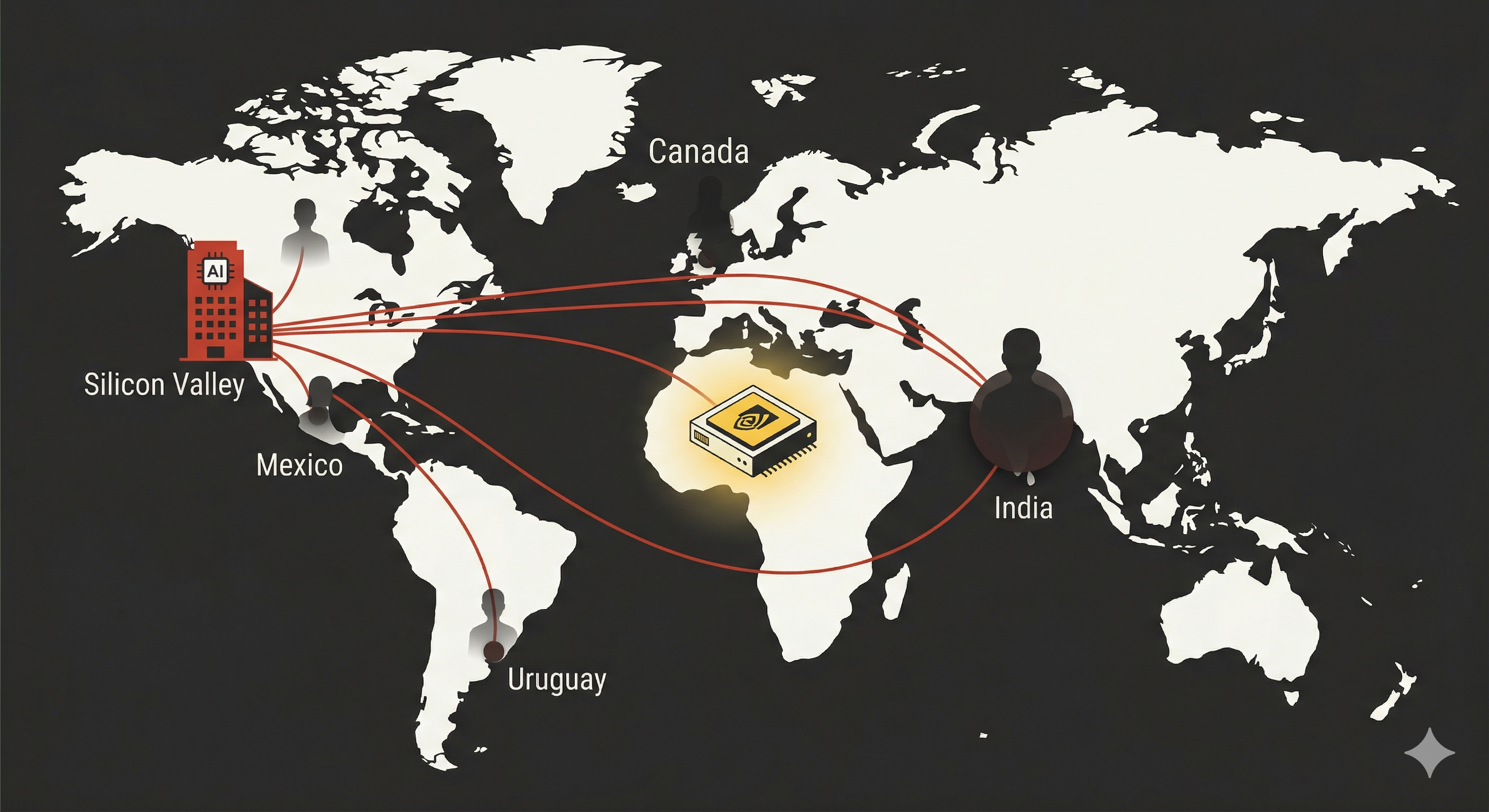
La India absorbió el golpe más duro: aproximadamente 12,000 posiciones eliminadas, cerca del 40% del total global, barriendo casi la misma proporción de la plantilla local de Oracle en ese país. La ola de correos también llegó a México, Uruguay y Canadá horas antes de que la guillotina cayera sobre los empleados en Estados Unidos. América Latina y Asia-Pacífico —los nodos que el discurso corporativo presenta como “centros de eficiencia”— fueron los primeros en recibir la notificación.
Los departamentos más afectados —Revenue and Health Sciences (la división médica heredada de Cerner), SaaS and Virtual Operations Services, y las áreas de soporte de Oracle Cloud Infrastructure— perdieron más del 30% de su personal. Directores, arquitectos de software y gerentes con 10, 15 y 20 años de antigüedad fueron incluidos. Las decisiones no estuvieron basadas en evaluaciones de desempeño. Las posiciones fueron eliminadas porque no se alineaban con la nueva visión “100% IA” de la compañía.
Ni Larry Ellison ni Safra Catz emitieron comunicado alguno. Oracle declinó las solicitudes de comentarios de Bloomberg, Reuters y The Hindu. El silencio institucional fue absoluto.
Los importados también son desechables: la paradoja H-1B
El ángulo más revelador del recorte es lo que está ocurriendo con los ingenieros extranjeros en Estados Unidos que trabajaban bajo visa H-1B.
Oracle se benefició de este programa durante décadas: importó talento altamente calificado, lo ancló mediante un mecanismo migratorio que ata al trabajador al empleador, y construyó sobre ese talento gran parte de su infraestructura operativa. Se estima que Oracle America patrocinaba entre 2,000 y 3,000 visas H-1B, cuyos titulares entraron en el periodo de gracia de 60 días el mismo 31 de marzo: encontrar un nuevo patrocinador corporativo o salir del país.
Lo que hace el caso especialmente contundente es esto: mientras ejecutaba el recorte, Oracle había presentado 436 nuevas peticiones de visa H-1B para el año fiscal 2026. Y los avisos WARN registrados en marzo confirmaron cientos de despidos de desarrolladores de software e ingenieros en el estado de Washington y en el campus de Kansas City — exactamente los perfiles para los que se solicitaban esas nuevas visas. El sistema importa cuando conviene. Despide localmente. Y vuelve a importar.
Firmas de abogados de inmigración lanzaron asesorías de emergencia recomendando transferir la visa mediante el formulario I-129 de inmediato, o cambiar al estatus B o F para ganar tiempo. No hay red de protección diseñada para este escenario. Hay 60 días y un correo automático como punto de partida.
La arquitectura del sacrificio distribuido
Lo que Oracle llama “cambio organizacional” tiene una geografía muy precisa. Los recortes más profundos ocurrieron en los nodos que el capitalismo corporativo globalizado trata como intercambiables: los centros de servicio en India, los equipos distribuidos en LATAM. El talento importado a los centros de decisión tampoco fue inmune, pero su situación es cualitativamente distinta: además de perder el empleo, pierden el estatus legal.
Esto no es eficiencia. Es el sacrificio concentrado en la periferia: el beneficio se acumula en la infraestructura de IA de la empresa, el costo se dispersa en las vidas de trabajadores en Bangalore, Montevideo, Ciudad de México y San Francisco.
Las empresas llevan décadas construyendo narrativas sobre talento global, diversidad de equipos y la promesa de oportunidades sin fronteras. Oracle demostró esta semana qué tan condicionales son esas promesas: duran exactamente mientras el modelo financiero las necesita.
Oracle no es una anomalía. Es un caso de estudio de lo que ocurre cuando la “carrera por la IA” se financia con el costo que el sistema siempre externaliza primero: las personas, preferentemente las que viven lejos de los centros de decisión, o las que dependen de un estatus migratorio para quedarse.
La pregunta que queda no es si otras empresas seguirán el mismo camino. Ya lo están haciendo — en marzo, la IA fue responsable directa del 25% de todos los despidos tech en EE.UU. La pregunta es quién está pagando la factura de la infraestructura que, se nos dice, va a liberarnos.
¿Tú qué opinas?
REFERENCIAS Y FUENTES
- TD Cowen. “Oracle Equity Research Note — Workforce Restructuring”. TD Cowen, 2026-03-31.
- Oracle Corporation. “Q3 FY2026 Earnings Call Transcript”. Oracle Investor Relations, 2026-03-11.
- Oracle Corporation. “Form 10-Q — Restructuring Plan, Q3 FY2026”. SEC EDGAR, 2026-03-31.
- Challenger, Gray & Christmas. “Job Cuts Report — March 2026”. Challenger, Gray & Christmas, 2026-04-02.
- The Register. “Oracle axes 30,000 jobs in largest-ever layoff”. The Register, 2026-04-01.
- TechCrunch. “Oracle layoffs hit India hardest as AI infrastructure bet reshapes workforce”. TechCrunch, 2026-04-02.
- The Hindu / PTI. “Oracle cuts 12,000 jobs in India in single-day restructuring”. The Hindu, 2026-04-01.
- Xataka México / GLOZO. “Despidos de Oracle llegan a México y Uruguay”. Xataka México, 2026-03-31.
- Times of India. “H-1B visa holders hit by Oracle layoffs face 60-day deportation clock”. Times of India, 2026-04-01.
- TNW. “Oracle files $2.1B restructuring plan with SEC amid mass layoffs”. The Next Web, 2026-03-31.
- USCIS. “H-1B Employer Obligations and Grace Period Guidelines”. USCIS.gov, 2025.
- Jaime-Muñoz, G. “‘Automatizar’ en 12-18 Meses: La fantasía sexual de Microsoft que nadie en LATAM puede permitirse” [BTA-0049-2026]. Beyond the Algorithm, 2026. URL: https://www.linkedin.com/pulse/automatizar-en-12-18-meses-la-fantas%C3%ADa-sexual-de-que-jaime-mu%C3%B1oz-l5gme
In late January 2026, analysts at TD Cowen published an internal note: Oracle needed to free up between $8 billion and $10 billion in free cash flow to compete in the data center arms race. The market took notice. The employees did not.
Published accounts from former employees describe how on March 31, 2026, at 6:00 a.m. — local time in each region — thousands of people opened an email signed by “Oracle Leadership.” Before finishing it, they had lost access to Slack, VPN, and corporate email. Thirty thousand positions eliminated in a single move. The largest layoff in the company’s 47-year history. Eighteen percent of its global workforce, shut down in a matter of hours.
What a month ago was a rumor in analyst reports had become a reality — with no warning and no anesthesia.
The context Oracle doesn’t want you to read
Oracle was not in crisis. In its Q3 FY2026 earnings report, published on March 10, the company posted a Non-GAAP net income of $5.2 billion — a 23% increase. It did not lay off 30,000 people because its numbers were bad. It did so to free up capital and redirect it elsewhere.
That “elsewhere” was documented with the SEC: in its 10-Q filing for Q3 FY2026, Oracle disclosed a $2.1 billion restructuring plan aimed at financing a massive AI data center infrastructure deployment valued at $156 billion. The goal: compete against AWS and Microsoft Azure for contracts with xAI and OpenAI.
Oracle’s case is not isolated. According to a report by Challenger, Gray & Christmas published in April 2026, of the 60,620 job cuts announced in the U.S. in March, artificial intelligence led as the primary cause, directly driving 15,341 layoffs — 25% of the total. In February, that proportion was 10%. The trend is accelerating.
The map of sacrifice
Thirty thousand people is not an abstract number. It is a map of where Oracle decided the cost of the future should be paid.
India absorbed the hardest blow: approximately 12,000 positions eliminated, nearly 40% of the global total, wiping out close to the same proportion of Oracle’s local workforce in that country. The wave of emails also reached Mexico, Uruguay, and Canada hours before the axe fell on employees in the United States. Latin America and Asia-Pacific — the nodes that corporate discourse presents as “efficiency centers” — were the first to receive the notification.
The most affected departments — Revenue and Health Sciences (the medical division inherited from the Cerner acquisition), SaaS and Virtual Operations Services, and Oracle Cloud Infrastructure support teams — lost more than 30% of their staff. Directors, software architects, and managers with 10, 15, and 20 years of tenure were included. The decisions were not based on performance reviews. Positions were eliminated because they did not align with the company’s new “100% AI” vision.
Neither Larry Ellison nor Safra Catz issued any statement. Oracle declined comment requests from Bloomberg, Reuters, and The Hindu. The institutional silence was absolute.
The imported are also disposable: the H-1B paradox
The most revealing angle of the layoff is what is happening to foreign engineers in the United States who worked under H-1B visas.
Oracle benefited from this program for decades: it imported highly skilled talent, anchored it through an immigration mechanism that ties workers to their employer, and built a significant part of its operational infrastructure on that talent. It is estimated that Oracle America sponsored between 2,000 and 3,000 H-1B visas, whose holders entered a 60-day grace period on March 31 itself: find a new corporate sponsor or leave the country.
What makes the case especially striking is this: while executing the layoff, Oracle had filed 436 new H-1B visa petitions for fiscal year 2026. And WARN Act notices registered in March confirmed hundreds of layoffs of software developers and engineers in Washington State and at the Kansas City campus — precisely the profiles for which those new visas were being requested. The system imports when it’s convenient. Fires locally. And imports again.
Immigration law firms launched emergency consultations recommending immediate visa transfer via Form I-129, or a change to B or F status to buy time. There is no safety net designed for this scenario. There are 60 days and an automated email as a starting point.
The architecture of distributed sacrifice
What Oracle calls “organizational change” has a very precise geography. The deepest cuts occurred in the nodes that globalized corporate capitalism treats as interchangeable: service centers in India, distributed teams across Latin America. Imported talent at the decision-making centers was not immune either, but its situation is qualitatively different: beyond losing their jobs, they lose their legal status.
This is not efficiency. It is sacrifice concentrated at the periphery: the benefit accumulates in the company’s AI infrastructure, the cost disperses across the lives of workers in Bangalore, Montevideo, Mexico City, and San Francisco.
Companies have spent decades building narratives about global talent, team diversity, and the promise of borderless opportunity. Oracle demonstrated this week just how conditional those promises are: they last exactly as long as the financial model needs them to.
Oracle is not an anomaly. It is a case study of what happens when the “AI race” is financed with the cost the system always externalizes first: people — preferably those who live far from the decision-making centers, or those who depend on an immigration status just to stay.
The question that remains is not whether other companies will follow the same path. They already are — in March, AI was directly responsible for 25% of all tech layoffs in the U.S. The question is who is paying the bill for the infrastructure that, we are told, is going to liberate us.
What do you think?
REFERENCES AND SOURCES
- TD Cowen. “Oracle Equity Research Note — Workforce Restructuring”. TD Cowen, 2026-03-31.
- Oracle Corporation. “Q3 FY2026 Earnings Call Transcript”. Oracle Investor Relations, 2026-03-11.
- Oracle Corporation. “Form 10-Q — Restructuring Plan, Q3 FY2026”. SEC EDGAR, 2026-03-31.
- Challenger, Gray & Christmas. “Job Cuts Report — March 2026”. Challenger, Gray & Christmas, 2026-04-02.
- The Register. “Oracle axes 30,000 jobs in largest-ever layoff”. The Register, 2026-04-01.
- TechCrunch. “Oracle layoffs hit India hardest as AI infrastructure bet reshapes workforce”. TechCrunch, 2026-04-02.
- The Hindu / PTI. “Oracle cuts 12,000 jobs in India in single-day restructuring”. The Hindu, 2026-04-01.
- Xataka México / GLOZO. “Oracle layoffs reach Mexico and Uruguay”. Xataka México, 2026-03-31.
- Times of India. “H-1B visa holders hit by Oracle layoffs face 60-day deportation clock”. Times of India, 2026-04-01.
- TNW. “Oracle files $2.1B restructuring plan with SEC amid mass layoffs”. The Next Web, 2026-03-31.
- USCIS. “H-1B Employer Obligations and Grace Period Guidelines”. USCIS.gov, 2025.
- Jaime-Muñoz, G. “‘Automate’ in 12-18 months: Microsoft’s fantasy that no one in LATAM can afford” [BTA-0049-2026]. Beyond the Algorithm, 2026. URL: https://www.linkedin.com/pulse/automate-12-18-months-microsofts-fantasy-one-latam-can-jaime-mu%C3%B1oz-zajce