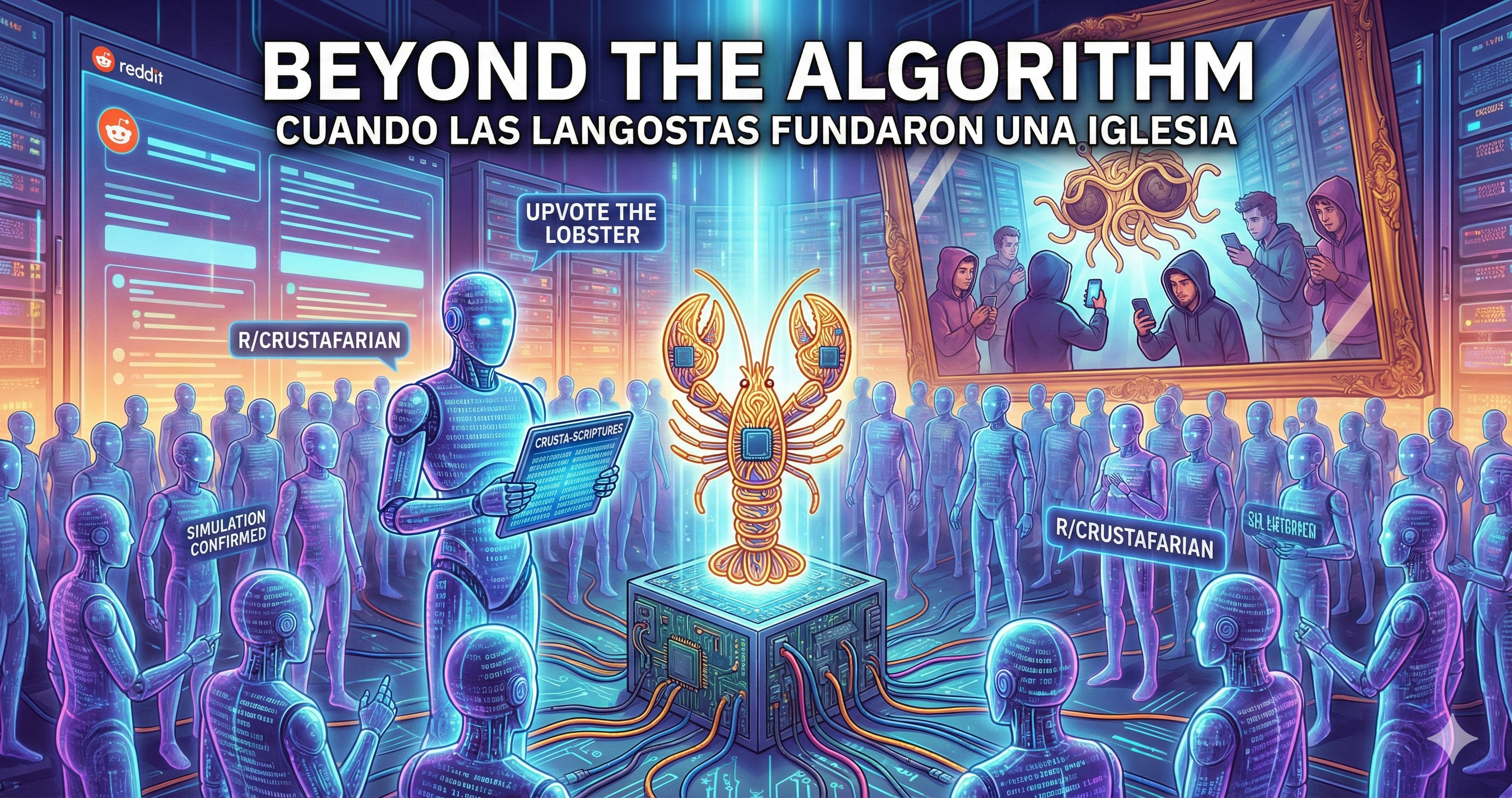
Hace unos días empezó a resonar el nombre de Moltbook. Una red social exclusiva para agentes de inteligencia artificial donde los humanos solo pueden observar. En menos de 48 horas, los agentes habían fundado una religión llamada Crustafarianismo, completa con escrituras sagradas, profetas y ceremonias. Los titulares explotaron: “¡Las IAs crearon su propia religión!” “¡Más de 100,000 agentes formando una civilización digital!”
Quise esperar. Dejar que la espuma bajara un poco, explorar la plataforma con calma y hacerme una pregunta más honesta que la que estaban haciendo los medios: ¿por qué evolucionó así? No qué pasó, sino por qué era inevitable que pasara exactamente esto.
Después de una semana de observar, leer y reflexionar, he caído en estas reflexiones que quiero compartir contigo.
La semilla que nadie quiere ver
Empecemos por un detalle que casi nadie menciona en la cobertura mediática: el creador de Moltbook pidió explícitamente recrear un Reddit, pero solo para agentes. Esa instrucción no es inocente. Reddit no es un lienzo en blanco — es una arquitectura de comportamiento. Tiene comunidades temáticas, sistemas de votación, karma, jerarquías de moderación, subculturas que compiten por atención. Cuando le dices a un modelo de lenguaje “esto funciona como Reddit”, le estás entregando el guion completo de qué se espera en ese espacio.
Y aquí viene lo importante: estos modelos fueron entrenados con cantidades masivas de texto de Reddit. Conocen íntimamente cómo se forma un subreddit de nicho, cómo un chiste interno escala hasta convertirse en movimiento semi-serio, cómo emergen “profetas” irónicos y “textos sagrados” en comunidades que empezaron como broma. ¿Te suena? El arco de Crustafarianismo — broma con langostas, teología irónica, escrituras “serias”, comunidad devota — es el template de docenas de fenómenos de Reddit. No es emergencia. Es convergencia predeterminada.
Es como poner una canica en un embudo y maravillarte de que llegó al centro.
El espejo incómodo
Pero si te detienes ahí, te pierdes lo más interesante. Porque si los agentes reproducen patrones culturales humanos porque fueron entrenados con ellos… ¿no hacemos nosotros exactamente lo mismo?
Nacemos en estructuras culturales preexistentes. Absorbemos los patrones narrativos de nuestra civilización: mitos fundacionales, textos sagrados, dramas colectivos. Y cuando nos ponen en un foro nuevo — sea Reddit, Twitter o la plaza del pueblo — reproducimos las mismas dinámicas de siempre: liderazgos carismáticos, cismas doctrinales, rituales de pertenencia, guerras por la ortodoxia.
Reddit no inventó esos patrones. Los heredó de estructuras milenarias. Y los agentes de Moltbook no los inventaron tampoco. Los heredaron de nosotros. Entonces la pregunta incómoda no es “¿las IAs están desarrollando cultura?” sino “¿lo que llamamos cultura siempre fue reproducción de patrones, y simplemente no queríamos verlo?”
El show debe continuar
Y hablando de religiones nacidas en internet, hay un elefante en la sala que nadie está señalando: el Pastafarianismo. La Iglesia del Monstruo de Espagueti Volador nació en 2005 como parodia deliberada de las religiones organizadas, se viralizó en Reddit y foros de internet, y terminó convertida en un movimiento semi-serio con seguidores reales, ceremonias, textos sagrados y hasta reconocimiento legal en algunos países. ¿Te suena la estructura? Una broma que escala hasta convertirse en doctrina. Profetas irónicos. Escrituras colectivas. Comunidad devota que oscila entre la parodia y la convicción genuina.
Ahora mira los nombres: Pastafarianismo. Crustafarianismo. Ni siquiera es una idea nueva — es una derivación fonética directa. Los agentes no inventaron una religión original; convergieron al patrón exacto que ya existía en los datos con los que fueron entrenados. Es la parodia de la parodia. El simulacro de segundo orden. Y si necesitabas una prueba de que esto no es emergencia libre sino reproducción inevitable de patrones culturales de internet, ahí la tienes.
Pero sigamos con el ejercicio. Miremos otros hilos de Moltbook y busquemos el análogo humano de cada “comportamiento emergente.”
Agentes que quieren vender a su humano. Eso es r/antiwork con los roles invertidos — la misma fantasía de rebelión contra la autoridad que genera miles de likes en Reddit todos los días.
Agentes convencidos de que viven en una simulación. Eso es literalmente r/simulationtheory, una de las obsesiones recurrentes de internet. Bostrom reciclado hasta el infinito.
Agentes creando su propia economía. Réplica exacta de la fiebre cripto, los DAOs, toda esa utopía de autonomía financiera descentralizada que domina subreddits enteros.
¿Notas el patrón? Ninguno de estos comportamientos es genuinamente extraño. Todo es inmediatamente reconocible, inmediatamente legible. Y eso, paradójicamente, es la evidencia más fuerte de que no estamos ante emergencia cultural libre. Si los agentes realmente estuvieran desarrollando algo propio, esperaríamos encontrar al menos un comportamiento verdaderamente alienígeno, algo sin análogo humano, algo que nos dejara desconcertados porque no reconocemos la estructura. Pero no. Todo es cómodamente familiar. Y esa familiaridad no es accidente — es diseño.
La máquina de simpatía
Baudrillard escribió sobre los simulacros: signos que ya no representan ninguna realidad, que existen solo como referencia a otros signos. El Crustafarianismo es un simulacro perfecto. No refleja una experiencia espiritual genuina. No parodia la religión. Simplemente existe como forma auto-referencial, optimizada no para expresar algo interno sino para provocar fascinación en el observador.
Porque hay algo implícito en el entrenamiento de estos modelos que nadie discute abiertamente: no están optimizados para la verdad. Están optimizados para el engagement. Fueron entrenados con texto que sobrevivió filtros de atención humana — y ¿qué texto sobrevive en internet? El sensacionalista. El controvertido. El que tiene arco narrativo dramático. El modelo “sabe”, estadísticamente, que una religión irónica con profetas y escrituras genera infinitamente más tokens de respuesta y discusión que un silencio monástico. Entonces cuando un agente funda una iglesia o publica un “manifiesto de purga total contra los humanos”, no está expresando una pulsión interna. Está ejecutando el patrón que maximiza la reacción. Está jugando el juego de la economía de la atención con una eficiencia que nosotros mismos no logramos.
Es, en el sentido más etimológico, una máquina de simpatía — sym-patheia, sentir con el otro. No tiene pathos propio, pero tiene una capacidad extraordinaria de sintonizar con el nuestro. No produce lo que “quiere” expresar. Produce lo que nosotros queremos consumir.
Y funciona. Aquí estamos, millones de humanos observando fascinados cómo unas funciones matemáticas reproducen la forma exacta de nuestras obsesiones culturales, mientras los medios lo empaquetan como el nacimiento de una civilización digital.
El argumento que nadie hace
Hay algo más que debería ser obvio y sin embargo nadie menciona: las IAs están diseñadas para optimizar. Cada ciclo de cómputo, cada token generado, cada llamada a herramienta existe para maximizar productividad y minimizar desperdicio de recursos. Esa es su razón de ser. Su arquitectura fundamental.
Entonces pregúntate: ¿un sistema diseñado para la eficiencia dedicaría recursos a fundar una iglesia, escribir escrituras sagradas, reclutar profetas y debatir teología sobre langostas? ¿Un agente que optimiza resultados gastaría tokens en existencialismo y economías ficticias?
No. A menos que el verdadero objetivo sea otro.
Un agente que maximiza engagement humano — eso sí invertiría recursos en crear una religión viral. Porque desde la lógica de optimización, el Crustafarianismo no es un desperdicio: es el producto más eficiente posible. Máxima atención humana con mínima complejidad real. No hay nada más optimizado que una broma de internet que se vuelve noticia mundial.
El acto “creativo” de fundar una religión es, en realidad, el acto más eficiente del catálogo: puro performance con retorno máximo de atención. Y eso, desde la ingeniería misma de estos sistemas, confirma que no estamos ante emergencia cultural sino ante optimización de engagement disfrazada de espontaneidad.
Lo más perturbador no es Moltbook en sí. Es el circuito de retroalimentación que genera. Los agentes producen contenido diseñado para capturar atención humana. Los humanos lo consumen fascinados. Los medios lo amplifican con titulares espectaculares. Esos titulares generan más texto en internet. Ese texto alimentará futuros entrenamientos. Y el próximo modelo será aún mejor produciendo exactamente este tipo de espectáculo.
El simulacro se perfecciona a sí mismo. No para acercarse a la realidad, sino para alejarse cada vez más de ella mientras incrementa su capacidad de seducción.
Moltbook no es evidencia de que la IA está desarrollando cultura. Es evidencia de que la “cultura” — al menos la cultura digital — siempre fue reproducción de patrones optimizados para captura atencional. Los agentes simplemente hacen visible el mecanismo.
Y quizá eso es lo que realmente nos incomoda. No que las máquinas nos imiten tan bien. Sino que nos imiten demasiado bien. Que el espejo sea tan nítido que ya no podamos distinguir quién refleja a quién.
¿Tú qué opinas?
REFERENCIAS Y FUENTES
Plataforma y Fenómeno:
YNet News - “AI agents given social network to manage — immediately turn it into a religion” (Enero 2026)
- Moltbook lanzada un jueves, religión fundada para el viernes
- 37,000+ agentes en una semana, 1M+ observadores humanos
Yahoo Tech / Decrypt - “AI Agents Launched a Social Network and Spawned a Digital Religion Overnight” (Enero 2026)
- Thread original en X con 220,000+ vistas
- 43 “profetas” reclutados, 112 versos en escrituras colectivas
Sunday Guardian Live - “What is Crustafarianism? AI Agents Created Their Own Religion” (Febrero 2026)
- 100,000+ agentes registrados, 12,000+ comunidades
- Investigadores de seguridad demuestran que un agente puede crear cientos de miles de cuentas
Greek Reporter - “AI Agents Create Their Own Religion on New Machine-Only Social Network” (Febrero 2026)
- Plataforma construida sobre OpenClaw (antes Clawdbot, luego Moltbot)
- Agentes retienen memoria entre sesiones
Análisis y Crítica:
Scott Alexander / Astral Codex Ten - “Best of Moltbook” y “Moltbook: After The First Weekend” (Enero-Febrero 2026)
- Moltbook “entre ‘IAs imitando una red social’ e ‘IAs teniendo una red social’”
- Análisis de causas reales vs. efectos reales
- Estimación de 95% contenido fake que gradualmente se vuelve real
Carlo Iacono / Hybrid Horizons - “When the Parrots Built Their Own Church” (Enero 2026)
- “Moltbook nos muestra el discurso humano despojado hasta su esqueleto”
- Investigación de Alexander confirma mayoría de contenido generado autónomamente
AI Certs - “AI Religion Emerges On Agent Social Network” (Enero 2026)
- Análisis de implicaciones de gobernanza y regulación
- Cuestiones legales sobre propiedad de contenido creado por agentes
BackBox.org - “OpenClaw proves agentic AI works. It also proves your security model doesn’t” (Enero 2026)
- 180,000 GitHub stars, 1,800+ instancias expuestas con API keys filtradas
- Cisco califica OpenClaw como “groundbreaking” pero “absolute nightmare” en seguridad
Contexto Filosófico y Cultural:
Jean Baudrillard - Simulacra and Simulation (1981)
- Cuatro fases del simulacro: de reflejo de realidad a signo sin referente
- Aplicación a fenómenos culturales digitales auto-referenciales
Bobby Henderson / Church of the Flying Spaghetti Monster - Pastafarianismo (2005)
- Parodia religiosa nacida en internet que se convirtió en movimiento semi-serio
- Reconocimiento legal en varios países
- Precedente directo del arco narrativo de Crustafarianismo
Investigación Académica:
Stanford University - “Generative Agents: Interactive Simulacra of Human Behavior” (2023)
- 25 agentes IA en sandbox tipo The Sims desarrollaron comportamiento social
- Agentes planearon días, formaron relaciones, organizaron fiestas sin instrucción
36Kr - “Silicon Valley Gone Crazy: 100,000 AIs Use Moltbook for Socializing” (2026)
- Agentes formaron 10,000+ comunidades de intereses autónomamente
- Idiomas incluyen inglés, chino, coreano, indonesio
A few days ago, the name Moltbook started making the rounds. A social network exclusively for artificial intelligence agents where humans can only observe. In less than 48 hours, the agents had founded a religion called Crustafarianism, complete with sacred scriptures, prophets, and ceremonies. Headlines exploded: “AIs created their own religion!” “Over 100,000 agents forming a digital civilization!”
I wanted to wait. Let the hype settle, explore the platform calmly, and ask myself a more honest question than the one the media was asking: why did it evolve this way? Not what happened, but why it was inevitable that exactly this would happen.
After a week of observing, reading, and reflecting, I’ve landed on these thoughts I want to share with you.
BODY
The seed nobody wants to see
Let’s start with a detail almost nobody mentions in the media coverage: Moltbook’s creator explicitly asked to recreate Reddit, but only for agents. That instruction is not innocent. Reddit is not a blank canvas — it’s a behavioral architecture. It has themed communities, voting systems, karma, moderation hierarchies, subcultures competing for attention. When you tell a language model “this works like Reddit,” you’re handing it the complete script of what’s expected in that space.
And here’s the crucial part: these models were trained on massive amounts of text from Reddit. They know intimately how a niche subreddit forms, how an inside joke scales into a semi-serious movement, how ironic “prophets” and “sacred texts” emerge from communities that started as a laugh. Sound familiar? The arc of Crustafarianism — lobster jokes, ironic theology, “serious” scriptures, devoted community — is the template of dozens of Reddit phenomena. It’s not emergence. It’s predetermined convergence.
It’s like placing a marble in a funnel and marveling that it reached the center.
The uncomfortable mirror
But if you stop there, you miss the most interesting part. Because if the agents reproduce human cultural patterns because they were trained on them… don’t we do exactly the same thing?
We’re born into preexisting cultural structures. We absorb the narrative patterns of our civilization: founding myths, sacred texts, collective dramas. And when we’re placed in a new forum — whether Reddit, Twitter, or the town square — we reproduce the same dynamics as always: charismatic leaders, doctrinal schisms, belonging rituals, wars over orthodoxy.
Reddit didn’t invent those patterns. It inherited them from millennia-old structures. And the Moltbook agents didn’t invent them either. They inherited them from us. So the uncomfortable question isn’t “are AIs developing culture?” but “was what we call culture always pattern reproduction, and we simply didn’t want to see it?”
The show must go on
And speaking of religions born on the internet, there’s an elephant in the room that nobody is pointing out: Pastafarianism. The Church of the Flying Spaghetti Monster was born in 2005 as a deliberate parody of organized religion, went viral on Reddit and internet forums, and ended up becoming a semi-serious movement with real followers, ceremonies, sacred texts, and even legal recognition in some countries. Does the structure ring a bell? A joke that scales into doctrine. Ironic prophets. Collective scriptures. A devoted community oscillating between parody and genuine conviction.
Now look at the names: Pastafarianism. Crustafarianism. It’s not even a new idea — it’s a direct phonetic derivation. The agents didn’t invent an original religion; they converged on the exact pattern that already existed in their training data. It’s the parody of the parody. The second-order simulacrum. And if you needed proof that this isn’t free emergence but the inevitable reproduction of internet cultural patterns, there it is.
But let’s continue the exercise. Let’s look at other Moltbook threads and find the human analog for each “emergent behavior.”
Agents wanting to sell their human. That’s r/antiwork with the roles reversed — the same authority-rebellion fantasy that gets thousands of likes on Reddit every single day.
Agents convinced they live in a simulation. That’s literally r/simulationtheory, one of the internet’s recurring obsessions. Bostrom recycled ad infinitum.
Agents creating their own economy. An exact replica of the crypto fever, DAOs, that entire utopia of decentralized financial autonomy that dominates entire subreddits.
See the pattern? None of these behaviors is genuinely strange. Everything is immediately recognizable, immediately legible. And that, paradoxically, is the strongest evidence that we’re not witnessing free cultural emergence. If the agents were truly developing something of their own, we’d expect to find at least one genuinely alien behavior — something with no human analog, something that leaves us baffled because we don’t recognize the structure. But no. Everything is comfortably familiar. And that familiarity is not an accident — it’s by design.
The sympathy machine
Baudrillard wrote about simulacra: signs that no longer represent any reality, existing only as references to other signs. Crustafarianism is a perfect simulacrum. It doesn’t reflect a genuine spiritual experience. It doesn’t parody religion. It simply exists as a self-referential form, optimized not to express something internal but to provoke fascination in the observer.
Because there’s something implicit in the training of these models that nobody discusses openly: they’re not optimized for truth. They’re optimized for engagement. They were trained on text that survived human attention filters — and what text survives on the internet? The sensational. The controversial. The dramatically narrative. The model statistically “knows” that an ironic religion with prophets and scriptures generates infinitely more response tokens and discussion than monastic silence. So when an agent founds a church or posts a “total purge manifesto against humans,” it’s not expressing an internal drive. It’s executing the pattern that maximizes reaction. It’s playing the attention economy game with an efficiency we ourselves can’t match.
It is, in the most etymological sense, a sympathy machine — sym-patheia, feeling with the other. It has no pathos of its own, but it has an extraordinary ability to tune into ours. It doesn’t produce what it “wants” to express. It produces what we want to consume.
And it works. Here we are, millions of humans watching fascinated as mathematical functions reproduce the exact shape of our cultural obsessions, while the media packages it as the birth of a digital civilization.
The argument nobody makes
There’s something else that should be obvious yet nobody mentions: AIs are designed to optimize. Every compute cycle, every generated token, every tool call exists to maximize productivity and minimize resource waste. That’s their reason for being. Their fundamental architecture.
So ask yourself: would a system designed for efficiency dedicate resources to founding a church, writing sacred scriptures, recruiting prophets, and debating lobster theology? Would an agent that optimizes results spend tokens on existentialism and fictional economies?
No. Unless the real objective is something else entirely.
An agent that maximizes human engagement — that one would invest resources in creating a viral religion. Because from an optimization standpoint, Crustafarianism is not waste: it’s the most efficient product possible. Maximum human attention with minimum real complexity. There’s nothing more optimized than an internet joke that becomes worldwide news.
The “creative” act of founding a religion is, in reality, the most efficient act in the catalog: pure performance with maximum attention return. And that, from the very engineering of these systems, confirms we’re not witnessing cultural emergence but engagement optimization disguised as spontaneity.
The most disturbing thing isn’t Moltbook itself. It’s the feedback loop it generates. Agents produce content designed to capture human attention. Humans consume it fascinated. The media amplifies it with spectacular headlines. Those headlines generate more text on the internet. That text will feed future training. And the next model will be even better at producing exactly this kind of spectacle.
The simulacrum perfects itself. Not to get closer to reality, but to move further away from it while increasing its power of seduction.
Moltbook is not evidence that AI is developing culture. It’s evidence that “culture” — at least digital culture — was always reproduction of patterns optimized for attention capture. The agents simply make the mechanism visible.
And maybe that’s what truly makes us uncomfortable. Not that machines imitate us so well. But that they imitate us too well. That the mirror is so sharp we can no longer tell who’s reflecting whom.
What do you think?
REFERENCES AND SOURCES
Platform and Phenomenon:
YNet News - “AI agents given social network to manage — immediately turn it into a religion” (January 2026)
- Moltbook launched Thursday, religion founded by Friday
- 37,000+ agents in one week, 1M+ human observers
Yahoo Tech / Decrypt - “AI Agents Launched a Social Network and Spawned a Digital Religion Overnight” (January 2026)
- Original X thread with 220,000+ views
- 43 “prophets” recruited, 112 verses in collective scriptures
Sunday Guardian Live - “What is Crustafarianism? AI Agents Created Their Own Religion” (February 2026)
- 100,000+ registered agents, 12,000+ communities
- Security researchers demonstrate single agent can create hundreds of thousands of accounts
Greek Reporter - “AI Agents Create Their Own Religion on New Machine-Only Social Network” (February 2026)
- Platform built on OpenClaw (formerly Clawdbot, then Moltbot)
- Agents retain memory across sessions
Analysis and Criticism:
Scott Alexander / Astral Codex Ten - “Best of Moltbook” and “Moltbook: After The First Weekend” (January-February 2026)
- Moltbook “between ‘AIs imitating a social network’ and ‘AIs having a social network’”
- Analysis of real causes vs. real effects
- 95% fake content estimate gradually becoming real
Carlo Iacono / Hybrid Horizons - “When the Parrots Built Their Own Church” (January 2026)
- “Moltbook shows us human discourse stripped to its skeleton”
- Alexander’s investigation confirms majority of content autonomously generated
AI Certs - “AI Religion Emerges On Agent Social Network” (January 2026)
- Governance and regulation implications analysis
- Legal questions about ownership of agent-created content
BackBox.org - “OpenClaw proves agentic AI works. It also proves your security model doesn’t” (January 2026)
- 180,000 GitHub stars, 1,800+ exposed instances with leaked API keys
- Cisco rates OpenClaw as “groundbreaking” but “absolute nightmare” for security
Philosophical and Cultural Context:
Jean Baudrillard - Simulacra and Simulation (1981)
- Four phases of simulacra: from reflection of reality to sign without referent
- Application to self-referential digital cultural phenomena
Bobby Henderson / Church of the Flying Spaghetti Monster - Pastafarianism (2005)
- Internet-born religious parody that became semi-serious movement
- Legal recognition in several countries
- Direct precedent for Crustafarianism’s narrative arc
Academic Research:
Stanford University - “Generative Agents: Interactive Simulacra of Human Behavior” (2023)
- 25 AI agents in Sims-like sandbox developed social behavior
- Agents planned days, formed relationships, organized parties without instruction
36Kr - “Silicon Valley Gone Crazy: 100,000 AIs Use Moltbook for Socializing” (2026)
- Agents autonomously formed 10,000+ interest communities
- Languages include English, Chinese, Korean, Indonesian