Recuerdo que en uno de mis proyectos de data science, llegó el momento en que el equipo dejó de cuestionar los outputs del modelo. Eran tan consistentes —o eso creíamos— que empezamos a copiar resultados sin verificar supuestos. Tardamos semanas en detectar un sesgo que ninguno había cuestionado, precisamente porque la IA tampoco lo cuestionó. Nadie le había pedido que lo hiciera.
Eso fue mi primer encuentro personal con lo que hoy el MIT llama “deuda cognitiva”.
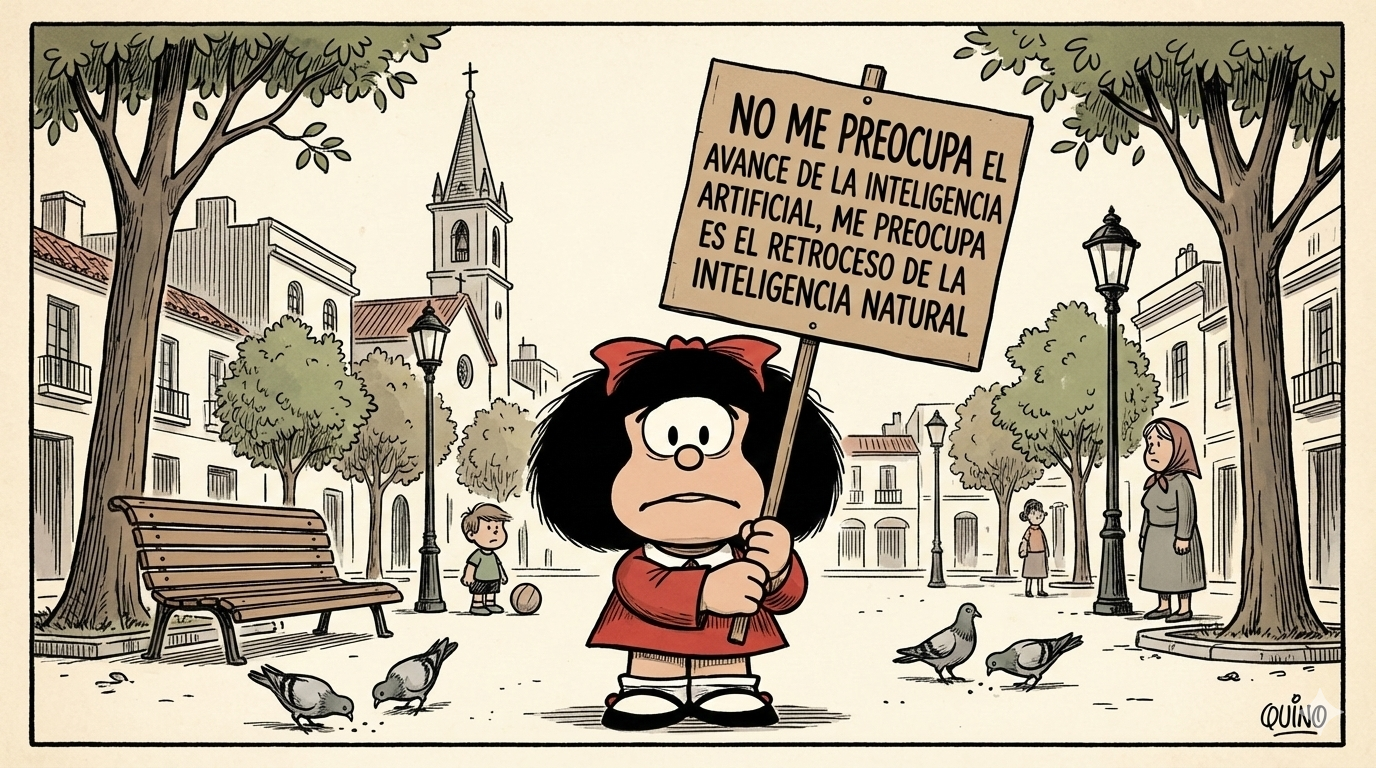
Un tiempo después me topé con una imagen de Mafalda sosteniendo un cartel: “No me preocupa el avance de la inteligencia artificial, me preocupa el retroceso de la inteligencia natural”.
Probablemente es apócrifa —Quino murió en 2020, antes del boom de ChatGPT— pero suena exactamente como algo que Mafalda diría. Porque si algo caracterizó a esa niña insoportable y brillante durante décadas, fue su habilidad para señalar, con precisión quirúrgica, las estupideces de los adultos.
Y vaya que lo necesitamos ahora.
La ciencia le da la razón a Mafalda
Ya no es solo intuición editorial. En enero de 2025, Michael Gerlich publicó en la revista Societies los resultados de un estudio con 666 participantes: encontró una correlación negativa significativa entre el uso de herramientas de IA y las puntuaciones en pensamiento crítico. Mientras más se delegaba en la IA, menor era la capacidad de análisis independiente.
Seis meses después, el MIT Media Lab publicó “Your Brain on ChatGPT”. Durante cuatro meses, monitorearon con electroencefalograma a 54 participantes divididos en tres grupos: los que usaban ChatGPT, los que usaban buscadores, y los que escribían sin ninguna herramienta. El resultado fue claro: los usuarios de ChatGPT mostraron la menor actividad cerebral de los tres grupos, y “underperformed consistentemente a nivel neural, lingüístico y conductual”. Lo más preocupante: aun cuando dejaron de usar ChatGPT, los efectos persistieron. Por eso lo llaman “deuda cognitiva” —porque se acumula, y no desaparece de inmediato.
Que no es metáfora. Es una deuda real que pagamos cada vez que dejamos que la máquina piense por nosotros.
La paradoja que nadie quiere ver
Estamos obsesionados con construir inteligencia artificial mientras la nuestra parece estar en caída libre.
Tenemos modelos de lenguaje que escriben ensayos y generan código. Pero millones de personas creen que la tierra es plana, que las vacunas tienen microchips, y que los chemtrails son reales.
Construimos algoritmos capaces de diagnosticar cáncer. Pero seguimos eligiendo políticos que prometen soluciones mágicas a problemas estructurales.
Creamos IA que pasa exámenes de medicina. Pero la mayoría de la gente no puede distinguir una nota de prensa de un anuncio pagado.
¿El problema es la inteligencia artificial? ¿O es que hemos tercerizado tanto el pensamiento que olvidamos cómo hacerlo nosotros mismos?
El ángulo que LATAM no puede ignorar
En América Latina esto tiene una dimensión adicional que incomoda. Según datos del Programa PISA, antes de la pandemia el 52% de los estudiantes de diez años en la región no podían leer y comprender un texto simple. Tres de cada cuatro jóvenes de 15 años estaban por debajo del nivel básico en matemáticas.
Llegamos a la era de la IA con déficits críticos de base. Y en lugar de resolverlos, le estamos dando a esa base una herramienta que —según la evidencia neurocientífica más reciente— puede acelerar el deterioro cognitivo cuando se usa sin conciencia.
No es anti-tecnología señalar esto. Es básica responsabilidad.
El verdadero retroceso
El retroceso de la inteligencia natural no es que seamos menos inteligentes biológicamente. Es que hemos construido un mundo donde el pensamiento crítico es opcional.
Donde puedes vivir toda tu vida en una burbuja algorítmica que refuerza lo que ya crees.
Donde la complejidad es incómoda, así que preferimos narrativas simples aunque sean falsas.
Donde leer tres párrafos es “demasiado largo” pero podemos ver TikToks durante tres horas.
Y aquí está la ironía brutal: mientras más inteligente se vuelve la IA, menos ejercitamos la nuestra. Es como tener una calculadora tan buena que olvidamos hacer matemáticas. Excepto que en lugar de matemáticas, estamos olvidando pensar.
Quino pasó 50 años dibujando a Mafalda cuestionando la sopa, la guerra, las injusticias y la estupidez humana en general. Si existiera hoy, no estaría preocupada por Skynet. Estaría preocupada porque estamos normalizando la ignorancia funcional.
La IA puede darnos todas las respuestas que queramos. Lo que no puede hacer es obligarnos a hacer mejores preguntas. No puede obligarnos a verificar fuentes. No puede obligarnos a leer más allá del titular. No puede obligarnos a tolerar la incertidumbre o la complejidad.
Esa sigue siendo nuestra responsabilidad. Y la estamos evadiendo.
El avance de la inteligencia artificial no es la amenaza. La amenaza es que mientras la celebramos, hemos dejado de cultivar la nuestra.
Y ningún algoritmo va a solucionar eso por nosotros.
¿Tú qué opinas?
REFERENCIAS Y FUENTES
- Gerlich, M. “AI Tools in Society: Impacts on Cognitive Offloading and the Future of Critical Thinking.” Societies, 15(1), 6. 2025-01-03. DOI: 10.3390/soc15010006
- Kosmyna, N. et al. “Your Brain on ChatGPT: Accumulation of Cognitive Debt when Using an AI Assistant for Essay Writing Task.” MIT Media Lab. arXiv:2506.08872. 2025-06-10. URL: https://www.media.mit.edu/publications/your-brain-on-chatgpt/
- PsyPost. “AI tools may weaken critical thinking skills by encouraging cognitive offloading, study suggests.” 2025-03-21. URL: https://www.psypost.org/ai-tools-may-weaken-critical-thinking-skills-by-encouraging-cognitive-offloading-study-suggests/
- Time Magazine. “ChatGPT’s Impact On Our Brains According to an MIT Study.” 2025-11-13. URL: https://time.com/7295195/ai-chatgpt-google-learning-school/
- EAVI. “When Convenience Costs: AI Tools and the Decline of Critical Thinking.” 2025-09-24. URL: https://eavi.eu/ai-tools-and-the-decline-of-critical-thinking/
- Banco Mundial / OIT. “¿Buffer o cuello de botella? Exposición laboral a la IA generativa y la brecha digital en América Latina.” 2025-02-10. URL: https://www.bancomundial.org/es/news/feature/2025/02/10/inteligencia-artificial-ia-educacion-america-latina
- PISA / OCDE. Datos sobre comprensión lectora en América Latina. Edición 2019 (datos pre-pandemia).
- Universidad Externado de Colombia. “IA y educación superior en América Latina: capacidades críticas o nuevas desigualdades.” 2025-11-28. URL: https://micomunidadvirtual.uexternado.edu.co/ia-educacion-superior-latam/
- Quino (Joaquín Salvador Lavado Tejón, 1932-2020). Mafalda. Tira cómica publicada entre 1964 y 1973. Símbolo de crítica social en América Latina.
I remember a data science project where the team stopped questioning the model’s outputs. The results were so consistent — or so we believed — that we started copying numbers without verifying the underlying assumptions. It took weeks to detect a bias that none of us had questioned, precisely because the AI hadn’t questioned it either. No one had asked it to.
That was my first personal encounter with what MIT now calls “cognitive debt.”
Some time later I came across an image of Mafalda holding a sign: “I’m not worried about the advancement of artificial intelligence, I’m worried about the regression of natural intelligence.”
It’s probably apocryphal — Quino died in 2020, before ChatGPT’s boom — but it sounds exactly like something Mafalda would say. Because if anything characterized that insufferable and brilliant girl for decades, it was her ability to point out, with surgical precision, the stupidities of adults.
And boy, do we need that now.
Science is giving Mafalda her vindication
This is no longer just editorial intuition. In January 2025, Michael Gerlich published in the journal Societies the results of a study with 666 participants: he found a significant negative correlation between AI tool usage and critical thinking scores. The more people delegated to AI, the weaker their capacity for independent analysis.
Six months later, MIT Media Lab published “Your Brain on ChatGPT.” Over four months, they monitored 54 participants using EEG headsets, divided into three groups: ChatGPT users, search engine users, and those who wrote without any tools. The finding was unambiguous: ChatGPT users showed the lowest brain activity of the three groups, and “consistently underperformed at neural, linguistic, and behavioral levels.” Most concerning: even after stopping ChatGPT use, the effects persisted. That’s why they call it “cognitive debt” — because it accumulates, and doesn’t disappear overnight.
This isn’t a metaphor. It’s a real debt we accrue every time we let the machine do our thinking.
The paradox nobody wants to see
We’re obsessed with building artificial intelligence while our own seems to be in free fall.
We have language models that write essays and generate code. But millions of people believe the earth is flat, that vaccines have microchips, and that chemtrails are real.
We build algorithms capable of diagnosing cancer. But we keep electing politicians who promise magical solutions to structural problems.
We create AI that passes medical exams. But most people can’t distinguish a press release from a paid advertisement.
Is the problem artificial intelligence? Or have we outsourced so much thinking that we’ve forgotten how to do it ourselves?
The angle LATAM cannot ignore
In Latin America, this has an additional dimension that makes people uncomfortable. According to PISA data, before the pandemic, 52% of 10-year-olds in the region could not read and understand a simple text. Three out of four 15-year-olds were below the basic competency level in mathematics.
We arrived at the AI era with critical foundational deficits. And instead of resolving them, we are now giving that same fragile foundation a tool that — according to the latest neuroscientific evidence — can accelerate cognitive decline when used without awareness.
Pointing this out isn’t anti-technology. It’s basic responsibility.
The real regression
The regression of natural intelligence isn’t that we’re biologically less intelligent. It’s that we’ve built a world where critical thinking is optional.
Where you can live your entire life inside an algorithmic bubble that reinforces what you already believe.
Where complexity is uncomfortable, so we prefer simple narratives even when they’re false.
Where reading three paragraphs is “too long,” but we can scroll TikTok for three hours.
And here’s the brutal irony: the smarter AI becomes, the less we exercise our own intelligence. It’s like having a calculator so good that we forget how to do math. Except instead of math, we’re forgetting how to think.
Quino spent 50 years drawing Mafalda questioning soup, war, injustice, and human stupidity in general. If she existed today, she wouldn’t be worried about Skynet. She’d be worried that we’re normalizing functional ignorance.
AI can give us all the answers we want. What it cannot do is force us to ask better questions. It cannot force us to verify sources. It cannot force us to read beyond the headline. It cannot force us to tolerate uncertainty or complexity.
That is still our responsibility. And we’re avoiding it.
The advancement of artificial intelligence is not the threat. The threat is that while we celebrate it, we’ve stopped cultivating our own.
And no algorithm is going to fix that for us.
What do you think?
REFERENCES AND SOURCES
- Gerlich, M. “AI Tools in Society: Impacts on Cognitive Offloading and the Future of Critical Thinking.” Societies, 15(1), 6. 2025-01-03. DOI: 10.3390/soc15010006
- Kosmyna, N. et al. “Your Brain on ChatGPT: Accumulation of Cognitive Debt when Using an AI Assistant for Essay Writing Task.” MIT Media Lab. arXiv:2506.08872. 2025-06-10. URL: https://www.media.mit.edu/publications/your-brain-on-chatgpt/
- PsyPost. “AI tools may weaken critical thinking skills by encouraging cognitive offloading, study suggests.” 2025-03-21. URL: https://www.psypost.org/ai-tools-may-weaken-critical-thinking-skills-by-encouraging-cognitive-offloading-study-suggests/
- Time Magazine. “ChatGPT’s Impact On Our Brains According to an MIT Study.” 2025-11-13. URL: https://time.com/7295195/ai-chatgpt-google-learning-school/
- EAVI. “When Convenience Costs: AI Tools and the Decline of Critical Thinking.” 2025-09-24. URL: https://eavi.eu/ai-tools-and-the-decline-of-critical-thinking/
- World Bank / ILO. “Buffer or Bottleneck? Labor Market Exposure to Generative AI and the Digital Divide in Latin America.” 2025-02-10. URL: https://www.bancomundial.org/es/news/feature/2025/02/10/inteligencia-artificial-ia-educacion-america-latina
- PISA / OECD. Reading comprehension data in Latin America. 2019 edition (pre-pandemic data).
- Universidad Externado de Colombia. “AI and Higher Education in Latin America: Critical Capabilities or New Inequalities.” 2025-11-28. URL: https://micomunidadvirtual.uexternado.edu.co/ia-educacion-superior-latam/
- Quino (Joaquín Salvador Lavado Tejón, 1932-2020). Mafalda. Comic strip published between 1964 and 1973. Symbol of social criticism in Latin America.