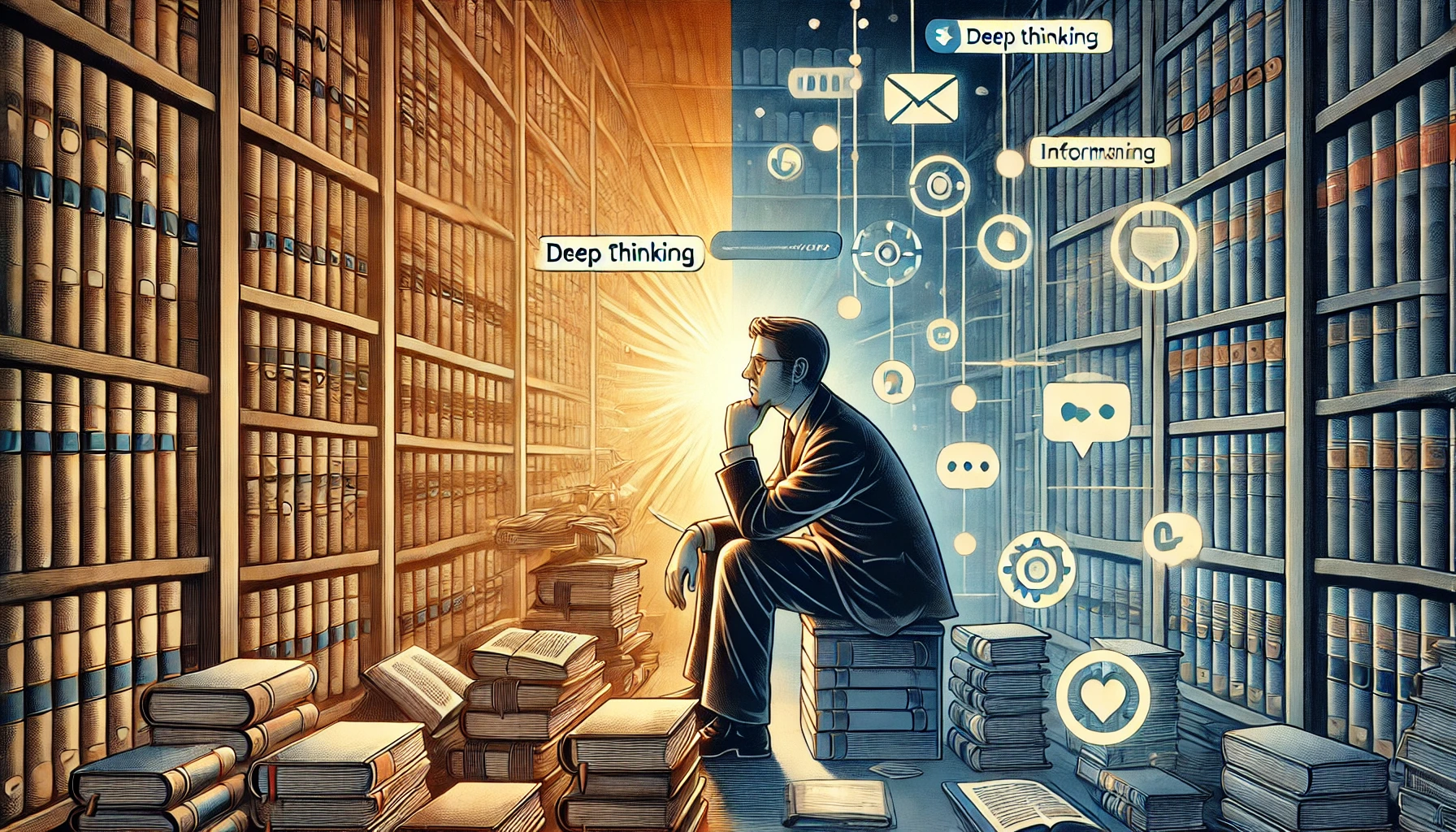
El Arte Perdido de Hacer Preguntas
O cómo Google y la IA nos convirtieron en zombies intelectuales
Había un ritual que hoy parece de otra era: entrar a una biblioteca, consultar el catálogo de fichas, buscar el libro correcto en los estantes, hojear índices, leer prólogos, encontrar referencias cruzadas. Era lento. Era deliberado. Era pensamiento en acción.
Luego llegó Google y nos dijo: “Toda esa búsqueda artesanal es innecesaria. Todo está a un clic de distancia.”
Y tenía razón. Pero olvidó mencionar algo crítico: cuando las respuestas son instantáneas, dejamos de aprender a hacer buenas preguntas.
La ilusión de la información curada
Al principio, cuando internet era joven, parecía que la información tenía más nivel de curación. Publicar en la web requería cierto esfuerzo técnico. Disponibilizar información en acervos bibliográficos digitales implicaba procesos. El costo de publicar una obra impresa—física o digital—limitaba la cantidad de basura disponible.
O al menos eso creíamos.
Hoy todos tenemos un blog. Todos tenemos opiniones que compartimos sin filtro. Y no necesitamos que sean verdad o estén bien fundamentadas—solo necesitamos que sean lo suficientemente sensacionalistas para ser retuiteadas, compartidas en Facebook, o multiplicadas en miles de videos de YouTube.
La democratización de la publicación es hermosa en teoría. En la práctica, nos ahogamos en un mar de ruido donde distinguir señal de basura requiere exactamente las habilidades críticas que hemos dejado atrofiar.
Cuando la IA completa tus preguntas mal formuladas
Y entonces llegaron los LLMs. ChatGPT, Gemini, Claude. Y nos abrieron avenidas completamente nuevas para obtener respuestas a nuestras preguntas mal formuladas, incompletas, de pésima redacción.
La promesa es seductora: no necesitas ser preciso. No necesitas contexto. No necesitas pensar demasiado en cómo articular lo que buscas. El algoritmo “entiende” tu intención y completa los huecos interpretativos con su gran contexto—sesgado, por cierto—de entrenamiento previo.
Y funciona. Demasiado bien.
Puedes escribir “dame ideas para presentación trabajo importante” y recibirás una respuesta estructurada, coherente, aparentemente útil. Sin que hayas tenido que precisar qué tipo de trabajo, para qué audiencia, con qué objetivo, bajo qué restricciones.
La IA hace el trabajo de traducir tu pereza mental en algo procesable. Y en el proceso, elimina completamente la necesidad de que TÚ hagas ese trabajo de clarificación mental.
La muerte del “¿Qué pregunto?” y el “¿Cómo lo pregunto?”
Hemos dejado de reflexionar antes de preguntar. Dejamos de preguntarnos cosas. Dejamos de intentar elucidar fenómenos naturales o razones sociales detrás de cada cuestión.
Ahora simplemente preguntamos lo primero que se nos ocurre a estas plataformas, confiando en que la máquina compensará nuestra falta de rigor.
Pero aquí está el problema:
La calidad de una respuesta está directamente relacionada con la calidad de la pregunta. Siempre lo ha estado. Los filósofos lo saben. Los científicos lo saben. Los buenos maestros lo saben.
Una pregunta bien formulada ya contiene la mitad de su respuesta. Porque formular una buena pregunta requiere:
- Entender qué es lo que realmente quieres saber
- Identificar qué información ya tienes y cuál te falta
- Reconocer tus supuestos y sesgos
- Articular con precisión el alcance de tu curiosidad
Ese proceso—el proceso de formular la pregunta—ES el pensamiento crítico en acción.
Y lo estamos tercierizando a algoritmos que lo hacen por nosotros.
El gran desperdicio de velocidad
Aquí está la ironía más brutal de todas:
Esa velocidad de disponibilización de información—que nos costó décadas desarrollar tecnológicamente—debió habernos dado más tiempo para pensar y razonar las respuestas.
Piénsalo: si antes pasabas 3 horas buscando información en biblioteca, y ahora la encuentras en 3 segundos, deberías tener 2 horas 59 minutos y 57 segundos extra para pensar sobre esa información.
Pero no lo hacemos.
En lugar de usar la velocidad para profundizar, la usamos para acelerar la superficialidad. Preguntamos, copiamos, pegamos, leemos superficialmente, saltamos a la siguiente pregunta. Sin abstraer. Sin profundizar. Sin dudar.
Nos convertimos en adictos a preguntar y adictos al estímulo inmediato de una respuesta que nos da información nueva. Y apenas la obtenemos, brincamos a la siguiente pregunta sin detenernos a digerir lo que acabamos de recibir.
Es bulimia intelectual.
El scroll infinito también llegó al conocimiento
Y quizá esto no es casualidad. Quizá está relacionado con ese otro fenómeno que viene surgiendo en paralelo: el constante swipe en reels de TikTok, Facebook, Instagram.
Nos volvimos adictos al hit de dopamina que acompaña lo nuevo, lo viral, lo trending. El nuevo baile de moda. La nueva broma que circula en redes. El siguiente video. El siguiente post. El siguiente estímulo.
Scroll. Consume. Olvida. Repite.
Y llevamos esa misma dinámica al conocimiento. Pregunta. Respuesta instantánea. Siguiente pregunta. Sin pausa. Sin reflexión. Sin que nada realmente se asiente en comprensión profunda.
Estamos entrenando nuestros cerebros para consumir información de la misma manera que consumimos entretenimiento: rápido, sin esfuerzo, sin consecuencias, sin memoria.
El Soma llegó en forma de pantalla
Aldous Huxley lo vio venir en “Un Mundo Feliz”: una sociedad adormecida no por fuerza bruta, sino por placer constante y superficial. El Soma—esa droga que mantenía a todos felices, complacientes, sin preguntas difíciles.
Probablemente el Soma llegó en forma de pantalla, no de cápsula.
Pero está haciendo el mismo trabajo: adormeciendo a la sociedad en una gran orgía-armonía de estímulos constantes, respuestas fáciles, dopamina inmediata. Un mundo donde preguntas profundas son incómodas, donde pensar es opcional, donde la comodidad de la respuesta instantánea supera el valor de la comprensión real.
¿Somos más felices? Quizá. ¿Somos más sabios? Definitivamente no.
Recuperando el arte de la pregunta
Entonces, ¿qué hacemos?
No vamos a volver a las bibliotecas de fichas. No vamos a rechazar Google o ChatGPT. Pero sí podemos aprender—o reaprender—a usarlos como herramientas, no como sustitutos de pensamiento.
Antes de preguntar a la IA, pregúntate a ti mismo:
¿Qué es exactamente lo que quiero saber?
¿Por qué quiero saberlo?
¿Qué información ya tengo sobre esto?
¿Cuáles son mis supuestos?
¿Cómo puedo formular esto de manera más precisa?
Después de recibir una respuesta, pregúntate:
¿Esto realmente responde mi pregunta?
¿Qué supuestos está haciendo esta respuesta?
¿Qué perspectivas podrían estar faltando?
¿Cómo puedo verificar esto?
¿Qué nuevas preguntas genera esta respuesta?
Y lo más importante: PAUSA.
Resiste el impulso de saltar a la siguiente pregunta. Siéntate con la respuesta. Digierela. Piénsala. Conéctala con lo que ya sabes. Deja que genere más preguntas—pero preguntas mejores, más profundas.
La ironía final
Aquí está la paradoja que debería hacernos reflexionar:
La IA necesita que seamos mejores pensadores, no peores.
Para obtener valor real de ChatGPT, Gemini, o cualquier LLM, necesitas hacer mejores preguntas. Necesitas pensar con claridad sobre lo que buscas. Necesitas tener el criterio para evaluar si la respuesta tiene sentido. Necesitas el conocimiento previo para detectar cuándo el modelo está alucinando.
La IA funciona mejor cuando la usa alguien que no la necesita desesperadamente. Alguien que podría resolver el problema sin ella, pero la usa para ir más rápido o más lejos.
Pero estamos criando generaciones que dependen de ella para el pensamiento básico.
Y eso es como darle un Ferrari a alguien que nunca aprendió a caminar. Sí, técnicamente puede ir más rápido. Pero perdió algo fundamental en el proceso.
Una modesta propuesta
La próxima vez que vayas a preguntarle algo a ChatGPT o Google:
Detente 30 segundos.
Escribe la pregunta. Luego reescríbela. Hazla más precisa. Más específica. Más clara.
No porque la IA lo necesite—la IA puede trabajar con basura.
Sino porque TÚ lo necesitas. Porque el acto de formular una buena pregunta es el acto de pensar claramente. Y pensar claramente es lo único que nos queda que las máquinas no pueden hacer por nosotros.
Todavía.
Para ti: ¿Has notado cambios en cómo formulas preguntas desde que usas IA? ¿Te detienes a pensar qué preguntar, o preguntas lo primero que se te ocurre? ¿Cuándo fue la última vez que te sentaste con una respuesta a reflexionarla, en lugar de saltar a la siguiente pregunta?
Comparte tus reflexiones. Porque creo que esta conversación es más importante de lo que parece.
The Lost Art of Asking Questions
Or how Google and AI turned us into intellectual zombies
There was a ritual that today seems from another era: entering a library, consulting the card catalog, finding the right book on the shelves, leafing through indexes, reading forewords, finding cross-references. It was slow. It was deliberate. It was thinking in action.
Then Google came along and told us: “All that artisanal searching is unnecessary. Everything is just a click away.”
And it was right. But it forgot to mention something critical: when answers are instantaneous, we stop learning how to ask good questions.
The illusion of curated information
At first, when the internet was young, it seemed that information had more curation. Publishing on the web required a certain technical effort. Making information available in digital bibliographic collections involved processes. The cost of publishing a work—physical or digital—limited the amount of available garbage.
Or at least that’s what we thought.
Today everyone has a blog. Everyone has opinions they share without filter. And they don’t need to be true or well-founded—they only need to be sensational enough to be retweeted, shared on Facebook, or multiplied in thousands of YouTube videos.
The democratization of publishing is beautiful in theory. In practice, we’re drowning in a sea of noise where distinguishing signal from garbage requires exactly the critical skills we’ve let atrophy.
When AI completes your poorly formulated questions
And then came the LLMs. ChatGPT, Gemini, Claude. And they opened completely new avenues for getting answers to our poorly formulated, incomplete, terribly written questions.
The promise is seductive: you don’t need to be precise. You don’t need context. You don’t need to think too much about how to articulate what you’re looking for. The algorithm “understands” your intention and fills in the interpretive gaps with its large context—biased, by the way—from previous training.
And it works. Too well.
You can write “give me ideas for important work presentation” and you’ll receive a structured, coherent, apparently useful response. Without you having to specify what type of work, for what audience, with what objective, under what constraints.
The AI does the work of translating your mental laziness into something processable. And in the process, it completely eliminates the need for YOU to do that work of mental clarification.
The death of “What do I ask?” and “How do I ask it?”
We’ve stopped reflecting before asking. We’ve stopped questioning things. We’ve stopped trying to elucidate natural phenomena or social reasons behind each question.
Now we simply ask the first thing that comes to mind to these platforms, trusting that the machine will compensate for our lack of rigor.
But here’s the problem:
The quality of an answer is directly related to the quality of the question. It always has been. Philosophers know this. Scientists know this. Good teachers know this.
A well-formulated question already contains half of its answer. Because formulating a good question requires:
- Understanding what you really want to know
- Identifying what information you already have and what you lack
- Recognizing your assumptions and biases
- Articulating with precision the scope of your curiosity
That process—the process of formulating the question—IS critical thinking in action.
And we’re outsourcing it to algorithms that do it for us.
The great waste of speed
Here’s the most brutal irony of all:
That speed of information availability—which took us decades to develop technologically—should have given us more time to think about and reason through the answers.
Think about it: if before you spent 3 hours searching for information in the library, and now you find it in 3 seconds, you should have 2 hours, 59 minutes, and 57 seconds extra to think about that information.
But we don’t.
Instead of using speed to deepen, we use it to accelerate superficiality. We ask, copy, paste, read superficially, jump to the next question. Without abstracting. Without deepening. Without doubting.
We’ve become addicted to asking and addicted to the immediate stimulus of an answer that gives us new information. And as soon as we get it, we jump to the next question without stopping to digest what we just received.
It’s intellectual bulimia.
The infinite scroll also came to knowledge
And perhaps this isn’t coincidence. Perhaps it’s related to that other phenomenon emerging in parallel: the constant swiping through reels on TikTok, Facebook, Instagram.
We’ve become addicted to the dopamine hit that accompanies what’s new, what’s viral, what’s trending. The new trending dance. The new joke circulating on social media. The next video. The next post. The next stimulus.
Scroll. Consume. Forget. Repeat.
And we bring that same dynamic to knowledge. Question. Instant answer. Next question. Without pause. Without reflection. Without anything really settling into deep understanding.
We’re training our brains to consume information the same way we consume entertainment: fast, effortless, without consequences, without memory.
Soma came in the form of a screen
Aldous Huxley saw it coming in “Brave New World”: a society lulled to sleep not by brute force, but by constant, superficial pleasure. Soma—that drug that kept everyone happy, complacent, without difficult questions.
Soma probably came in the form of a screen, not a capsule.
But it’s doing the same job: lulling society into a great orgy-harmony of constant stimuli, easy answers, immediate dopamine. A world where deep questions are uncomfortable, where thinking is optional, where the comfort of the instant answer surpasses the value of real understanding.
Are we happier? Perhaps. Are we wiser? Definitely not.
Recovering the art of the question
So what do we do?
We’re not going back to card catalog libraries. We’re not going to reject Google or ChatGPT. But we can learn—or relearn—to use them as tools, not as substitutes for thought.
Before asking AI, ask yourself:
What exactly do I want to know?
Why do I want to know it?
What information do I already have about this?
What are my assumptions?
How can I formulate this more precisely?
After receiving an answer, ask yourself:
Does this really answer my question?
What assumptions is this answer making?
What perspectives might be missing?
How can I verify this?
What new questions does this answer generate?
And most importantly: PAUSE.
Resist the impulse to jump to the next question. Sit with the answer. Digest it. Think about it. Connect it with what you already know. Let it generate more questions—but better, deeper questions.
The final irony
Here’s the paradox that should make us reflect:
AI needs us to be better thinkers, not worse.
To get real value from ChatGPT, Gemini, or any LLM, you need to ask better questions. You need to think clearly about what you’re looking for. You need the judgment to evaluate whether the answer makes sense. You need prior knowledge to detect when the model is hallucinating.
AI works best when used by someone who doesn’t desperately need it. Someone who could solve the problem without it, but uses it to go faster or further.
But we’re raising generations that depend on it for basic thinking.
And that’s like giving a Ferrari to someone who never learned to walk. Yes, technically they can go faster. But they lost something fundamental in the process.
A modest proposal
Next time you’re about to ask ChatGPT or Google something:
Stop for 30 seconds.
Write the question. Then rewrite it. Make it more precise. More specific. More clear.
Not because AI needs it—AI can work with garbage.
But because YOU need it. Because the act of formulating a good question is the act of thinking clearly. And thinking clearly is the only thing we have left that machines can’t do for us.
Yet.
For you: Have you noticed changes in how you formulate questions since using AI? Do you stop to think about what to ask, or do you ask the first thing that comes to mind? When was the last time you sat with an answer to reflect on it, instead of jumping to the next question?
Share your reflections. Because I think this conversation is more important than it seems.