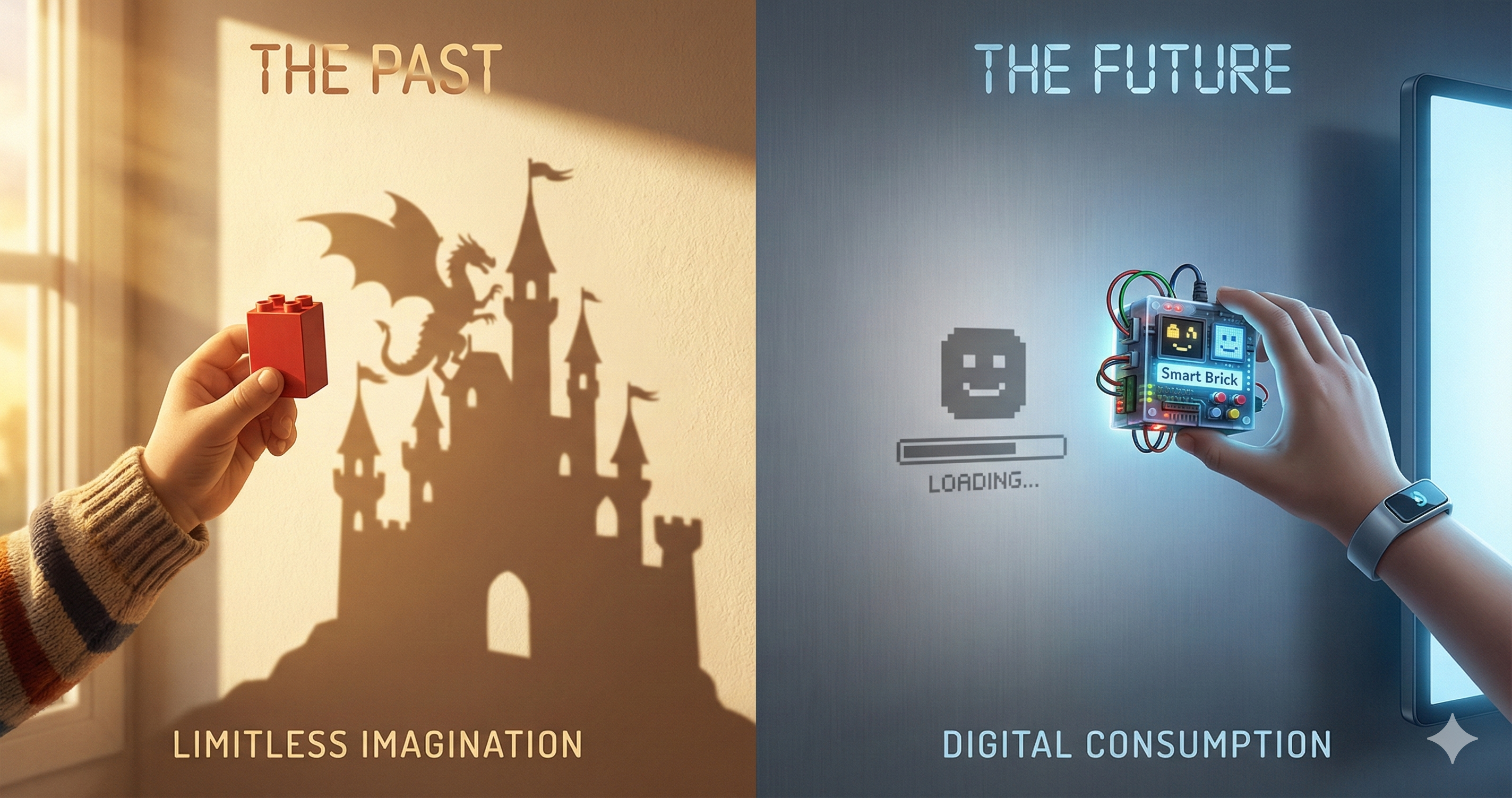
LEGO acaba de presentar su Smart Brick en el CES 2026. Un ladrillo con sensores, bluetooth, altavoces integrados y batería no reemplazable que promete “revolucionar el juego.” ¿El problema? Es el mismo problema de siempre: estamos convirtiendo juguetes que no necesitaban pantallas en dispositivos que las requieren. Y lo peor: estamos matando el aburrimiento que hace crecer la creatividad infantil.
El Cementerio Tecnológico de LEGO
LEGO tiene un historial accidentado con la tecnología. LEGO Vidiyo duró 6 meses antes de ser cancelado en 2022. Hidden Side cerró su app en 2023. LEGO Mindstorms, ícono de la robótica educativa por 24 años, fue descontinuado en 2022. LEGO Dimensions, LEGO Boost: todos descansando en el mismo cementerio digital.
El patrón es claro: apps que dejan de funcionar, baterías que no se pueden reemplazar, juguetes de $100+ USD convertidos en ladrillos inútiles cuando la empresa decide que “es hora de enfocarse en otras prioridades.” Los fans han aprendido la lección: “Las apps son el problema con todo LEGO. Desde que LEGO empezó a usar apps, todo ha salido mal.”
Y aún así, aquí estamos. Marzo 2026. Smart Brick. Sets de $70 a $160 USD. Batería integrada no reemplazable. App dedicada “para actualizaciones.” ¿Cuánto tiempo pasará antes de que LEGO anuncie que “después de una cuidadosa consideración, hemos decidido descontinuar el soporte de Smart Play”?
La Pregunta que Nadie Hace: ¿Por Qué?
Pero más allá de la obsolescencia programada, existe una pregunta más profunda que rara vez hacemos: ¿Por qué queremos meter tecnología a juguetes que ya funcionaban perfectamente sin ella?
Piensa en esto: ¿Recuerdas cuando jugabas con carritos de juguete e inventabas los sonidos del motor con tu boca? ¿Cuando hacías “pew pew” con los disparos láser y “vroooom” con los aviones? Esos sonidos no eran solo ruido—eran tu cerebro desarrollando creatividad, narrativa, y capacidad de abstracción.
Ahora el Smart Brick hace los sonidos por ti. Detecta colores. Responde “inteligentemente” a su posición. ¿Qué queda para que el niño imagine?
Teresa Belton, investigadora educativa de la Universidad de East Anglia, encontró que profesionales creativos exitosos—novelistas, poetas, artistas, neurocientíficos—citaron el aburrimiento como un factor crucial en el desarrollo de su creatividad. El Dr. Michael Rich de Harvard lo resume: “El aburrimiento es el espacio donde ocurre la creatividad y la imaginación.”
La investigación es contundente: estudios muestran que cuando niños experimentan períodos de aburrimiento constructivo, desarrollan habilidades de resolución de problemas, pensamiento crítico y juego imaginativo. Karen Gasper de Penn State encontró que el aburrimiento “funciona de manera similar a sentirse feliz o emocionado—resulta en que intentes acercarte a algo que es más significativo o interesante. Es un empujón para explorar.”
Entonces, ¿qué hacemos? Llenamos cada segundo con estimulación digital para que nunca, jamás, se aburran.
El Problema de la Sobreestimulación
No es solo LEGO. Es toda una generación entrenada en TikTok y CocoMelon.
CocoMelon—ese show infantil con cambios de escena cada 1-3 segundos, colores saturados, música sin pausas—ha sido vinculado por pediatras a problemas de atención, berrinches explosivos al apagarlo, y dificultad para tolerar actividades menos estimulantes. El problema no es el show en sí: es el patrón de hiperestimulación constante.
Estudios en JAMA Pediatrics encontraron que niños de 1 año expuestos a más de 4 horas diarias de pantallas mostraron retrasos en comunicación y resolución de problemas a los 2 y 4 años. La Dra. Jennifer Cross de Weill Cornell señala que los niños aprenden mejor del diálogo recíproco—interacciones cara a cara, no consumo pasivo de pantallas.
Y aquí viene la paradoja más cruel: después de sobreestimular a nuestros hijos con pantallas desde los 2 años, después de entrenar su atención para videos de 15 segundos, después de condicionar sus cerebros a esperar dopamina constante… nos quejamos de que “el sistema educativo está obsoleto” y “necesitamos IA en las escuelas.”
No. El sistema no está obsoleto. Nosotros rompimos la atención de nuestros hijos y ahora exigimos que el mundo se adapte a la disfunción que creamos.
Juego Tecnológico vs. Juego Imaginativo
Un estudio de 10 años del Center for Early Childhood Education de Eastern Connecticut State University observó a niños jugando con más de 100 tipos de juguetes diferentes. Su conclusión: juguetes simples, de final abierto, no realistas—como una colección aleatoria de bloques LEGO tradicionales—inspiraron el juego de más alta calidad.
Los niños que jugaron con juguetes de final abierto mostraron más juego creativo, resolución de problemas, interacción con pares y uso del lenguaje. Por el contrario, los juguetes electrónicos “limitaron el juego de los niños” porque ya tenían opciones predeterminadas de interacción.
El ejemplo del estudio es revelador: una caja registradora de madera inspiró a los niños a crear juegos de compra-venta, negociación, conversación. Una caja registradora de plástico con sonidos electrónicos inspiró a los niños a… presionar botones repetidamente.
Menos es más. Mientras menos hace el juguete, más tiene que hacer el niño. Y en ese “más” está toda la diferencia.
El Contexto Latinoamericano
Para la mayoría de familias en América Latina, este debate es casi académico. Un set Smart Brick de $160 USD representa el salario mensual completo en muchas economías de la región. LEGO ya es un lujo prohibitivo—Smart LEGO ni siquiera entra en la conversación.
Pero la tendencia sí importa. Porque lo que LEGO intenta hoy, las copias chinas lo intentarán mañana. Porque los juguetes “inteligentes” de menor calidad llegarán a nuestros mercados. Porque la presión cultural de tener juguetes “modernos” que luzcan bien en redes sociales impacta a familias de todos los niveles económicos.
Y porque, fundamentalmente, estamos importando un problema que ni siquiera los países ricos han logrado resolver: cómo criar niños creativos, atentos y emocionalmente regulados en la era de la estimulación digital constante.
Preguntas Incómodas (para Ti, No para tus Hijos)
Antes de seguir, detente un momento:
¿Recuerdas qué sonidos hacías cuando jugabas de niño? ¿El motor del carro? ¿El rugido del dinosaurio? ¿Los disparos láser? ¿Los diálogos entre tus muñecos?
¿Cuándo fue la última vez que viste a un niño aburrirse… y resolverlo solo? Sin tablet, sin YouTube, sin un adulto interviniendo. Solo un niño, aburrido, inventando.
¿Qué estás optimizando cuando compras un juguete “inteligente”? ¿El desarrollo de tu hijo? ¿O tu propia comodidad de tenerlo entretenido y callado?
Si el juguete hace los sonidos, inventa las historias, y responde “inteligentemente”… ¿qué hace el niño? ¿Consumir? ¿Presionar botones? ¿Esperar el siguiente estímulo?
¿En qué momento decidimos que el aburrimiento era el enemigo? ¿Y si el verdadero enemigo fuera nuestra intolerancia al aburrimiento de nuestros hijos?
No necesitas responderme. Pero quizá necesitas responderte.
¿Qué Sigue?
LEGO lanzará Smart Brick en marzo 2026. Los niños lo amarán—claro que sí. Pero también amaban Vidiyo hasta que la app dejó de funcionar. También amaban Hidden Side hasta que el soporte terminó. También amaban Mindstorms hasta que se volvió “una prioridad diferente.”
Quizá el Smart Brick sea diferente. Quizá dure. Quizá LEGO finalmente aprendió.
O quizá, dentro de 3 años, otro set de $160 USD terminará en un cajón cuando la batería no reemplazable muera o cuando LEGO decida que Smart Play ya cumplió su propósito comercial.
Mientras tanto, recordemos: el mejor juguete que puedes darle a un niño no viene con sensores, ni bluetooth, ni apps. Viene con tiempo, espacio y aburrimiento—ese aburrimiento incómodo, productivo, creativo que tanto nos esforzamos en eliminar.
Quizá ese es el verdadero problema: no que LEGO haga juguetes “inteligentes”, sino que nosotros hayamos olvidado el valor de los juguetes tontos.
Referencias
- Belton, T. (Universidad de East Anglia). Investigación sobre aburrimiento y creatividad en profesionales exitosos.
- Rich, M. (Harvard Medical School). “Boredom is the space in which creativity and imagination happen.”
- Gasper, K. (Penn State University). Estudios sobre aburrimiento constructivo y búsqueda de significado.
- JAMA Pediatrics. Estudios sobre efectos del tiempo de pantalla en desarrollo infantil temprano.
- Cross, J. (Weill Cornell Medicine). Investigación sobre desarrollo del lenguaje e interacción cara a cara.
- Center for Early Childhood Education, Eastern Connecticut State University. Estudio longitudinal de 10 años sobre juguetes y calidad de juego.
#BeyondTheAlgorithm #TechEthics #ChildDevelopment #LEGOSmartBrick #DigitalParenting
Nota del autor: Este artículo forma parte de Beyond the Algorithm, un newsletter que examina las implicaciones éticas y sociales de la tecnología desde una perspectiva crítica, con especial atención al contexto latinoamericano.
LEGO just unveiled its Smart Brick at CES 2026. A brick with sensors, Bluetooth, integrated speakers, and a non-replaceable battery that promises to “revolutionize play.” The problem? It’s the same problem as always: we’re turning toys that didn’t need screens into devices that require them. And worse: we’re killing the boredom that nurtures children’s creativity.
LEGO’s Technology Graveyard
LEGO has a troubled history with technology. LEGO Vidiyo lasted 6 months before being canceled in 2022. Hidden Side shut down its app in 2023. LEGO Mindstorms, an educational robotics icon for 24 years, was discontinued in 2022. LEGO Dimensions, LEGO Boost: all resting in the same digital cemetery.
The pattern is clear: apps that stop working, batteries that can’t be replaced, $100+ USD toys turned into useless bricks when the company decides it’s “time to focus on other priorities.” Fans have learned their lesson: “Apps are the problem with all LEGO. Since LEGO started using apps, everything has gone wrong.”
And yet, here we are. March 2026. Smart Brick. Sets from $70 to $160 USD. Non-replaceable integrated battery. Dedicated app “for updates.” How long before LEGO announces that “after careful consideration, we’ve decided to discontinue Smart Play support”?
The Question Nobody Asks: Why?
But beyond planned obsolescence, there’s a deeper question we rarely ask: Why do we want to add technology to toys that worked perfectly without it?
Think about this: Do you remember when you played with toy cars and made engine sounds with your mouth? When you made “pew pew” sounds for laser shots and “vrooom” for airplanes? Those sounds weren’t just noise—they were your brain developing creativity, narrative, and abstraction capacity.
Now the Smart Brick makes the sounds for you. It detects colors. It responds “intelligently” to its position. What’s left for the child to imagine?
Teresa Belton, an educational researcher at the University of East Anglia, found that successful creative professionals—novelists, poets, artists, neuroscientists—cited boredom as a crucial factor in developing their creativity. Harvard’s Dr. Michael Rich sums it up: “Boredom is the space in which creativity and imagination happen.”
The research is compelling: studies show that when children experience periods of constructive boredom, they develop problem-solving skills, critical thinking, and imaginative play. Penn State’s Karen Gasper found that boredom “operates similarly to feeling happy or excited—it results in you trying to approach something that is more meaningful or interesting. It’s a push to explore.”
So what do we do? We fill every second with digital stimulation so they never, ever get bored.
The Overstimulation Problem
It’s not just LEGO. It’s an entire generation trained on TikTok and CocoMelon.
CocoMelon—that children’s show with scene changes every 1-3 seconds, saturated colors, non-stop music—has been linked by pediatricians to attention problems, explosive tantrums when turned off, and difficulty tolerating less stimulating activities. The problem isn’t the show itself: it’s the pattern of constant hyperstimulation.
JAMA Pediatrics studies found that 1-year-olds exposed to more than 4 hours of daily screen time showed delays in communication and problem-solving at ages 2 and 4. Weill Cornell’s Dr. Jennifer Cross notes that children learn best from reciprocal dialogue—face-to-face interactions, not passive screen consumption.
And here comes the cruelest paradox: after overstimulating our children with screens from age 2, after training their attention for 15-second videos, after conditioning their brains to expect constant dopamine… we complain that “the education system is obsolete” and “we need AI in schools.”
No. The system isn’t obsolete. We broke our children’s attention and now demand that the world adapt to the dysfunction we created.
Tech Play vs. Imaginative Play
A 10-year study by the Center for Early Childhood Education at Eastern Connecticut State University observed children playing with over 100 different types of toys. Their conclusion: simple, open-ended, non-realistic toys—like a random assortment of traditional LEGO blocks—inspired the highest-quality play.
Children who played with open-ended toys showed more creative play, problem-solving, peer interaction, and language use. Conversely, electronic toys “limited children’s play” because they had predetermined interaction options.
The study’s example is revealing: a wooden cash register inspired children to create buying-selling games, negotiation, conversation. A plastic cash register with electronic sounds inspired children to… repeatedly press buttons.
Less is more. The less a toy does, the more the child has to do. And in that “more” lies all the difference.
The Latin American Context
For most families in Latin America, this debate is almost academic. A $160 USD Smart Brick set represents a full month’s salary in many regional economies. LEGO is already prohibitively expensive—Smart LEGO doesn’t even enter the conversation.
But the trend matters. Because what LEGO attempts today, Chinese copies will attempt tomorrow. Because lower-quality “smart” toys will reach our markets. Because the cultural pressure to have “modern” toys that look good on social media impacts families at all economic levels.
And because, fundamentally, we’re importing a problem that even wealthy countries haven’t managed to solve: how to raise creative, attentive, and emotionally regulated children in an era of constant digital stimulation.
Uncomfortable Questions (for You, Not Your Kids)
Before continuing, pause for a moment:
Do you remember what sounds you made when you played as a child? The car engine? The dinosaur roar? The laser shots? The dialogues between your dolls?
When was the last time you saw a child get bored… and solve it alone? Without a tablet, without YouTube, without an adult intervening. Just a child, bored, inventing.
What are you optimizing when you buy a “smart” toy? Your child’s development? Or your own convenience of having them entertained and quiet?
If the toy makes the sounds, invents the stories, and responds “intelligently”… what does the child do? Consume? Press buttons? Wait for the next stimulus?
When did we decide boredom was the enemy? What if the real enemy was our intolerance of our children’s boredom?
You don’t need to answer me. But maybe you need to answer yourself.
What’s Next?
LEGO will launch Smart Brick in March 2026. Kids will love it—of course they will. But they also loved Vidiyo until the app stopped working. They also loved Hidden Side until support ended. They also loved Mindstorms until it became “a different priority.”
Maybe Smart Brick will be different. Maybe it’ll last. Maybe LEGO finally learned.
Or maybe, in 3 years, another $160 USD set will end up in a drawer when the non-replaceable battery dies or when LEGO decides Smart Play has fulfilled its commercial purpose.
Meanwhile, let’s remember: the best toy you can give a child doesn’t come with sensors, Bluetooth, or apps. It comes with time, space, and boredom—that uncomfortable, productive, creative boredom we work so hard to eliminate.
Maybe that’s the real problem: not that LEGO makes “smart” toys, but that we’ve forgotten the value of dumb toys.
References
- Belton, T. (University of East Anglia). Research on boredom and creativity in successful professionals.
- Rich, M. (Harvard Medical School). “Boredom is the space in which creativity and imagination happen.”
- Gasper, K. (Penn State University). Studies on constructive boredom and search for meaning.
- JAMA Pediatrics. Studies on screen time effects on early childhood development.
- Cross, J. (Weill Cornell Medicine). Research on language development and face-to-face interaction.
- Center for Early Childhood Education, Eastern Connecticut State University. 10-year longitudinal study on toys and play quality.
#BeyondTheAlgorithm #TechEthics #ChildDevelopment #LEGOSmartBrick #DigitalParenting
Author’s note: This article is part of Beyond the Algorithm, a newsletter that examines the ethical and social implications of technology from a critical perspective, with special attention to the Latin American context.