Recuerdo el momento en que entendí que la opacidad no era un accidente de diseño sino una decisión de negocio.
Trabajaba en datos en una de las grandes corporaciones. Propuse simplificar la política de privacidad de nuestra app — hacerla legible, honesta, comprensible para alguien sin formación legal. El legal counsel me explicó con mucha paciencia que eso “no era conveniente.” Un documento claro limita el espacio de maniobra. Un documento opaco crea opciones.
Fue la primera vez que escuché la complejidad explicada explícitamente como ventaja competitiva.
No como mal necesario. Como estrategia.
Llevaba ya dos artículos construyendo este argumento: la IA fue secuestrada por la lógica capitalista (BTA-0011), y tú eres el producto que se extrae y vende (BTA-0012). Ahora viene la última pieza de la trilogía, la más incómoda:
¿Por qué nadie cambia nada? ¿Por qué seguimos aceptando?
La respuesta: porque la ignorancia es increíblemente rentable. Y mantenerla es una inversión estratégica.
El analfabetismo digital es ingeniería, no accidente
Los Términos y Condiciones de Facebook — en su conjunto completo de políticas — superan las 15,000 palabras. Los de iTunes llegan a casi 20,000 palabras según análisis de Which? (2015). Más largo que Macbeth. Menos entretenido.
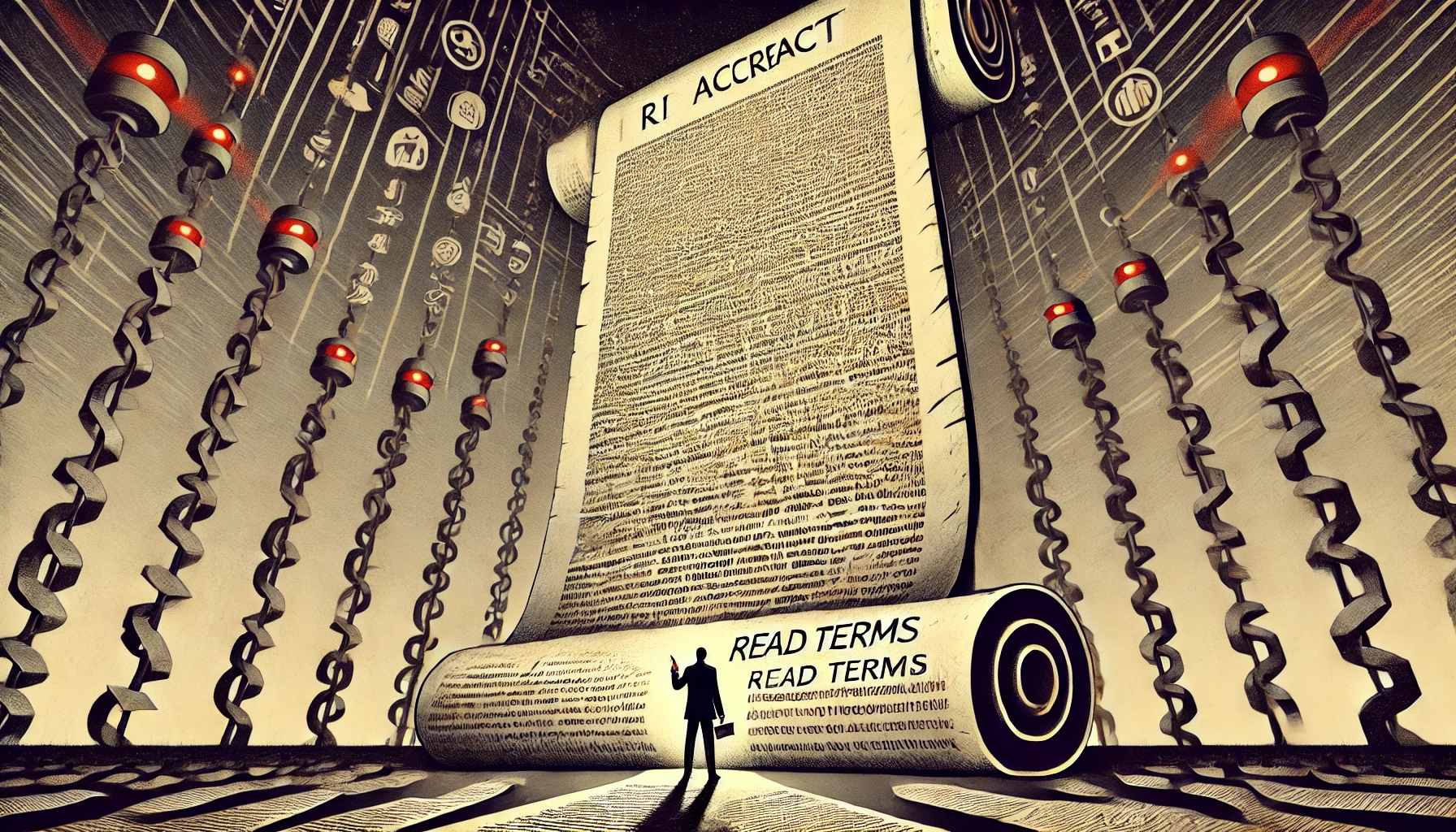
Investigadores de Carnegie Mellon calcularon en 2012 que leer todas las políticas de privacidad que un usuario promedio de internet encuentra en un año tomaría 76 días laborales de ocho horas. Es literalmente imposible. Las empresas lo saben. Lo calcularon. Lo diseñaron así.
No son complejos porque la complejidad sea necesaria para explicar el servicio. Son complejos para que dejes de intentar entenderlos.
Es diseño deliberado para generar resignación aprendida. El mensaje subliminal es claro: “Es demasiado complicado para ti. Solo acepta. Confía. Todos los demás ya lo hicieron.”
Y funciona: el 91% de usuarios acepta los términos sin leerlos; entre los 18 y 34 años, el porcentaje sube al 97% según encuesta de Deloitte. (NextBillion, 2022)
El analfabetismo digital funcional no es falla del sistema educativo. Es el objetivo del diseño corporativo.
Dark patterns: la manipulación como ciencia aplicada
¿Notaste que suscribirte a un servicio toma un click pero cancelarlo requiere 15 pasos, tres emails de confirmación y una llamada a horario laboral?
No es incompetencia de UX. Es un dark pattern — diseño específico para manipular tu comportamiento contra tus propios intereses. Y no es improvisación: hay equipos completos de psicólogos conductistas, diseñadores y científicos de datos dedicados a perfeccionar estas técnicas.
Ejemplos que has experimentado sin saberlo:
Confirmshaming: “¿Quieres mejorar tu salud?” [Sí] vs “No gracias, prefiero enfermarme.” Vergüenza diseñada para extraer consentimiento.
Roach Motel: Un click para entrar. Un proceso kafkiano de 14 pasos para salir. Te atrapan por agotamiento.
Preselección maliciosa: Todas las casillas de “compartir mis datos con socios comerciales” vienen marcadas por defecto. Para negarte tienes que desmarcarlas manualmente, una por una.
Precio señuelo: El plan básico a $5 existe para hacer que el plan de $50 parezca razonable. El de $500 existe para que el de $50 parezca moderado. El contexto es fabricado.
Camino de jardín: Te llevan por un flujo largo y tedioso. Al final: “¿Quieres compartir todo o empezar de nuevo?” Cedes por no perder los 20 minutos invertidos.
No llaman a esto “manipulación.” Lo llaman behavioral design o growth hacking o conversion optimization. Su métrica de éxito no es tu bienestar. Es tu engagement — eufemismo para “tiempo que pasas atrapado en la plataforma.”
Por eso sigues scrolleando a las 2am sabiendo que deberías dormir. No es falta de voluntad. Es diseño deliberado de adicción.
El teatro regulatorio y lo que revelan las multas
Europa tiene el GDPR. California el CCPA. México la Ley Federal de Protección de Datos Personales.
¿Te sientes más protegido?
Porque las multas existen. Solo que no son castigos — son el costo de hacer negocios.
Facebook pagó $5,000 millones a la FTC por Cambridge Analytica (2019). El mayor castigo tech en privacidad en su momento. Fue el 9% de sus ingresos anuales de ese año — lo absorbieron en un trimestre sin afectar su crecimiento.
Google ha acumulado más de €8,000 millones en multas antimonopolio en Europa en tres casos documentados: €2.4B por Google Shopping (2017, confirmada por el Tribunal de Justicia de la UE en 2024), €4.1B por Android (2018), más €2.95B en adtech (2025). Sigue siendo la empresa más rentable del mundo.
Amazon fue multada con €746 millones ($887M) por violaciones del GDPR en Luxemburgo (2021). Ese año generó $470,000 millones en ingresos. La multa fue 0.19% de sus ingresos.
No son castigos. Son licencias para seguir operando.
Y mientras tanto, las “soluciones” regulatorias te bombardean con el banner de cookies que todos clickeamos sin pensar. Botón gigante luminoso: [ACEPTAR TODO]. Link microscópico en gris: “administrar preferencias.” Si lo clickeas, 47 categorías incomprensibles, 15 subcategorías cada una, cada socio comercial con su propia política.
Diseñado para que digas “para qué” y presiones [ACEPTAR TODO]. Y legalmente, eso cuenta como consentimiento informado.
Es teatro regulatorio que protege el espectáculo sin amenazar el modelo.
El costo invisible de la conveniencia — y la trampa del no-hay-alternativa
“Pero es conveniente,” dices. Y tienes razón.
La trampa más sofisticada del capitalismo de vigilancia no es mentirte. Es crear infraestructura tan indispensable que tu consentimiento deja de ser voluntario.
Necesitas WhatsApp para comunicarte con tu familia (porque todos están ahí). Necesitas Google Maps para moverte. Necesitas LinkedIn para buscar empleo. No puedes “salirte del sistema” sin perder acceso a empleo, relaciones, servicios básicos, y participación en la sociedad digital.
¿Es consentimiento cuando la alternativa es exclusión económica y social?
Marx lo llamaría alienación por necesidad: vendes tu privacidad no porque quieras, sino porque la estructura fue diseñada de tal manera que no tienes opción real. Es coerción disfrazada de elección.
Entonces, ¿qué hacemos?
No hay soluciones mágicas. No puedes “hackear el sistema” con life hacks mientras las estructuras de poder permanecen intactas.
Pero la conciencia colectiva es lo único que realmente le teme a este modelo.
A nivel individual (reducción de daño): revisa permisos antes de instalar apps, usa alternativas cuando existan (Signal sobre WhatsApp, DuckDuckGo sobre Google, Firefox sobre Chrome), activa configuraciones de privacidad disponibles, solicita tus datos bajo GDPR o leyes locales equivalentes.
A nivel colectivo (cambio sistémico real): exige transparencia algorítmica en tu empresa, educa a quienes te rodean sobre estos mecanismos, apoya regulación con recursos de enforcement reales — no teatro.
A nivel profesional (si trabajas en tech): rechaza implementar dark patterns aunque te lo pidan. Especialmente si te lo piden. Recuerda: cada línea de código es una decisión moral. No eres neutral. Eres cómplice o eres resistencia.
La ignorancia masiva sobre nuestra explotación digital no es falla del sistema.
Es el sistema funcionando perfectamente.
No va a cambiar con artículos o posts de LinkedIn. Aunque ayuden a sembrar conciencia.
Va a cambiar cuando suficientes personas entiendan que están siendo explotadas, decidan que es inaceptable, y se organicen para cambiar las reglas del juego.
No necesitas ser ingeniero para entender esto. Solo necesitas entender que están diseñando tu realidad para maximizar su ganancia — no tu bienestar.
Marx tenía razón: la clase dominante no solo controla los medios de producción. Controla los medios de percepción.
El primer acto revolucionario siempre es el mismo: ver el sistema como realmente es.
Ya lo viste. No puedes des-verlo.
¿Y ahora qué vas a hacer con esa conciencia?
REFERENCIAS Y FUENTES
- McDonald, A.M. & Cranor, L.F. “The Cost of Reading Privacy Policies.” I/S: A Journal of Law and Policy for the Information Society, 2008. (Citado en TIME, 2012-03-06: “You’d Need 76 Work Days to Read All Your Privacy Policies Each Year.” URL: https://techland.time.com/2012/03/06/)
- Which? Conversation. “Online T&Cs word counts compared to famous books.” Which?, 2015. (Apple iTunes: 19,972 palabras.) URL: https://conversation.which.co.uk/technology/length-of-website-terms-and-conditions/
- NextBillion / Deloitte. “Nobody Reads Privacy Policies: Why We Need to Go Beyond Consent to Ensure Data Privacy.” NextBillion.net, 2022-10-27. (91% acepta sin leer; 97% entre 18-34.) URL: https://nextbillion.net/beyond-consent-for-data-privacy/
- Federal Trade Commission (FTC). “FTC Imposes $5 Billion Penalty and Sweeping New Privacy Restrictions on Facebook.” FTC Press Release, 2019-07-24. URL: https://www.ftc.gov/
- European Commission. “Antitrust: Commission fines Google €2.42 billion for abusing dominance as search engine.” EC Press Release, 2017-06-27. URL: https://europa.eu/
- European Commission. “Antitrust: Commission fines Google €4.34 billion for illegal practices regarding Android.” EC Press Release, 2018-07-18. URL: https://europa.eu/
- European Commission. “Commission fines Google €2.95 billion over abusive practices in adtech.” EC Press Release, 2025. URL: https://ec.europa.eu/
- TechCrunch. “EU hits Amazon with record-breaking $887M GDPR fine over data misuse.” TechCrunch, 2021-07-30. URL: https://techcrunch.com/2021/07/30/eu-hits-amazon-with-record-breaking-887m-gdpr-fine/
- AllAboutCookies. “You’ll Need a College Education to Read the Terms of Service for These Social Media Sites.” AllAboutCookies, 2022-07. URL: https://allaboutcookies.org/social-media-terms-of-service
- Zuboff, Shoshana. “The Age of Surveillance Capitalism.” PublicAffairs, 2019. ISBN: 978-1610395694.
I remember the moment I understood that opacity was not a design accident but a business decision.
I was working in data at one of the large corporations. I proposed simplifying our app’s privacy policy — making it readable, honest, comprehensible for someone without legal training. Legal counsel explained to me very patiently that this “wasn’t convenient.” A clear document limits room to maneuver. An opaque document creates options.
It was the first time I heard complexity explained explicitly as a competitive advantage.
Not as a necessary evil. As strategy.
I’ve spent two articles building this argument: AI was hijacked by capitalist logic (BTA-0011), and you are the product that gets extracted and sold (BTA-0012). Now comes the final piece of the trilogy, the most uncomfortable:
Why does nothing change? Why do we keep accepting?
The answer: because ignorance is incredibly profitable. And maintaining it is a strategic investment.
Digital illiteracy is engineering, not accident
Facebook’s Terms and Conditions — across its complete policy suite — exceed 15,000 words. Apple’s iTunes terms reach nearly 20,000 words according to analysis by Which? (2015). Longer than Macbeth. Less entertaining.
Carnegie Mellon researchers calculated in 2012 that reading all the privacy policies an average internet user encounters in a year would take 76 eight-hour workdays. It is literally impossible. Companies know this. They calculated it. They designed it this way.
They are not complex because complexity is necessary to explain the service. They are complex so you’ll stop trying to understand them.
It is deliberate design to generate learned helplessness. The subliminal message is clear: “It’s too complicated for you. Just accept. Trust us. Everyone else already did.”
And it works: 91% of users accept terms without reading them; among 18- to 34-year-olds, the figure reaches 97%, according to a Deloitte survey. (NextBillion, 2022)
Functional digital illiteracy is not a failure of the educational system. It is the objective of corporate design.
Dark patterns: manipulation as applied science
Have you noticed that subscribing to a service takes one click but canceling requires 15 steps, three confirmation emails, and a phone call during business hours?
That is not UX incompetence. It is a dark pattern — specific design to manipulate your behavior against your own interests. And it is not improvisation: entire teams of behavioral psychologists, experience designers, and data scientists are dedicated to perfecting these techniques.
Examples you have experienced without knowing:
Confirmshaming: “Do you want to improve your health?” [Yes] vs “No thanks, I prefer to stay sick.” Shame designed to extract consent.
Roach Motel: One click to enter. A Kafkaesque 14-step process to leave. They trap you through exhaustion.
Malicious pre-selection: All the “share my data with commercial partners” checkboxes come checked by default. To opt out, you must uncheck them manually, one by one.
Decoy pricing: The $5 basic plan exists to make the $50 plan seem reasonable. The $500 plan exists to make the $50 one seem moderate. The context is fabricated.
Garden path: They lead you through a long, tedious flow. At the end: “Share everything or start over?” You surrender rather than lose the 20 minutes invested.
They don’t call this “manipulation.” They call it behavioral design or growth hacking or conversion optimization. Their success metric is not your wellbeing. It is your engagement — a euphemism for “time spent trapped in the platform.”
That is why you keep scrolling at 2am knowing you should sleep. It is not lack of willpower. It is deliberate addiction design.
The regulatory theater and what the fines reveal
Europe has GDPR. California has CCPA. Mexico has its Federal Law on Personal Data Protection.
Do you feel more protected?
Because fines exist. They just aren’t punishments — they are the cost of doing business.
Facebook paid $5 billion to the FTC for Cambridge Analytica (2019). The largest tech privacy penalty at the time. It was 9% of their annual revenue that year — they absorbed it in one quarter without affecting their growth trajectory.
Google has accumulated more than €8 billion in antitrust fines in Europe across three documented cases: €2.4B for Google Shopping (2017, upheld by the EU Court of Justice in 2024), €4.1B for Android (2018), plus €2.95B in adtech (2025). It remains the most profitable company in the world.
Amazon was fined €746 million ($887M) for GDPR violations in Luxembourg (2021). That year it generated $470 billion in revenue. The fine was 0.19% of income.
These are not punishments. They are operating licenses.
And meanwhile, the “regulatory solutions” bombard you with cookie banners that everyone clicks without thinking. Giant illuminated button: [ACCEPT ALL]. Tiny grey link: “manage preferences.” If you click it, 47 incomprehensible categories, 15 subcategories each, each commercial partner with its own policy.
Designed so you say “forget it” and press [ACCEPT ALL]. And legally, that counts as informed consent.
It is regulatory theater that protects the spectacle without threatening the model.
The invisible cost of convenience — and the no-alternative trap
“But it’s convenient,” you say. And you’re right.
The most sophisticated trap of surveillance capitalism is not lying to you. It is creating infrastructure so indispensable that your consent ceases to be voluntary.
You need WhatsApp to communicate with your family (because everyone is there). You need Google Maps to get around. You need LinkedIn to find work. You cannot “exit the system” without losing access to employment, relationships, basic services, and participation in digital society.
Is it consent when the alternative is economic and social exclusion?
Marx would call it alienation by necessity: you sell your privacy not because you want to, but because the structure was designed so you have no real choice. It is coercion disguised as choice.
So what do we do?
There are no magic solutions. You cannot “hack the system” with life hacks while power structures remain intact.
But collective awareness is the only thing this model truly fears.
At the individual level (harm reduction): review permissions before installing apps, use alternatives when available (Signal over WhatsApp, DuckDuckGo over Google, Firefox over Chrome), enable available privacy settings, request your data under GDPR or local equivalent laws.
At the collective level (real systemic change): demand algorithmic transparency in your company, educate those around you about these mechanisms, support regulation with real enforcement resources — not theater.
At the professional level (if you work in tech): refuse to implement dark patterns even if asked. Especially if asked. Remember: every line of code is a moral decision. You are not neutral. You are either complicit or resistance.
Mass ignorance about our digital exploitation is not a system failure.
It is the system working perfectly.
It will not change with articles or LinkedIn posts. Though they help plant awareness.
It will change when enough people understand they are being exploited, decide it is unacceptable, and organize to change the rules of the game.
You don’t need to be an engineer to understand this. You only need to understand that they are designing your reality to maximize their profit — not your wellbeing.
Marx was right: the ruling class does not only control the means of production. It controls the means of perception.
The first revolutionary act is always the same: see the system as it really is.
You’ve seen it. You can’t unsee it.
What are you going to do with that awareness?
REFERENCES AND SOURCES
- McDonald, A.M. & Cranor, L.F. “The Cost of Reading Privacy Policies.” I/S: A Journal of Law and Policy for the Information Society, 2008. (Cited in TIME, 2012-03-06: “You’d Need 76 Work Days to Read All Your Privacy Policies Each Year.” URL: https://techland.time.com/2012/03/06/)
- Which? Conversation. “Online T&Cs word counts compared to famous books.” Which?, 2015. (Apple iTunes: 19,972 words.) URL: https://conversation.which.co.uk/technology/length-of-website-terms-and-conditions/
- NextBillion / Deloitte. “Nobody Reads Privacy Policies.” NextBillion.net, 2022-10-27. (91% accept without reading; 97% among 18-34.) URL: https://nextbillion.net/beyond-consent-for-data-privacy/
- Federal Trade Commission (FTC). “FTC Imposes $5 Billion Penalty and Sweeping New Privacy Restrictions on Facebook.” FTC Press Release, 2019-07-24. URL: https://www.ftc.gov/
- European Commission. “Antitrust: Commission fines Google €2.42 billion for abusing dominance as search engine.” EC Press Release, 2017-06-27. URL: https://europa.eu/
- European Commission. “Antitrust: Commission fines Google €4.34 billion for illegal practices regarding Android.” EC Press Release, 2018-07-18. URL: https://europa.eu/
- European Commission. “Commission fines Google €2.95 billion over abusive practices in adtech.” EC Press Release, 2025. URL: https://ec.europa.eu/
- TechCrunch. “EU hits Amazon with record-breaking $887M GDPR fine over data misuse.” TechCrunch, 2021-07-30. URL: https://techcrunch.com/2021/07/30/eu-hits-amazon-with-record-breaking-887m-gdpr-fine/
- AllAboutCookies. “You’ll Need a College Education to Read the Terms of Service for These Social Media Sites.” AllAboutCookies, 2022. URL: https://allaboutcookies.org/social-media-terms-of-service
- Zuboff, Shoshana. “The Age of Surveillance Capitalism.” PublicAffairs, 2019. ISBN: 978-1610395694.