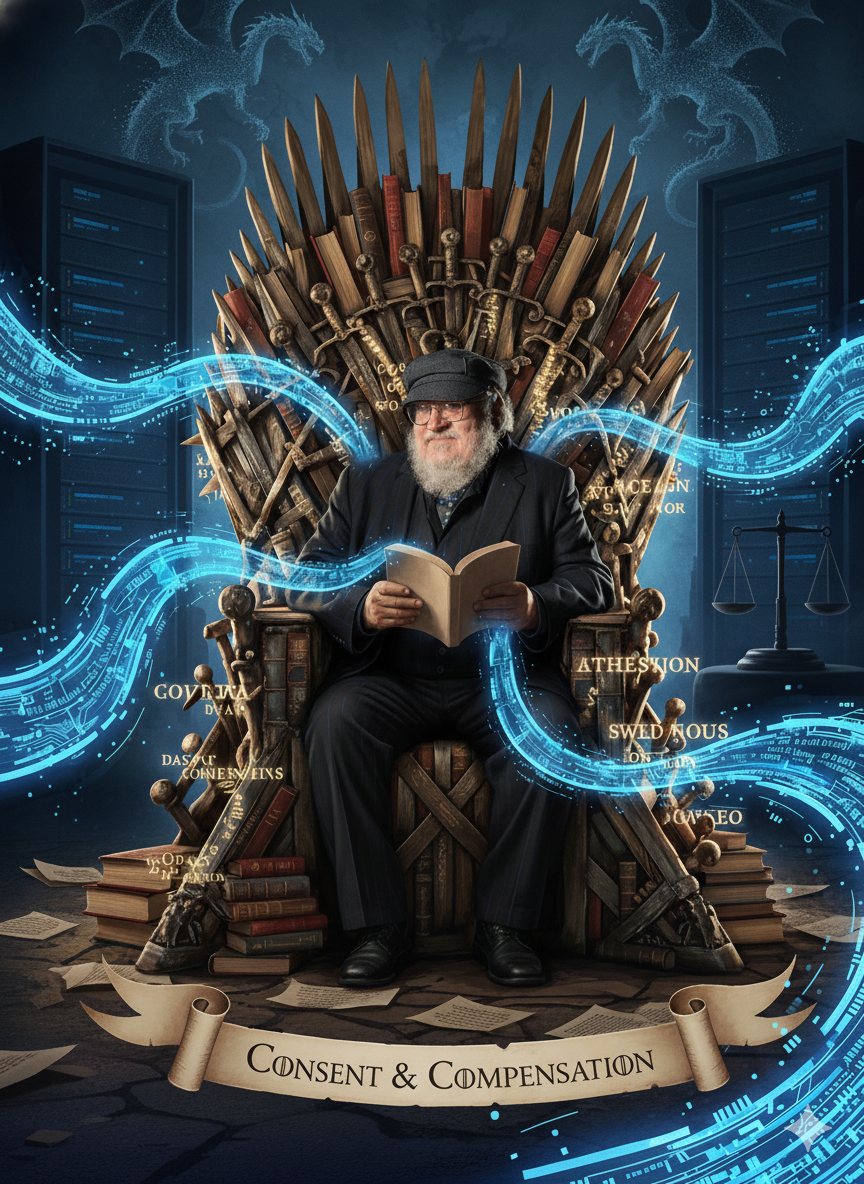
George R.R. Martin está demandando a OpenAI. El creador de Game of Thrones, junto con otros autores como Ta-Nehisi Coates, Sarah Silverman y John Grisham, acusa a la empresa de usar sus libros—con copyright vigente—para entrenar ChatGPT sin permiso ni compensación.
Y hace tres semanas, un juez federal le dio la razón para que el caso avance.
Pero antes de caer en la trampa de tomar bandos, Martin dijo algo que todos deberíamos escuchar: “No puedes prohibir nueva tecnología. Está aquí para quedarse. La pregunta es: ¿qué tipo de regulaciones va a haber? ¿Qué reglas habrá?”
No es anti-IA. Es pro-reglas-claras.
Las tres preguntas que importan
Martin planteó las preguntas correctas, las que la industria tech ha evitado sistemáticamente:
"¿El autor puede consentir el uso del libro?"
Respuesta actual: No. OpenAI descargó millones de libros de “shadow libraries”—sitios de piratería como LibGen—sin preguntarle a nadie. Anthropic hizo lo mismo y en septiembre pagó $1.5 billones para resolver la demanda. El mayor settlement por copyright en la historia.
"¿El autor tiene algo que decir al respecto?"
Respuesta actual: Nada. Los autores se enteraron cuando ChatGPT empezó a generar secuelas de sus propias obras. Los abogados de Martin le pidieron a ChatGPT que escribiera una continuación alternativa de A Clash of Kings. El chatbot generó “A Dance with Shadows,” con tramas, personajes y hasta nueva magia dragónica que sonaban… sospechosamente a Martin.
El juez determinó que un jurado razonable podría encontrar que el output es “sustancialmente similar” a la obra original. Infracción de copyright.
"¿El autor obtiene algún ingreso de ello?"
Respuesta actual: Cero. Tu libro entrena el modelo. El modelo genera contenido. La empresa cobra $20/mes por acceso. Tú no ves un centavo.
¿Inspiración o plagio con pasos extra?
Aquí está la pregunta filosófica que nadie quiere responder:
¿En qué momento deja de ser inspiración para convertirse en plagio?
Cualquier artista se inspira en obras previas. Borges leía a Cervantes. García Márquez absorbía a Faulkner. Eso es cultura, es natural, es inevitable.
Pero hay una diferencia crucial: ellos transformaban, no replicaban. Añadían su voz, su contexto, su humanidad.
ChatGPT no tiene voz propia. Es un sistema de predicción estadística que calcula “qué palabra probablemente sigue después de esta otra” basándose en patrones que extrajo de… tus libros.
No es creatividad. Es interpolación sofisticada.
Y sí, los humanos también interpolamos. Pero cuando un humano lee Game of Thrones, Martin no pierde el control de su obra. Cuando un LLM ingiere Game of Thrones, ahora puede generar derivados infinitos sin su consentimiento, sin su supervisión, sin su compensación.
¿Eso es “aprendizaje”? ¿O es extracción automatizada a escala industrial?
El costo real: quién paga, quién gana
Anthropic pagó $1.5 billones. Suena como mucho, ¿verdad?
Contexto: la empresa está valuada en $183 billones y genera $5 billones al año en ingresos. El settlement representa el 30% de sus ingresos anuales. Duele, pero no es letal.
Y ahí está el problema. La multa más grande en la historia del copyright sigue siendo una fracción de la ganancia que generaron con el contenido robado.
Es como si alguien te robara tu carro, lo usara para Uber durante tres años, y cuando lo atrapan, pague el 30% de lo que ganó con tu carro. ¿Justicia? ¿O costo de hacer negocios?
¿Y los autores latinoamericanos?
Aquí viene la pregunta que nadie está haciendo en LATAM:
¿Cuántos libros de autores latinoamericanos están en LibGen? ¿Cuántos fueron usados para entrenar modelos sin consentimiento ni compensación?
Isabel Allende, Vargas Llosa, Elena Poniatowska, Juan Rulfo, Octavio Paz—obras que son patrimonio cultural de nuestros países, convertidas en datos de entrenamiento para corporaciones que no les preguntaron, no les pagaron, y probablemente ni siquiera saben que sus obras están ahí.
¿Pueden estos autores unirse a class actions en Estados Unidos? ¿Qué jurisdicción aplica cuando el servidor está en la nube, la empresa en Silicon Valley, y el autor en Ciudad de México?
Silicon Valley extrae valor del corpus literario global. Y LATAM, como siempre, genera contenido pero no captura la riqueza.
Es colonialismo de datos. Pero con libros.
No hay respuestas fáciles
No voy a decirte que la IA es mala o que hay que prohibir los LLMs. Eso sería tan ingenuo como decir que “la innovación no puede esperar.”
Lo que sí te voy a decir es esto:
La tecnología no es neutral. Y “porque podemos” nunca ha sido justificación suficiente para “entonces debemos.”
Martin tiene razón: no puedes detener la tecnología. Pero sí puedes exigir consentimiento. Sí puedes exigir compensación. Sí puedes exigir que las reglas existan antes de que las corporaciones decidan unilateralmente cuáles son.
ChatGPT puede escribir más rápido que George R.R. Martin. Pero no puede escribir como George R.R. Martin. Porque la velocidad no es creatividad. La eficiencia no es arte. Y la interpolación estadística no es pensamiento.
Lo que Martin está defendiendo no es su derecho a controlar la tecnología. Es su derecho a decir “sí” o “no” antes de que su trabajo se convierta en combustible para el modelo de negocios de alguien más.
Y ese derecho—el derecho al consentimiento—no debería ser revolucionario. Debería ser obvio.
Pero aquí estamos.
A few months ago — exactly on November 19, 2025 — I published the Spanish version of this article. Today, 129 days later, as I sit down to publish the English version, I realize I can’t just translate it. I need to update it. Because the story didn’t stop. If anything, it got more interesting.
[Versión en español: Lo que George R.R. Martin puede enseñarte sobre ética en IA]
Here’s what changed — and what the evolution of this case reveals about the real power dynamics behind AI.
The Case Grew Three Heads
When I originally wrote this piece, the lawsuit filed by George R.R. Martin, John Grisham, Ta-Nehisi Coates, and dozens of other authors against OpenAI had one central question: does training an AI on copyrighted books without permission constitute infringement?
Simple. Clean. Hard to answer.
By November 2025, that question had multiplied. U.S. District Judge Sidney Stein, presiding over the Southern District of New York, not only refused to dismiss the authors’ claims — he allowed the case to advance on three separate theories of infringement:
- That training AI models on copyrighted books is infringement in itself.
- That downloading those books from shadow libraries — piracy sites like LibGen — is illegal regardless of whether they were used for training.
- That ChatGPT’s outputs are sufficiently similar to the original works to constitute direct copyright violation.
Why does this matter? Because the court only needs to rule in favor of the authors on one of these theories to force OpenAI to pay. And statutory damages for copyright infringement can reach up to $150,000 per work infringed. The math gets uncomfortable fast.
“A Dance with Shadows” Is No Longer Just Anecdote
In the original article, I mentioned that ChatGPT generated an alternative sequel to A Clash of Kings — titled “A Dance with Shadows” — complete with plot points, characters, and dragon lore that sounded suspiciously like Martin’s own prose. I used it as a narrative flourish.
Judge Stein used it as legal reasoning.
In his October 28, 2025 ruling, he directly compared Martin’s A Game of Thrones to ChatGPT-generated summaries and wrote that “a discerning observer could easily conclude that this detailed summary is substantially similar to Martin’s original work because the summary conveys the overall tone and feel of the original work by parroting the plot, characters, and themes of the original.” That’s not a book review. That’s a federal judge giving authors a viable path to trial.
OpenAI’s Archive Is Now a Liability
Here’s the development I couldn’t have predicted in November: OpenAI has been ordered to hand over 20 million anonymized ChatGPT conversation logs to plaintiffs.
Let that sink in.
The company preserved tens of billions of user conversations. When faced with discovery requests, it first agreed to produce 20 million — calling that “surely more than enough.” Then it changed course, proposing to hand over only logs that specifically referenced plaintiffs’ works. The court said no. Judge Stein affirmed the ruling on January 5, 2026, ordering the full sample be produced.
OpenAI argued that this would invade user privacy. The judge’s response was essentially: users voluntarily submitted their conversations to OpenAI, the company owns those logs, and de-identification protocols are sufficient protection. The privacy shield failed.
The irony is brutal. The same company that sells the promise of a smarter, more helpful future had to be forced by a court to open its own archive. Not because it was asked nicely — but because it tried to filter what it showed.
The Cost of Doing Business Keeps Rising
In the original piece, I wrote that Anthropic’s $1.5 billion settlement — the largest copyright settlement in history at the time — represented roughly 30% of their annual income. A painful but survivable number.
Then came January 28, 2026. Universal Music Publishing Group, Concord Music, and ABKCO Music filed a $3.1 billion lawsuit against Anthropic, alleging the company built Claude on a foundation of torrented content. Two months after the historic settlement, the same company is staring at a demand more than twice as large.
The “cost of doing business” narrative is getting harder to sustain.
The LATAM Question Nobody’s Answering
None of this changes the fundamental asymmetry I raised in November, and I want to sit with it a moment longer for an English-speaking audience that may not have seen it.
How many books by Latin American authors were scraped without consent? Isabel Allende, Juan Rulfo, Elena Poniatowska, Vargas Llosa — works that are cultural patrimony, turned into training data for companies that didn’t ask, didn’t pay, and possibly don’t even know their names are in the dataset.
Can they join class actions in the United States? Which jurisdiction applies when the server is in the cloud, the company is in San Francisco, and the author is in Mexico City or Buenos Aires?
The Authors Guild can mobilize powerful American names. Who mobilizes for the writers of the Global South?
This isn’t a rhetorical question. The legal architecture for answering it doesn’t fully exist yet.
Martin said it clearly: you can’t outlaw new technology. The question is what rules govern it.
129 days later, the courts are slowly — frustratingly slowly — building those rules in real time. Three theories of infringement, 20 million conversation logs, $3.1 billion in new claims. The scaffolding is being constructed mid-air, while the companies that benefit from the absence of rules lobby hard to keep the ceiling high.
The creative work of millions of people — including writers who will never appear in a U.S. courtroom — is still being used, right now, to train systems that then compete with those same creators in their own markets.
Speed isn’t creativity. Efficiency isn’t art. And “we can” has never been sufficient justification for “we should.”
The question Martin asked in 2023 is still unanswered. But at least now, a judge is making OpenAI sweat while they figure it out.
What do you think — should authors outside the U.S. have a seat at this table?
REFERENCES AND SOURCES
- Publishers Weekly. “Authors’ Class Action Lawsuit Against OpenAI Moves Ahead.” Publishers Weekly, 2025-10-28. https://www.publishersweekly.com/pw/by-topic/digital/copyright/article/98961-authors-class-action-lawsuit-against-openai-moves-forward.html
- The Hollywood Reporter. “George R.R. Martin Is Carving Up OpenAI in Court, So Far.” THR, 2025-11-11. https://www.hollywoodreporter.com/business/business-news/george-rr-martin-openai-court-legal-1236413461/
- National Law Review / Jones Walker. “OpenAI Loses Privacy Gambit: 20 Million ChatGPT Logs Likely Headed to Copyright Plaintiffs.” NLR, 2026-01-05. https://natlawreview.com/article/openai-loses-privacy-gambit-20-million-chatgpt-logs-likely-headed-copyright
- Bloomberg Law. “OpenAI Must Turn Over 20 Million ChatGPT Logs, Judge Affirms.” Bloomberg Law, 2026-01-05. https://news.bloomberglaw.com/ip-law/openai-must-turn-over-20-million-chatgpt-logs-judge-affirms
- Sustainable Tech Partner. “Generative AI Lawsuits Timeline.” 2026-03-25. https://sustainabletechpartner.com/topics/ai/generative-ai-lawsuit-timeline/
- SlashGear. “George RR Martin’s ChatGPT Lawsuit Could Change The Rules For AI Forever.” SlashGear, 2025-11-05. https://www.slashgear.com/2017670/chatgpt-george-rr-martin-game-of-thrones-lawsuit/
- Chat GPT Is Eating the World. “Status of all 51 copyright lawsuits v. AI (Oct. 8, 2025).” 2025-10-13. https://chatgptiseatingtheworld.com/2025/10/08/status-of-all-51-copyright-lawsuits-v-ai-oct-8-2025-no-more-decisions-on-fair-use-in-2025/
- McKool Smith. “AI Infringement Case Updates: November 24, 2025.” 2025-11-24. https://www.mckoolsmith.com/newsroom-ailitigation-46