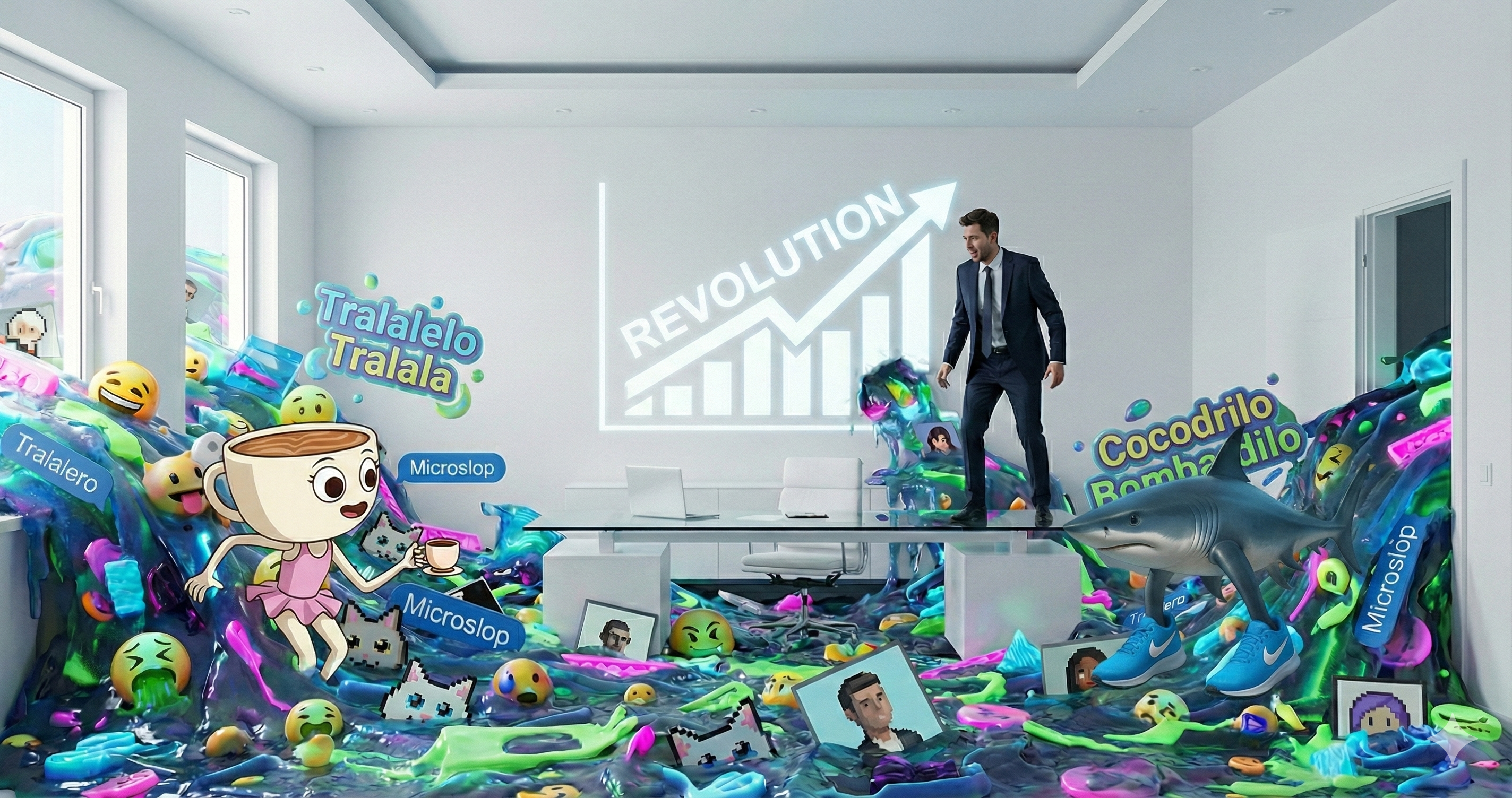
Este 2025 que recién terminó, la IA invadió prácticamente todas las áreas de la vida, tanto para personas dentro del área de tech, como aquellos ciudadanos de a pie distantes (en apariencia) a la tecnología.
¿Recuerdas aún ese ataque de Italian Brainrot y tus sobrinos cantando “tralalero tralala” o “capuchino capuchina” y otras tantas frases que quizá ya olvidamos, o desearíamos sacar de nuestra cabeza? Pues Merriam-Webster nombró “slop” como palabra del año 2025, conectando directamente con esa tendencia de contenido generado por IA sin sentido aparente. El término existía hace tiempo en círculos tech, pero fue Satya Nadella, CEO de Microsoft, quien lo potenció cuando publicó en su blog personal el 29 de diciembre pidiendo que “superemos los argumentos de slop vs sofisticación”.
¿Pero qué implica todo esto en realidad? ¿En qué momento esta “bicicleta para potenciar nuestra mente” —citando a Steve Jobs— se vuelve el lastre? Es, ha sido, y seguirá siendo un tema recurrente en este newsletter porque esta temática no dejará de aparecer por mucho tiempo, mientras intentamos hacerle un lugar adecuado en nuestras vidas a la IA y acomodarla de la misma forma que otras revoluciones tecnológicas en la antigüedad.
Quizá sea solo una burbuja que eventualmente termine de tronar mientras madura, así como lo fueron las PDAs o los cartuchos de 8 tracks, pero eventualmente terminará integrándose de alguna u otra forma. Mientras tanto, las ironías y contradicciones como el comentario del CEO de Microsoft serán un tema recurrente en nuestras vidas.
La tormenta perfecta
Para entender la magnitud de la contradicción, necesitamos el contexto completo. El 16 de diciembre, Merriam-Webster definió “slop” como “contenido digital de baja calidad producido usualmente en cantidad mediante inteligencia artificial”. Ejemplos: videos absurdos, imágenes publicitarias extrañas, propaganda barata, libros generados por IA, y sí, esos gatos parlantes que inundaron TikTok. El diccionario notó que el término adoptó un tono “menos temeroso, más burlón” hacia la tecnología.
Apenas 12 días después, el 28 de diciembre, The Information reveló emails internos donde Nadella criticaba brutalmente a su propio equipo: las integraciones de Copilot con Gmail y Outlook “mayormente no funcionan” y “no son inteligentes”. El CEO se había convertido en el “product manager más influyente de Microsoft”, realizando reuniones semanales donde interrogaba a sus 100 mejores ingenieros, enviando reportes de bugs directamente a los equipos, reclutando talento de OpenAI y Google DeepMind con salarios extraordinariamente altos.
Un día después, Nadella publicó su blog pidiendo exactamente lo contrario de lo que sus productos merecían: que dejáramos de llamarlo “slop”.
La ironía que escribe sola
Aquí viene lo verdaderamente delicioso. Windows Central, medio especializado en tecnología Microsoft, decidió analizar el blog de Nadella usando… Copilot. El veredicto fue devastador: “alta abstracción, baja especificidad”, con características típicas de contenido generado por IA: cadencia uniforme, repetición de motivos (“scaffolding”, “systems”, “diffusion”), cero huellas personales, ninguna experiencia vivida. Copilot concluyó: “Si me dijeras que esto vino de un blog de CEO o un borrador de keynote, te creería instantáneamente. Si me dijeras que fue generado por IA, también te creería, porque el tono está muy alineado con cómo los modelos escriben cuando se les pide ‘comentario tecnológico visionario’”.
El CEO de Microsoft, con salario de $79 millones anuales, pidiendo que superemos llamar “slop” a la IA, posiblemente escribió su defensa con… slop.
El permiso social que no existe
La reacción pública fue inmediata y brutal. “Microslop” se volvió trending topic en X, un perfecto ejemplo del efecto Streisand: al pedir que no lo llamen slop, Nadella logró que millones descubrieran el término por primera vez. Se creó el subreddit r/Microslop en cuestión de horas. Los memes fueron despiadados: la evolución del ícono de basura de Windows desde 1995 hasta 2025 terminando en el logo de Copilot.
Nadella admitió en su blog que la IA “no tiene permiso social” todavía. Pero la pregunta real es: ¿cómo esperas obtenerlo cuando admites privadamente que tu producto estrella no funciona, mientras públicamente pides que ignoremos el problema?
El colonialismo del slop
Aquí está la trampa que rara vez discutimos desde América Latina: ¿quién decide qué es “slop” y qué es “sofisticación”? Nadella, desde su oficina en Redmond con su salario de $79 millones anuales, propone desarrollar una “nueva teoría de la mente que contemple a los humanos equipados con estas herramientas amplificadoras cognitivas”. Suena filosófico, casi trascendente.
Mientras tanto, millones de niños en México, Colombia, Argentina cantan “Ballerina Capuchina” y “Tralalero Tralala” en los recreos —contenido que es literalmente la definición exacta que Merriam-Webster dio para “slop”. La Generación Alpha latina consume el producto más puro del AI slop mientras Silicon Valley debate la “sofisticación” de sus amplificadores cognitivos.
La brecha no es solo digital, es existencial. Microsoft anuncia que sus nuevas Copilot+ PCs requieren NPUs especializados y 32GB de RAM mínimo, volviendo obsoleto hardware perfectamente funcional. En mercados donde una computadora representa meses de ahorro familiar, la “revolución” de la IA significa: compra nuevo o quédate atrás. Nuestros datos entrenan modelos que nos venden de regreso, empaquetados como “innovación”, a precios que asumen poder adquisitivo del primer mundo.
El colonialismo digital tiene un nuevo nombre: quien controla la infraestructura define qué es basura y qué es progreso. Y nosotros, como siempre, pagamos por consumir ambos.
Las contradicciones sistémicas
Los números cuentan una historia que las palabras de Nadella intentan ocultar. Microsoft ha invertido $135 mil millones en su asociación con OpenAI, mientras su CEO admite internamente que las integraciones básicas de Copilot “no funcionan”. Un estudio de Carnegie Mellon encontró que los agentes de IA fallan en 70% de las tareas que supuestamente deberían automatizar. Mil millones de PCs permanecen en Windows 10, y la mitad de ellos son elegibles para actualizar a Windows 11, pero sus usuarios activamente rechazan el sistema operativo saturado de IA.
OpenAI, socio estrella de Microsoft, abandonó Bing para usar Google Search en ChatGPT. Microsoft discontinuó Xandr, su plataforma líder de transparencia publicitaria. Gobiernos enteros están migrando de Windows a Linux. El CEO reestructuró toda la cúpula directiva para enfocarse personalmente en IA, delegando el negocio comercial, porque la apuesta es tan grande que no puede permitirse que falle.
¿Y su respuesta ante este panorama? Pedirnos que “superemos el debate” sobre la calidad del producto.
La asimetría es brutal: Nadella puede filosofar sobre “teorías de la mente” mientras nosotros lidiamos con menús de inicio que tardan tres segundos en abrir porque Copilot está precargando recursos “por si acaso” le hacemos una pregunta. Él habla de “amplificadores cognitivos” mientras nosotros intentamos que el corrector ortográfico deje de reemplazar palabras correctas con sugerencias generadas por IA que suenan ligeramente más “corporativas”.
Ciudadanización imposible
El verdadero problema no es técnico, es político. Nadella tiene la libertad de pedir que “superemos” el debate del slop. Nosotros no tenemos la libertad de superar el slop mismo. Está en nuestros sistemas operativos, en los feeds de nuestros hijos, en las herramientas que nos obligan a usar en el trabajo, en los televisores LG que venían con íconos de Copilot no removibles hasta que la presión pública obligó a la empresa a permitir su eliminación.
¿Cómo ejerces ciudadanización —ese derecho a participar informadamente en las decisiones que te afectan— cuando el problema ya está integrado en la infraestructura cultural? No puedes regular lo que tus sobrinos cantan en el recreo. No puedes legislar contra el Italian Brainrot cuando ya se volvió parte del vocabulario de una generación completa.
La brecha entre el discurso corporativo y la realidad del usuario nunca fue tan amplia. Nadella habla de “scaffolds que orquestan múltiples modelos y agentes”. Los usuarios hablan de funciones básicas que dejaron de funcionar después de actualizaciones forzadas. Él promete “digital workers” que automatizan tareas administrativas. Carnegie Mellon publica estudios mostrando que esos agentes fallan siete de cada diez veces.
Aquí está la asimetría definitiva: quien genera el problema controla el vocabulario para discutirlo. Cuando millones decimos “esto es slop”, el CEO responde “desarrollemos una nueva teoría de la mente”. No es un debate, es una imposición disfrazada de filosofía.
El poder de nombrar
Volvamos al inicio: “Tralalero Tralala, Capuchino Capuchina”. Contenido absurdo generado por IA, consumido masivamente, integrado culturalmente, imposible de regular. Merriam-Webster lo nombró “slop” y el término capturó perfectamente la frustración colectiva: esto no es innovación, es basura producida en masa.
Cuando Nadella pidió que “superáramos” ese nombre, la respuesta fue inmediata: #Microslop. No fue solo un meme, fue un acto de resistencia semántica. Si no podemos rechazar el producto, al menos podemos nombrarlo honestamente. Si no tenemos el poder de desinstalarlo de nuestros sistemas, tenemos el poder de llamarlo por lo que es.
La IA no va a desaparecer. Probablemente no es una burbuja como las PDAs o los cartuchos de 8 tracks. Se integrará, mutará, evolucionará. Pero en qué términos se integra, eso aún está en disputa. Las contradicciones como la de Nadella —admitir que el producto falla mientras pide que ignoremos el problema— seguirán apareciendo porque estamos en medio de una negociación cultural que apenas comienza.
Mientras tanto, cada vez que un CEO multimillonario nos pide que “superemos” una crítica legítima, tenemos una herramienta poderosa: nombrar el problema. “Microslop” no resuelve la crisis, pero hace visible la contradicción. Y ese es el primer paso de toda ciudadanización: hacer que lo invisible se vuelva innegable.
Porque al final, si tus sobrinos van a cantar “Tralalero Tralala” de todos modos, al menos que sepamos llamarlo por su nombre.
Referencias
- Merriam-Webster (2025). “Word of the Year 2025: Slop”. https://www.merriam-webster.com/wordplay/word-of-the-year
- The Information (28 dic 2025). “Microsoft’s Nadella Pressures Deputies to Accelerate Copilot Improvements”
- Windows Central (29 dic 2025). “Even Copilot thinks Satya Nadella’s blog post sounds like a robot wrote it”
- Nadella, S. (29 dic 2025). “Looking Ahead to 2026”. SN Scratchpad
- Carnegie Mellon University (2025). AI Agent Task Completion Research
- Euronews (17 dic 2025). “AI slop, clean girl aesthetic and clutter: 2025’s biggest cultural trends”
Palabras clave: AI slop, Satya Nadella, Microsoft Copilot, colonialismo digital, ciudadanización tecnológica, Italian Brainrot, Microslop, ética IA
Longitud: ~4,800 caracteres (contenido principal)
As 2025 just ended, AI invaded practically every area of life, both for people in tech and for everyday citizens seemingly distant from technology.
Remember that Italian Brainrot attack and your nieces and nephews singing “tralalero tralala” or “capuchino capuchina” and all those other phrases we’ve perhaps already forgotten, or wish we could get out of our heads? Well, Merriam-Webster named “slop” as the 2025 word of the year, directly connecting to that trend of seemingly senseless AI-generated content. The term existed for a while in tech circles, but it was Satya Nadella, Microsoft’s CEO, who amplified it when he published on his personal blog on December 29th asking us to “get beyond the arguments of slop vs sophistication.”
But what does all this really mean? At what point does this “bicycle for the mind” —quoting Steve Jobs— become a burden? This has been, is, and will continue to be a recurring theme in this newsletter because this topic won’t disappear anytime soon, as we try to make room for AI in our lives and accommodate it in the same way as other technological revolutions in history.
Perhaps it’s just a bubble that will eventually burst as it matures, like PDAs or 8-track cartridges, but it will eventually integrate one way or another. Meanwhile, ironies and contradictions like the Microsoft CEO’s comment will be a recurring theme in our lives.
The perfect storm
To understand the magnitude of this contradiction, we need the complete context. On December 16th, Merriam-Webster defined “slop” as “digital content of low quality that is produced usually in quantity by means of artificial intelligence.” Examples: absurd videos, off-kilter advertising images, cheap propaganda, AI-written books, and yes, those talking cats that flooded TikTok. The dictionary noted the term adopted a tone that’s “less fearful, more mocking” toward the technology.
Barely 12 days later, on December 28th, The Information revealed internal emails where Nadella brutally criticized his own team: Copilot’s integrations with Gmail and Outlook “for the most part don’t really work” and are “not smart.” The CEO had become Microsoft’s “most influential product manager,” holding weekly meetings interrogating his top 100 engineers, sending bug reports directly to teams, recruiting talent from OpenAI and Google DeepMind with extraordinarily high salaries.
One day later, Nadella published his blog asking for exactly the opposite of what his products deserved: that we stop calling it “slop.”
The irony writes itself
Here comes the truly delicious part. Windows Central, a Microsoft technology specialist media outlet, decided to analyze Nadella’s blog using… Copilot. The verdict was devastating: “high abstraction, low specificity,” with typical characteristics of AI-generated content: uniform cadence, repetition of motifs (“scaffolding,” “systems,” “diffusion”), zero personal fingerprints, no lived experience. Copilot concluded: “If you told me this came from a CEO blog post or a keynote draft, I’d believe you instantly. If you told me it was AI-generated, I’d also believe you—because the tone is very aligned with how models write when asked for ‘visionary tech commentary.’”
Microsoft’s CEO, with his $79 million annual salary, asking us to get beyond calling AI “slop,” possibly wrote his defense with… slop.
The social permission that doesn’t exist
The public reaction was immediate and brutal. “Microslop” became a trending topic on X, a perfect example of the Streisand effect: by asking people not to call it slop, Nadella ensured millions discovered the term for the first time. The r/Microslop subreddit was created within hours. The memes were merciless: the evolution of the Windows trash icon from 1995 to 2025 ending in the Copilot logo.
Nadella admitted in his blog that AI “doesn’t have social permission” yet. But the real question is: how do you expect to obtain it when you privately admit your flagship product doesn’t work, while publicly asking us to ignore the problem?
The colonialism of slop
Here’s the trap we rarely discuss from Latin America: who decides what is “slop” and what is “sophistication”? Nadella, from his Redmond office with his $79 million salary, proposes developing a “new equilibrium in terms of our ’theory of the mind’ that accounts for humans being equipped with these new cognitive amplifier tools.” It sounds philosophical, almost transcendent.
Meanwhile, millions of children in Mexico, Colombia, Argentina sing “Ballerina Capuchina” and “Tralalero Tralala” on playgrounds—content that is literally the exact definition Merriam-Webster gave for “slop.” Latin America’s Generation Alpha consumes the purest product of AI slop while Silicon Valley debates the “sophistication” of its cognitive amplifiers.
The gap isn’t just digital, it’s existential. Microsoft announces its new Copilot+ PCs require specialized NPUs and minimum 32GB RAM, rendering perfectly functional hardware obsolete. In markets where a computer represents months of family savings, the AI “revolution” means: buy new or get left behind. Our data trains models they sell back to us, packaged as “innovation,” at prices that assume first-world purchasing power.
Digital colonialism has a new name: whoever controls the infrastructure defines what is garbage and what is progress. And we, as always, pay to consume both.
Systemic contradictions
The numbers tell a story Nadella’s words try to hide. Microsoft has invested $135 billion in its OpenAI partnership, while its CEO internally admits Copilot’s basic integrations “don’t work.” A Carnegie Mellon study found AI agents fail at 70% of tasks they’re supposedly meant to automate. One billion PCs remain on Windows 10, and half of them are eligible to upgrade to Windows 11, but their users actively reject the AI-saturated operating system.
OpenAI, Microsoft’s star partner, abandoned Bing to use Google Search in ChatGPT. Microsoft discontinued Xandr, its leading advertising transparency platform. Entire governments are migrating from Windows to Linux. The CEO restructured the entire executive suite to personally focus on AI, delegating commercial business, because the bet is so big it can’t afford to fail.
And his response to this landscape? Asking us to “get beyond the debate” about product quality.
The asymmetry is brutal: Nadella can philosophize about “theories of the mind” while we deal with start menus that take three seconds to open because Copilot is preloading resources “just in case” we ask it a question. He talks about “cognitive amplifiers” while we try to stop the spell checker from replacing correct words with AI-generated suggestions that sound slightly more “corporate.”
Impossible citizenship
The real problem isn’t technical, it’s political. Nadella has the freedom to ask us to “get beyond” the slop debate. We don’t have the freedom to get beyond the slop itself. It’s in our operating systems, in our children’s feeds, in the tools we’re forced to use at work, in LG TVs that came with non-removable Copilot icons until public pressure forced the company to allow their deletion.
How do you exercise citizenship—that right to participate informedly in decisions that affect you—when the problem is already integrated into cultural infrastructure? You can’t regulate what your nieces and nephews sing on the playground. You can’t legislate against Italian Brainrot when it’s already become part of an entire generation’s vocabulary.
The gap between corporate discourse and user reality has never been wider. Nadella talks about “scaffolds that orchestrate multiple models and agents.” Users talk about basic functions that stopped working after forced updates. He promises “digital workers” that automate administrative tasks. Carnegie Mellon publishes studies showing those agents fail seven out of ten times.
Here’s the ultimate asymmetry: whoever generates the problem controls the vocabulary to discuss it. When millions of us say “this is slop,” the CEO responds “let’s develop a new theory of the mind.” It’s not a debate, it’s an imposition disguised as philosophy.
The power to name
Let’s return to the beginning: “Tralalero Tralala, Capuchino Capuchina.” Absurd AI-generated content, massively consumed, culturally integrated, impossible to regulate. Merriam-Webster named it “slop” and the term perfectly captured collective frustration: this isn’t innovation, it’s mass-produced garbage.
When Nadella asked us to “get beyond” that name, the response was immediate: #Microslop. It wasn’t just a meme, it was an act of semantic resistance. If we can’t reject the product, at least we can name it honestly. If we don’t have the power to uninstall it from our systems, we have the power to call it what it is.
AI isn’t going to disappear. It’s probably not a bubble like PDAs or 8-track cartridges. It will integrate, mutate, evolve. But on what terms it integrates, that’s still in dispute. Contradictions like Nadella’s—admitting the product fails while asking us to ignore the problem—will keep appearing because we’re in the middle of a cultural negotiation that’s just beginning.
Meanwhile, every time a multimillionaire CEO asks us to “get beyond” a legitimate criticism, we have a powerful tool: naming the problem. “Microslop” doesn’t solve the crisis, but it makes the contradiction visible. And that’s the first step of all citizenship: making the invisible undeniable.
Because in the end, if your nieces and nephews are going to sing “Tralalero Tralala” anyway, at least let’s know how to call it by its name.
References
- Merriam-Webster (2025). “Word of the Year 2025: Slop”. https://www.merriam-webster.com/wordplay/word-of-the-year
- The Information (Dec 28, 2025). “Microsoft’s Nadella Pressures Deputies to Accelerate Copilot Improvements”
- Windows Central (Dec 29, 2025). “Even Copilot thinks Satya Nadella’s blog post sounds like a robot wrote it”
- Nadella, S. (Dec 29, 2025). “Looking Ahead to 2026”. SN Scratchpad
- Carnegie Mellon University (2025). AI Agent Task Completion Research
- Euronews (Dec 17, 2025). “AI slop, clean girl aesthetic and clutter: 2025’s biggest cultural trends”
Keywords: AI slop, Satya Nadella, Microsoft Copilot, digital colonialism, technological citizenship, Italian Brainrot, Microslop, AI ethics
Length: ~4,800 characters (main content)