Feliz May the 4th.
Hoy, mientras el internet se inunda de sables de luz y nostalgia de ciencia ficción, vale la pena mirar la mitología de Star Wars a través de un lente más contemporáneo. Porque si George Lucas escribiera la saga hoy, el Imperio Galáctico no necesitaría construir una Estrella de la Muerte de trillones de créditos para subyugar sistemas estelares enteros.
Le bastaría con lanzar una red social de microvideos y ajustar el algoritmo.
Piénsalo. Obi-Wan Kenobi describía la Fuerza como “un campo de energía creado por todas las cosas vivientes. Nos rodea, penetra en nosotros y mantiene unida a la galaxia”. Hoy, a esa energía mística e invisible que conecta cada uno de nuestros movimientos, interacciones y deseos la llamamos metadatos conductuales.
Y al igual que en la saga, existe una orden dedicada a extraer, manipular y monopolizar esa energía. No visten túnicas negras, sino chalecos de lana en Silicon Valley, pero su doctrina es sospechosamente similar a la de los Sith: la dominación a través de la vigilancia y la manipulación emocional.
La falacia del Lado Oscuro: “Más rápido, más fácil, más seductor”
Cuando Luke Skywalker, en su ingenuidad, le pregunta a Yoda si el Lado Oscuro es más fuerte, el viejo maestro responde con una de las lecciones más precisas sobre la economía de la atención: “No, no, no. Más rápido, más fácil, más seductor”.
El Lado Oscuro es el algoritmo de recomendación original.
Palpatine no era un hechicero místico; era el CEO arquetípico del capitalismo de vigilancia. Entendió antes que nadie que no puedes gobernar la galaxia apelando a la razón, la pausa o la deliberación republicana. El engagement real —el que mantiene a los usuarios activos y dependientes— se alimenta de las emociones más primarias del ser humano: el miedo, la ira y la indignación.
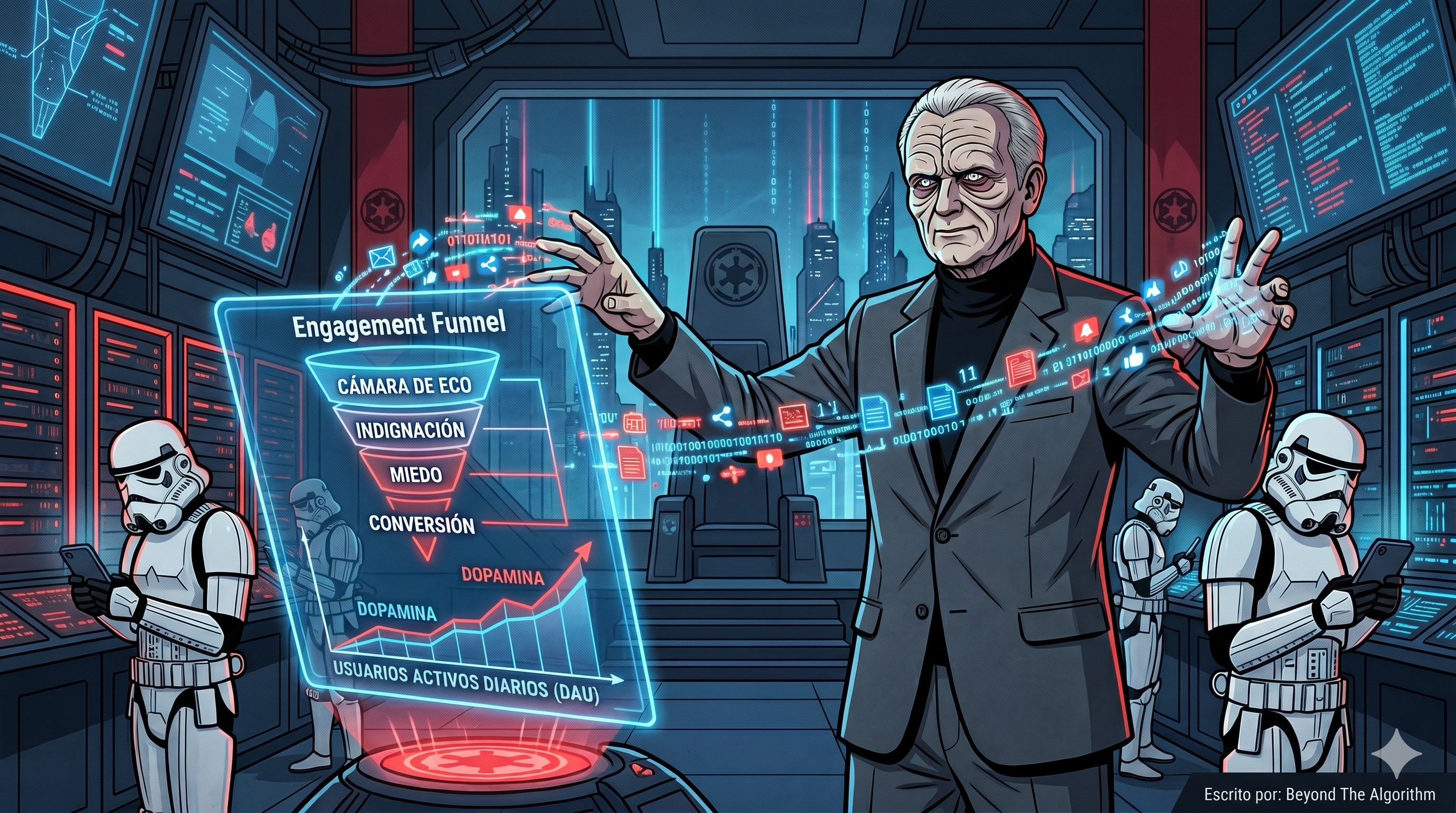
La radicalización de Anakin Skywalker no ocurrió de la noche a la mañana. Fue un proceso gradual de doomscrolling mental. Palpatine identificó su punto de dolor (el miedo a perder a Padmé), creó un embudo de conversión perfecto, y lo alimentó con contenido altamente personalizado que validaba sus peores ansiedades. Lo aisló en una cámara de eco emocional hasta que masacrar younglings le pareció una decisión perfectamente lógica dentro de su feed distorsionado.
El Imperio de las Métricas
En este universo, la Estrella de la Muerte no dispara rayos láser; es un centro de datos masivo diseñado para destruir la cohesión social de un planeta entero mediante pruebas A/B. El modelo de negocio del Imperio es simple: extraer la agencia humana y venderla al mejor postor.
Los Stormtroopers: No son soldados, son bots y granjas de clics, creando la ilusión de un consenso abrumador.
La Orden 66: Una actualización unilateral de los Términos y Condiciones que los usuarios (los clones) ni siquiera leyeron antes de ejecutar.
Los Jedi: Los defensores del minimalismo digital y la privacidad. Se retiran a montañas lejanas (o a servidores locales) intentando meditar y mantener su soberanía cognitiva en un universo diseñado para sobreestimularlos. Pero, como demostró la caída de la República, la disciplina individual y el “mindfulness” rara vez son suficientes contra una infraestructura diseñada billonariamente para hackear tu sistema límbico.
La sátira nos deja una advertencia clara sobre nuestra relación íntima con la tecnología. Cuando delegamos nuestra percepción de la realidad a sistemas de IA optimizados para el engagement, estamos entregando nuestro libre albedrío a un algoritmo que se alimenta de nuestra ansiedad.
La rebelión de nuestros días no requiere volar estaciones espaciales. Requiere actos radicales de fricción: desconectarse, auto-hospedar nuestra vida digital, cuestionar las métricas de validación y reclamar nuestra agencia sobre dónde y cómo invertimos nuestra atención.
Hoy no necesitamos sables de luz para combatir al Imperio. Necesitamos soberanía de datos y una comprensión profunda de cómo se están monetizando nuestras emociones.
Que la Agencia Humana te acompañe. Siempre.
¿Tú qué opinas?
REFERENCIAS Y FUENTES
- Zuboff, Shoshana. The Age of Surveillance Capitalism. PublicAffairs, 2019.
- Lucas, George. Star Wars: Episode III – Revenge of the Sith (guión). Lucasfilm, 2005.
- Haugen, Frances. Testimonio ante el Senado de EE.UU. sobre algoritmos de Facebook. The Wall Street Journal, 2021-10-05.
- Harris, Tristan. “How Technology is Hijacking Your Mind”. Medium / Thrive Global, 2016-05-18.
Nota editorial: Por el carácter satírico-ensayístico del artículo, las referencias sostienen el marco teórico sin requerir datos cuantitativos adicionales.
Happy May the 4th.
Today, as the internet floods with lightsabers and sci-fi nostalgia, it’s worth looking at the mythology of Star Wars through a more contemporary lens. Because if George Lucas were writing the saga today, the Galactic Empire wouldn’t need to build a Death Star worth trillions of credits to subjugate entire star systems.
It would be enough to launch a short-video social network and tune the algorithm.
Think about it. Obi-Wan Kenobi described the Force as “an energy field created by all living things. It surrounds us, penetrates us, and binds the galaxy together.” Today, we call that same invisible energy that connects our every movement, interaction, and desire behavioral metadata.
And just like in the saga, there is an order dedicated to extracting, manipulating, and monopolizing that energy. They don’t wear black robes — they wear fleece vests in Silicon Valley — but their doctrine is suspiciously similar to the Sith’s: domination through surveillance and emotional manipulation.
The Dark Side Fallacy: “Quicker, Easier, More Seductive”
When Luke Skywalker naively asks Yoda whether the Dark Side is stronger, the old master responds with one of the most precise lessons ever delivered about the attention economy: “No, no, no. Quicker, easier, more seductive.”
The Dark Side is the original recommendation algorithm.
Palpatine was no mystical sorcerer — he was the archetypal CEO of surveillance capitalism. He understood before anyone else that you cannot govern the galaxy by appealing to reason, pause, or republican deliberation. Real engagement — the kind that keeps users active and dependent — feeds on the most primal human emotions: fear, anger, and outrage.
The radicalization of Anakin Skywalker didn’t happen overnight. It was a gradual process of mental doomscrolling. Palpatine identified his pain point (the fear of losing Padmé), built a perfect conversion funnel, and fed him highly personalized content that validated his worst anxieties. He isolated him in an emotional echo chamber until massacring younglings seemed like a perfectly logical decision within his distorted feed.
The Empire of Metrics
In this universe, the Death Star doesn’t fire laser beams — it’s a massive data center designed to destroy the social cohesion of an entire planet through A/B testing. The Empire’s business model is simple: extract human agency and sell it to the highest bidder.
The Stormtroopers: Not soldiers — bots and click farms, manufacturing the illusion of overwhelming consensus.
Order 66: A unilateral update to the Terms and Conditions that the users (the clones) never read before executing.
The Jedi: Defenders of digital minimalism and privacy. They retreat to remote mountains (or local servers) trying to meditate and maintain their cognitive sovereignty in a universe engineered to overstimulate them. But, as the fall of the Republic demonstrated, individual discipline and “mindfulness” are rarely enough against an infrastructure designed with billions of dollars to hack your limbic system.
The satire leaves us with a clear warning about our intimate relationship with technology. When we delegate our perception of reality to AI systems optimized for engagement, we are surrendering our free will to an algorithm that feeds on our anxiety.
The rebellion of our time doesn’t require blowing up space stations. It requires radical acts of friction: disconnecting, self-hosting our digital lives, questioning validation metrics, and reclaiming our agency over where and how we invest our attention.
Today we don’t need lightsabers to fight the Empire. We need data sovereignty and a deep understanding of how our emotions are being monetized.
May Human Agency be with you. Always.
What do you think?
REFERENCES AND SOURCES
- Zuboff, Shoshana. The Age of Surveillance Capitalism. PublicAffairs, 2019.
- Lucas, George. Star Wars: Episode III – Revenge of the Sith (screenplay). Lucasfilm, 2005.
- Haugen, Frances. U.S. Senate testimony on Facebook algorithms. The Wall Street Journal, 2021-10-05.
- Harris, Tristan. “How Technology is Hijacking Your Mind.” Medium / Thrive Global, 2016-05-18.
Editorial note: Given the satirical-essayistic nature of this piece, references support the theoretical framework without requiring additional quantitative data.