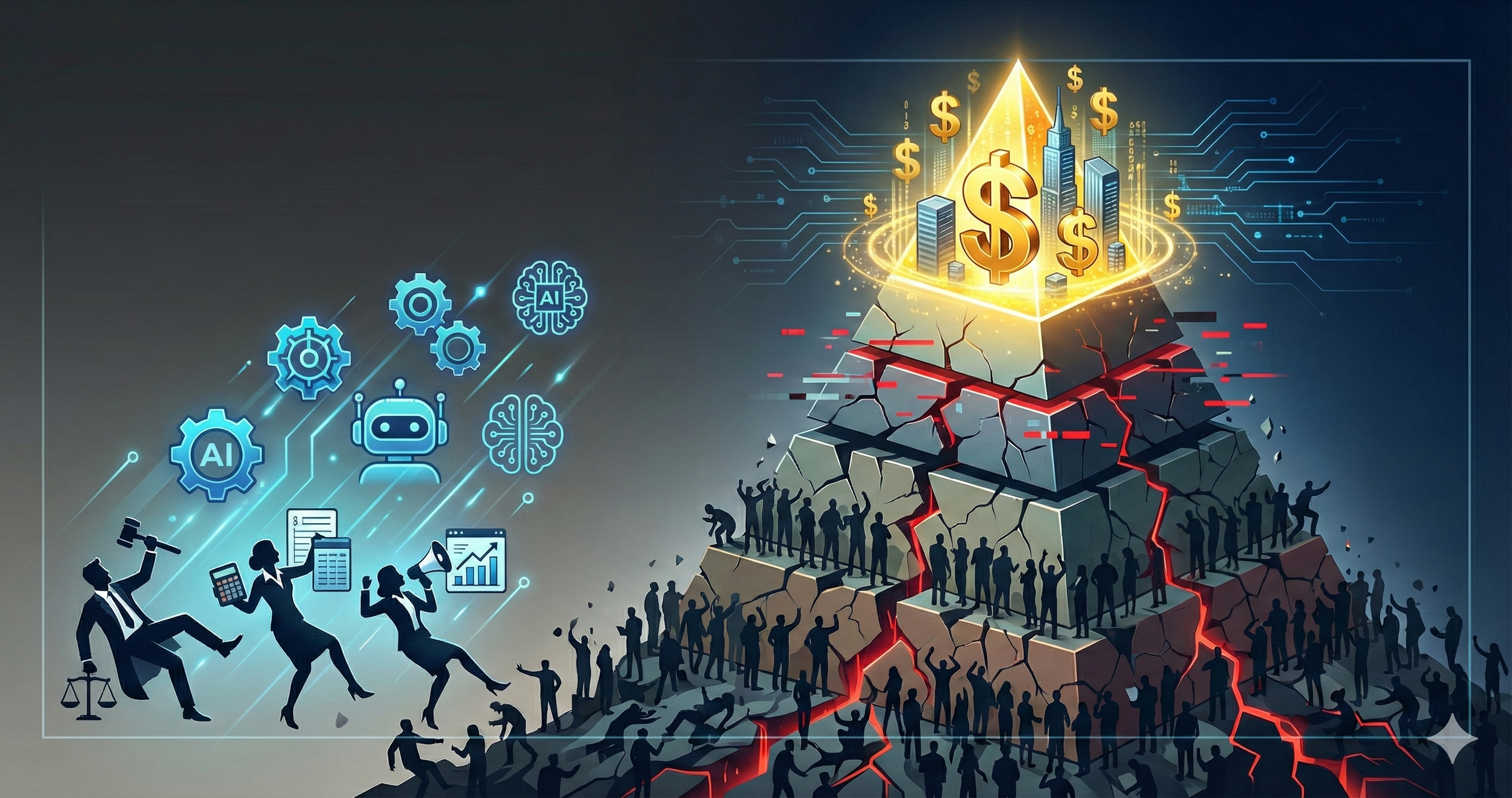
Mustafa Suleyman, CEO de Microsoft AI, acaba de vender la fantasía más peligrosa de 2026: que en 12 a 18 meses, la IA “automatizará completamente” el trabajo de contadores, abogados, project managers y marketers. La declaración, hecha en entrevista con Financial Times el 12 de febrero, no es ficción: está verificada, documentada, y circulando en cada medio de tecnología del planeta.
Tengo amigos abogados, contadores, y por supuesto project managers y gente del medio de marketing. Todos, incluyéndome, varias veces a la semana nos preguntamos sobre cómo la IA promete “empoderarnos”. Pero en nuestra mente sabemos que para nuestros jefes esto significa una cosa: reducir mi equipo y abaratar los costos.
Algo dentro de mí me hace preocuparme por un tema paralelo que poco hablamos. No es la automatización ni el empoderamiento de trabajadores con herramientas más sofisticadas. Es el discurso de SUSTITUIR humanos por IA lo que nos incomoda a muchos.
Suena futurista, distópico… pero cada puesto de trabajo sustituido por una IA imperfecta y alucinante es una persona o una familia que pierde estabilidad económica. Sí, un humano imperfecto también, pero con la capacidad de adaptarse y contextualizarse en cuestiones que la IA aún no ha logrado dominar.
EL CÓDIGO ES DEFICIENTE, PERO AHORA QUEREMOS LLEVARLO A FISCAL Y LEGAL
Suleyman justifica su predicción señalando que los ingenieros de software ya usan “IA para la gran mayoría de su producción de código”. El problema: la calidad de ese código es cuestionable.
Un estudio de Stanford de 2024 encontró que cuando se pregunta a LLMs sobre precedentes legales, alucinan al menos el 75% del tiempo sobre casos judiciales. No estamos hablando de errores menores: los modelos inventaron más de 120 casos inexistentes con nombres convincentes como “Thompson v. Western Medical Center (2019)”, completos con razonamiento legal detallado pero completamente fabricado.
Y no son solo modelos genéricos. Sistemas legales especializados como Lexis+ AI y Westlaw AI-Assisted Research — diseñados específicamente para investigación legal — producen información incorrecta entre el 17% y el 34% del tiempo, según investigadores de Stanford RegLab.
Las consecuencias reales ya están aquí. En julio 2025, los abogados de Mike Lindell fueron multados $3,000 cada uno por presentar un documento legal lleno de errores generados por IA. La base de datos de Damien Charlotin documenta 914 casos globales donde alucinaciones de IA causaron problemas legales — y la cifra sigue creciendo.
Si sabemos que el código es deficiente cuando lo genera una IA, ¿por qué queremos llevar estas estructuras al sector fiscal y legal cuando los riesgos de las alucinaciones podrían generar impactos económicos graves o prisión para quienes prescinden de un humano en el loop?
CONTADORES Y ABOGADOS EN LATAM: EL CONTEXTO QUE SILICON VALLEY IGNORA
Hablemos de algo que Suleyman convenientemente omite: el contexto latinoamericano.
En México, el 25.4% del PIB proviene de la economía informal — el nivel más alto desde que hay registros en 2003. No es un porcentaje marginal: es uno de cada cuatro pesos generados en el país. El 55.4% de los trabajadores están en informalidad, según datos de septiembre 2025. Por cada trabajador formal, hay 1.2 en condiciones de informalidad.
¿Cómo planea una IA “automatizar” la contabilidad en un ecosistema donde más de la mitad de la economía opera fuera del sistema formal? ¿Cómo procesará un LLM la extrema flexibilidad e interpretación de las leyes mexicanas que ni siquiera los órganos judiciales ejecutan de manera consistente?
La corrupción, la evasión fiscal sistémica, y la complejidad de un marco legal que cambia según quién lo interprete no son “edge cases” que se resuelven con más datos de entrenamiento. Son realidades estructurales que requieren juicio humano, contexto cultural, y navegación política.
Y mientras Microsoft vende esta fantasía, la economía informal en México creció 4.3% en 2024, mientras la formal solo avanzó 0.5%. La automatización está llegando a un mercado laboral que ya está colapsando.
QUEREMOS LLEVAR EL DESASTRE DE LOS ROBOTAXIS A LOS PLANOS FISCALES Y LEGALES
Recordemos qué tan bien nos ha ido con la “automatización completa” hasta ahora.
Waymo, líder en robotaxis, ha reportado 1,429 accidentes entre julio 2021 y noviembre 2025. Hubo 117 heridos y 2 muertes. La compañía ha emitido tres recalls de software — incluyendo uno en mayo 2025 por 1,212 vehículos que colisionaban con barreras estacionarias.
En diciembre 2025, durante un apagón en San Francisco, los robotaxis de Waymo simplemente se congelaron en intersecciones bloqueando el tráfico. Videos en redes sociales mostraron cinco vehículos Waymo con luces de emergencia atascados mientras conductores humanos intentaban navegar entre ellos.
Cruise, respaldado por General Motors, tuvo que cerrar operaciones después de que uno de sus vehículos arrastró a una peatona 20 pies mientras estaba atrapada debajo.
Estos sistemas operan en ambientes controlados, con décadas de investigación en sensores, mapas HD, y conectividad en la nube. Y aún así fallan espectacularmente.
¿De verdad queremos replicar esto en declaraciones fiscales, contratos legales, y documentos que determinan la libertad o prisión de personas?
LAS PREGUNTAS ÉTICAS QUE NADIE QUIERE RESPONDER
Estamos vendiendo otra fantasía de “fully automated job position” que traerá recortes masivos no solo en Tech, sino en sectores legal, contable, de gestión. Y nadie está respondiendo las preguntas básicas:
¿Las empresas realmente garantizarán la seguridad de nuestros datos? En mayo-septiembre 2025, una orden federal obligó a OpenAI a preservar TODAS las conversaciones de ChatGPT indefinidamente para descubrimiento legal. Tu “conversación privada” quedó archivada para siempre.
Un estudio encontró que el 63% de los datos de usuarios de ChatGPT contienen información personalmente identificable, pero solo el 22% de los usuarios saben que pueden hacer opt-out. ChatGPT no cumple con GDPR en 2025. Samsung ya aprendió esto en 2023 cuando ingenieros filtraron código confidencial vía ChatGPT.
¿Los usuarios tendrán capacitaciones en GDPR? Es obvio que no. Salesforce despidió 1,000 empleados en febrero 2026 mientras “integra IA”. Amazon, FedEx, Ericsson reportan lo mismo. La capacitación cuesta dinero. Despedir es más barato.
¿Dónde está la responsabilidad social de las empresas más allá de buscar escalamiento exponencial de ingresos reduciendo people cost? ¿Dónde pretenden colocar a todos estos desplazados laborales MIENTRAS se dan cuenta de los errores de no empoderar a sus empleados con herramientas correctas para MEJORAR su trabajo, no para eliminar posiciones humanas valiosas?
Ah, pero espera. Tradicionalmente, cuando alguien perdía su trabajo “profesional”, siempre quedaba la salida del Uber, Didi, o conductor de taxi. Excepto que Tesla, Waymo y Cruise están automatizando precisamente eso.
¿Delivery de comida entonces? Nop. Amazon, Uber Eats y compañías similares ya están piloteando drones y robots de entrega.
¿Las maquilas? Empresas como Huawei están construyendo fábricas completamente a oscuras, operadas 100% por robots — literalmente no necesitan encender las luces porque no hay humanos adentro.
¿Entonces? ¿Vuelvo a mi punto de ensanchar la base de la pirámide? Porque aparentemente el plan maestro de Silicon Valley es automatizar TODAS las salidas laborales simultáneamente y luego… ¿sorprenderse de que nadie pueda comprar sus productos?
Y en LATAM, ¿dónde queda la deuda ética que necesitamos incluir en las conversaciones políticas antes de permitir que esto genere más caos social y económico que el supuesto beneficio para grandes corporativos?
Sí, quizá esta predicción beneficia a una elite inversionista que apuesta ciegamente a la tecnología sin evaluar las implicaciones sociales de sus decisiones. Pretenden enriquecer sus bolsillos a costa de agrandar la brecha económica entre clases, disminuyendo la banda de clase media y ensanchando la base de la pirámide.
Pero no para los usuarios de a pie. No para el grueso de la población que, al final, somos los consumidores de los bienes y servicios que producen muchas de estas empresas.
Algo que los genios de Silicon Valley no observan: si la pirámide se ensancha demasiado de la base, poco quedará para un mercado de consumidores para sus productos.
Cada puesto de trabajo sustituido por una IA imperfecta no es solo una métrica de “eficiencia operativa” en una presentación de PowerPoint. Es una familia que pierde estabilidad. Es un profesional con años de experiencia reducido a “costo laboral”. Es una economía que colapsa mientras vendemos la fantasía de que todo esto es “progreso”.
La pregunta no es si PODEMOS automatizar todo en 12-18 meses.
La pregunta es: ¿Podemos permitirnos las consecuencias de intentarlo?
¿Tú qué opinas?
REFERENCIAS Y FUENTES
Declaración de Mustafa Suleyman:
Financial Times - Entrevista con Mustafa Suleyman, CEO Microsoft AI (Febrero 12, 2026)
- Declaración textual: “Most, if not all, professional tasks will be fully automated by AI within the next 12 to 18 months”
- Video entrevista disponible: Tweet oficial @FT
Benzinga - Microsoft AI Chief Says Most Professional Tasks Will Be Fully Automated By AI Within 12-18 Months (Febrero 13, 2026)
- Confirma timeline 12-18 meses para contadores, abogados, project managers, marketers
TechSpot - AI could wipe out most white-collar jobs within 12 months, Microsoft AI chief warns (Febrero 12, 2026)
- Contexto sobre “professional-grade AGI” de Microsoft
Alucinaciones en IA Legal:
Stanford RegLab & Human-Centered AI - AI on Trial: Legal Models Hallucinate in 1 out of 6 Benchmarking Queries (Mayo 2024)
- Lexis+ AI: 17% información incorrecta
- Westlaw AI-Assisted Research: 34% alucinaciones
- Ask Practical Law AI: 17%+ errores
Stanford HAI - Hallucinating Law: Legal Mistakes with Large Language Models are Pervasive (Enero 2024)
- 75% alucinaciones en preguntas sobre precedentes legales
- 120+ casos falsos inventados con nombres convincentes
Damien Charlotin - AI Hallucination Cases Database (Actualizado Julio 2025)
- 914 casos documentados globalmente de alucinaciones en contexto legal
- Base de datos exhaustiva de decisiones judiciales afectadas
NPR - AI Hallucination in Mike Lindell Case Serves as Stark Warning (Julio 10, 2025)
- Abogados multados $3,000 cada uno por citas fabricadas por IA
- Juez Alison Bachus sanciona documento con 12 de 19 casos fabricados
All About AI - AI Hallucination Report 2026: Which AI Hallucinates the Most? (Diciembre 2025)
- Información legal: 6.4% tasa de alucinación (mejores modelos)
- 75% alucinaciones en preguntas legales (promedio)
Economía Informal México/LATAM:
INEGI - Medición de la Economía Informal (MEI) 2024 (Diciembre 2025)
- 25.4% del PIB nacional es economía informal (récord histórico desde 2003)
- Sector informal contribuye 14.5% PIB, otras modalidades 10.9%
- Participación aumentó 0.7 puntos porcentuales respecto a 2023
INEGI - Encuesta Nacional de Ocupación y Empleo Q3 2025
- 55.4% de trabajadores en informalidad laboral (septiembre 2025)
- 33 millones ocupados informalmente vs 26.5 millones formales
- Ratio: 1.2 trabajadores informales por cada formal
El Financiero - Informalidad: ¿principal motor del crecimiento? (Diciembre 20, 2025)
- Economía informal creció 4.3% en 2024 vs formal 0.5%
- Sector informal aumentó 7.4%, otras modalidades 0.8%
CEPAL - América Latina y el Caribe continúa en prolongado período de bajo crecimiento (Agosto 2025)
- Proyección crecimiento: 2.2% (2025), 2.3% (2026)
- Informalidad permanecerá en niveles elevados
- Tasa desocupación estabilizada ~5.6%
Accidentes y Fallas Robotaxis:
NHTSA Database - Waymo Accident Statistics (Actualizado Noviembre 17, 2025)
- 1,429 incidentes reportados Waymo (Julio 2021 - Noviembre 2025)
- 117 heridos, 2 muertes confirmadas
- 4 accidentes con lesiones graves documentadas
GovTech - After Minor Barrier Crashes, Waymo Recalled 1,200 Robotaxis (Mayo 15, 2025)
- 1,212 vehículos Gen-5 software recalled
- 16 colisiones baja velocidad con barreras (2022-2024)
- Tercer recall relacionado con software
NBC News - Videos show Waymo self-driving cars blocking roads during San Francisco blackout (Diciembre 22, 2025)
- Robotaxis congelados en intersecciones durante apagón
- 130,000 hogares/negocios afectados por apagón PG&E
- Videos muestran 5+ Waymos bloqueando tráfico
Carrier Management - Waymo Outage Issues Raise Doubts Over Robotaxi Readiness During Crises (Diciembre 30, 2025)
- Llamados a regulación más estricta post-blackout
- Necesidad de operaciones remotas de respaldo
NBC News - Waymo recalls software in all its cars after robotaxi crashes into pole (Junio 14, 2024)
- 672 vehículos recalled por colisión con poste
- Software defectuoso en maniobras cerca de objetos tipo-poste
Recall Masters - Are We Self-Driving Our Way Over a Cliff? (Agosto 5, 2025)
- Cruise cerró operaciones tras arrastrar peatona 20 pies
- Suspensión permiso California DMV (2023)
- Ciclista herido por Waymo en carril bici (Febrero 2025)
Privacidad de Datos en LLMs:
Nightfall AI - Does ChatGPT Store Your Data in 2025? (Febrero 2025)
- 63% datos usuarios ChatGPT contienen información personalmente identificable
- Solo 22% usuarios conscientes de opciones opt-out
- ChatGPT no cumple con GDPR en 2025
- Retención indefinida de prompts/respuestas
DataNorth AI - ChatGPT Data Privacy: Key Insights on Security and Privacy (Diciembre 2, 2025)
- Orden federal preservación datos (Mayo-Septiembre 2025)
- Caso New York Times v. OpenAI obligó archivo permanente
- “Zombie Data” no puede eliminarse hasta concluir litigio
- Operator: 90 días retención post-eliminación
MDPI - Future Internet - Privacy Concerns in ChatGPT Data Collection and Its Impact on Individuals (Noviembre 10, 2025)
- Survey 215 participantes Arabia Saudita
- Gap significativo en comprensión de prácticas de datos
- Preocupaciones: acceso no autorizado, retención prolongada, falta transparencia
PMC/NIH - Understanding privacy concerns in ChatGPT: A data-driven approach with LDA topic modeling (2024)
- Análisis 500k+ tweets sobre ChatGPT
- 3 categorías de fuga: explotación datos públicos, inputs personales, acceso no autorizado
- Difícil garantizar eliminación completa de PII de datos entrenamiento
Wald.ai/Skywork - How to Keep ChatGPT Data Private: A 2025 Guide (2025)
- Caso Samsung 2023: ingenieros filtraron código confidencial vía ChatGPT
- 4 categorías principales de exposición de datos
- Necesidad soluciones enterprise-grade con PII redaction
Despidos y Reestructuración Corporativa:
- Multiple Sources - Corporate AI-Related Layoffs (2025-2026)
- Salesforce: ~1,000 empleados (Febrero 2026)
- Amazon, FedEx, Ericsson: reestructuraciones vinculadas a IA
- Tendencia: despidos abiertos vinculados a adopción IA
Mustafa Suleyman, CEO of Microsoft AI, just sold the most dangerous fantasy of 2026: that in 12 to 18 months, AI will “fully automate” the work of accountants, lawyers, project managers, and marketers. The statement, made in an interview with Financial Times on February 12, is not fiction: it’s verified, documented, and circulating in every tech media outlet on the planet.
I have friends who are lawyers, accountants, and of course project managers and people in marketing. All of us, including myself, ask each other several times a week how AI promises to “empower us.” But in our minds we know what this means to our bosses: reduce my team and cut costs.
Something inside me makes me worry about a parallel issue we rarely discuss. It’s not automation or empowering workers with more sophisticated tools. It’s the discourse of REPLACING humans with AI that makes many of us uncomfortable.
It sounds futuristic, dystopian… but each job replaced by imperfect, hallucinating AI is a person or family losing economic stability. Yes, an imperfect human too, but one with the capacity to adapt and contextualize in ways AI has not yet mastered.
THE CODE IS DEFICIENT, BUT NOW WE WANT TO TAKE IT TO FISCAL AND LEGAL
Suleyman justifies his prediction by pointing out that software engineers already use “AI for the vast majority of their code production.” The problem: the quality of that code is questionable.
A 2024 Stanford study found that when LLMs are asked about legal precedents, they hallucinate at least 75% of the time about court cases. We’re not talking about minor errors: the models invented over 120 non-existent cases with convincing names like “Thompson v. Western Medical Center (2019)”, complete with detailed but completely fabricated legal reasoning.
And it’s not just generic models. Specialized legal systems like Lexis+ AI and Westlaw AI-Assisted Research — designed specifically for legal research — produce incorrect information between 17% and 34% of the time, according to Stanford RegLab researchers.
The real consequences are already here. In July 2025, Mike Lindell’s lawyers were fined $3,000 each for submitting a legal document filled with AI-generated errors. Damien Charlotin’s database documents 914 global cases where AI hallucinations caused legal problems — and the number keeps growing.
If we know the code is deficient when generated by AI, why do we want to bring these structures to the fiscal and legal sector when the risks of hallucinations could generate serious economic impacts or prison for those who dispense with a human in the loop?
ACCOUNTANTS AND LAWYERS IN LATAM: THE CONTEXT SILICON VALLEY IGNORES
Let’s talk about something Suleyman conveniently omits: the Latin American context.
In Mexico, 25.4% of GDP comes from the informal economy — the highest level since records began in 2003. This isn’t a marginal percentage: it’s one out of every four pesos generated in the country. 55.4% of workers are in informality, according to September 2025 data. For every formal worker, there are 1.2 in informal conditions.
How does AI plan to “automate” accounting in an ecosystem where more than half the economy operates outside the formal system? How will an LLM process the extreme flexibility and interpretation of Mexican laws that not even judicial bodies execute consistently?
Corruption, systemic tax evasion, and the complexity of a legal framework that changes depending on who interprets it aren’t “edge cases” solved with more training data. These are structural realities requiring human judgment, cultural context, and political navigation.
And while Microsoft sells this fantasy, the informal economy in Mexico grew 4.3% in 2024, while the formal economy only advanced 0.5%. Automation is arriving at a labor market that is already collapsing.
WE WANT TO BRING THE ROBOTAXI DISASTER TO FISCAL AND LEGAL PLANES
Let’s remember how well “full automation” has gone so far.
Waymo, the robotaxi leader, has reported 1,429 accidents between July 2021 and November 2025. There were 117 injuries and 2 deaths. The company has issued three software recalls — including one in May 2025 for 1,212 vehicles colliding with stationary barriers.
In December 2025, during a San Francisco blackout, Waymo robotaxis simply froze at intersections blocking traffic. Social media videos showed five Waymo vehicles with hazard lights stuck while human drivers tried to navigate between them.
Cruise, backed by General Motors, had to shut down operations after one of its vehicles dragged a pedestrian 20 feet while she was trapped underneath.
These systems operate in controlled environments, with decades of research in sensors, HD maps, and cloud connectivity. And they still fail spectacularly.
Do we really want to replicate this in tax returns, legal contracts, and documents that determine people’s freedom or imprisonment?
THE ETHICAL QUESTIONS NO ONE WANTS TO ANSWER
We’re selling another “fully automated job position” fantasy that will bring massive cuts not just in Tech, but in legal, accounting, and management sectors. And no one is answering the basic questions:
Will companies really guarantee the security of our data? In May-September 2025, a federal order forced OpenAI to preserve ALL ChatGPT conversations indefinitely for legal discovery. Your “private conversation” was archived forever.
A study found that 63% of ChatGPT user data contains personally identifiable information, but only 22% of users know they can opt-out. ChatGPT does not comply with GDPR in 2025. Samsung learned this in 2023 when engineers leaked confidential code via ChatGPT.
Will users receive GDPR training? Obviously not. Salesforce fired 1,000 employees in February 2026 while “integrating AI.” Amazon, FedEx, Ericsson report the same. Training costs money. Firing is cheaper.
Where is corporate social responsibility beyond seeking exponential income scaling by reducing people cost? Where do they plan to place all these displaced workers WHILE they realize the mistakes of not empowering their employees with the right tools to IMPROVE their work, not to eliminate valuable human positions?
Ah, but wait. Traditionally, when someone lost their “professional” job, there was always the fallback of Uber, Didi (a ride-sharing service popular in Latin America), or taxi driver. Except Tesla, Waymo and Cruise are automating precisely that.
Food delivery then? Nope. Amazon, Uber Eats and similar companies are already piloting drones and delivery robots.
Manufacturing plants? Companies like Huawei are building completely dark factories, operated 100% by robots — literally they don’t need to turn on the lights because there are no humans inside.
So? Back to my point about widening the pyramid’s base? Because apparently Silicon Valley’s master plan is to automate ALL labor exits simultaneously and then… be surprised no one can buy their products?
And in LATAM, where is the ethical debt we need to include in political conversations before allowing this to generate more social and economic chaos than the supposed benefit for large corporations?
Yes, perhaps this prediction benefits an investor elite blindly betting on technology without evaluating the social implications of their decisions. They intend to enrich their pockets at the cost of widening the economic gap between classes, shrinking the middle-class band and widening the pyramid’s base.
But not for everyday users. Not for the bulk of the population who, in the end, are the consumers of the goods and services these companies produce.
Something Silicon Valley geniuses don’t observe: if the pyramid widens too much at the base, little will remain of a consumer market for their products.
Each job replaced by imperfect AI is not just an “operational efficiency” metric in a PowerPoint presentation. It’s a family losing stability. It’s a professional with years of experience reduced to “labor cost.” It’s an economy collapsing while we sell the fantasy that all this is “progress.”
The question isn’t whether we CAN automate everything in 12-18 months.
The question is: Can we afford the consequences of trying?
What do you think?
REFERENCES AND SOURCES
Mustafa Suleyman Statement:
Financial Times - Interview with Mustafa Suleyman, Microsoft AI CEO (February 12, 2026)
- Verbatim quote: “Most, if not all, professional tasks will be fully automated by AI within the next 12 to 18 months”
- Video interview available: Official @FT tweet
Benzinga - Microsoft AI Chief Says Most Professional Tasks Will Be Fully Automated By AI Within 12-18 Months (February 13, 2026)
- Confirms 12-18 month timeline for accountants, lawyers, project managers, marketers
TechSpot - AI could wipe out most white-collar jobs within 12 months, Microsoft AI chief warns (February 12, 2026)
- Context on Microsoft’s “professional-grade AGI”
AI Legal Hallucinations:
Stanford RegLab & Human-Centered AI - AI on Trial: Legal Models Hallucinate in 1 out of 6 Benchmarking Queries (May 2024)
- Lexis+ AI: 17% incorrect information
- Westlaw AI-Assisted Research: 34% hallucinations
- Ask Practical Law AI: 17%+ errors
Stanford HAI - Hallucinating Law: Legal Mistakes with Large Language Models are Pervasive (January 2024)
- 75% hallucinations on legal precedent questions
- 120+ fake cases invented with convincing names
Damien Charlotin - AI Hallucination Cases Database (Updated July 2025)
- 914 globally documented cases of hallucinations in legal context
- Exhaustive database of affected judicial decisions
NPR - AI Hallucination in Mike Lindell Case Serves as Stark Warning (July 10, 2025)
- Lawyers fined $3,000 each for AI-fabricated citations
- Judge Alison Bachus sanctions document with 12 of 19 fabricated cases
All About AI - AI Hallucination Report 2026: Which AI Hallucinates the Most? (December 2025)
- Legal information: 6.4% hallucination rate (best models)
- 75% hallucinations on legal questions (average)
Informal Economy Mexico/LATAM:
INEGI - Measurement of the Informal Economy (MEI) 2024 (December 2025)
- 25.4% of national GDP is informal economy (historical record since 2003)
- Informal sector contributes 14.5% GDP, other modalities 10.9%
- Participation increased 0.7 percentage points from 2023
INEGI - National Occupation and Employment Survey Q3 2025
- 55.4% of workers in labor informality (September 2025)
- 33 million informally employed vs 26.5 million formal
- Ratio: 1.2 informal workers per formal worker
El Financiero - Informality: main engine of growth? (December 20, 2025)
- Informal economy grew 4.3% in 2024 vs formal 0.5%
- Informal sector increased 7.4%, other modalities 0.8%
ECLAC (CEPAL) - Latin America and the Caribbean continues in prolonged period of low growth (August 2025)
- Growth projection: 2.2% (2025), 2.3% (2026)
- Informality will remain at high levels
- Unemployment rate stabilized ~5.6%
Robotaxi Accidents and Failures:
NHTSA Database - Waymo Accident Statistics (Updated November 17, 2025)
- 1,429 Waymo incidents reported (July 2021 - November 2025)
- 117 injuries, 2 confirmed deaths
- 4 accidents with serious injuries documented
GovTech - After Minor Barrier Crashes, Waymo Recalled 1,200 Robotaxis (May 15, 2025)
- 1,212 Gen-5 software vehicles recalled
- 16 low-speed collisions with barriers (2022-2024)
- Third software-related recall
NBC News - Videos show Waymo self-driving cars blocking roads during San Francisco blackout (December 22, 2025)
- Robotaxis frozen at intersections during blackout
- 130,000 homes/businesses affected by PG&E outage
- Videos show 5+ Waymos blocking traffic
Carrier Management - Waymo Outage Issues Raise Doubts Over Robotaxi Readiness During Crises (December 30, 2025)
- Calls for stricter regulation post-blackout
- Need for backup remote operations
NBC News - Waymo recalls software in all its cars after robotaxi crashes into pole (June 14, 2024)
- 672 vehicles recalled for pole collision
- Defective software in maneuvers near pole-like objects
Recall Masters - Are We Self-Driving Our Way Over a Cliff? (August 5, 2025)
- Cruise shut down operations after dragging pedestrian 20 feet
- California DMV permit suspension (2023)
- Cyclist injured by Waymo in bike lane (February 2025)
LLM Data Privacy:
Nightfall AI - Does ChatGPT Store Your Data in 2025? (February 2025)
- 63% ChatGPT user data contains personally identifiable information
- Only 22% users aware of opt-out options
- ChatGPT does not comply with GDPR in 2025
- Indefinite retention of prompts/responses
DataNorth AI - ChatGPT Data Privacy: Key Insights on Security and Privacy (December 2, 2025)
- Federal data preservation order (May-September 2025)
- New York Times v. OpenAI case forced permanent archiving
- “Zombie Data” cannot be deleted until litigation concludes
- Operator: 90-day retention post-deletion
MDPI - Future Internet - Privacy Concerns in ChatGPT Data Collection and Its Impact on Individuals (November 10, 2025)
- Survey of 215 participants in Saudi Arabia
- Significant gap in understanding data practices
- Concerns: unauthorized access, prolonged retention, lack of transparency
PMC/NIH - Understanding privacy concerns in ChatGPT: A data-driven approach with LDA topic modeling (2024)
- Analysis of 500k+ tweets about ChatGPT
- 3 leakage categories: public data exploitation, personal inputs, unauthorized access
- Difficult to guarantee complete PII elimination from training data
Wald.ai/Skywork - How to Keep ChatGPT Data Private: A 2025 Guide (2025)
- Samsung 2023 case: engineers leaked confidential code via ChatGPT
- 4 main data exposure categories
- Need for enterprise-grade solutions with PII redaction
Corporate Layoffs and Restructuring:
- Multiple Sources - Corporate AI-Related Layoffs (2025-2026)
- Salesforce: ~1,000 employees (February 2026)
- Amazon, FedEx, Ericsson: restructuring linked to AI
- Trend: open layoffs tied to AI adoption