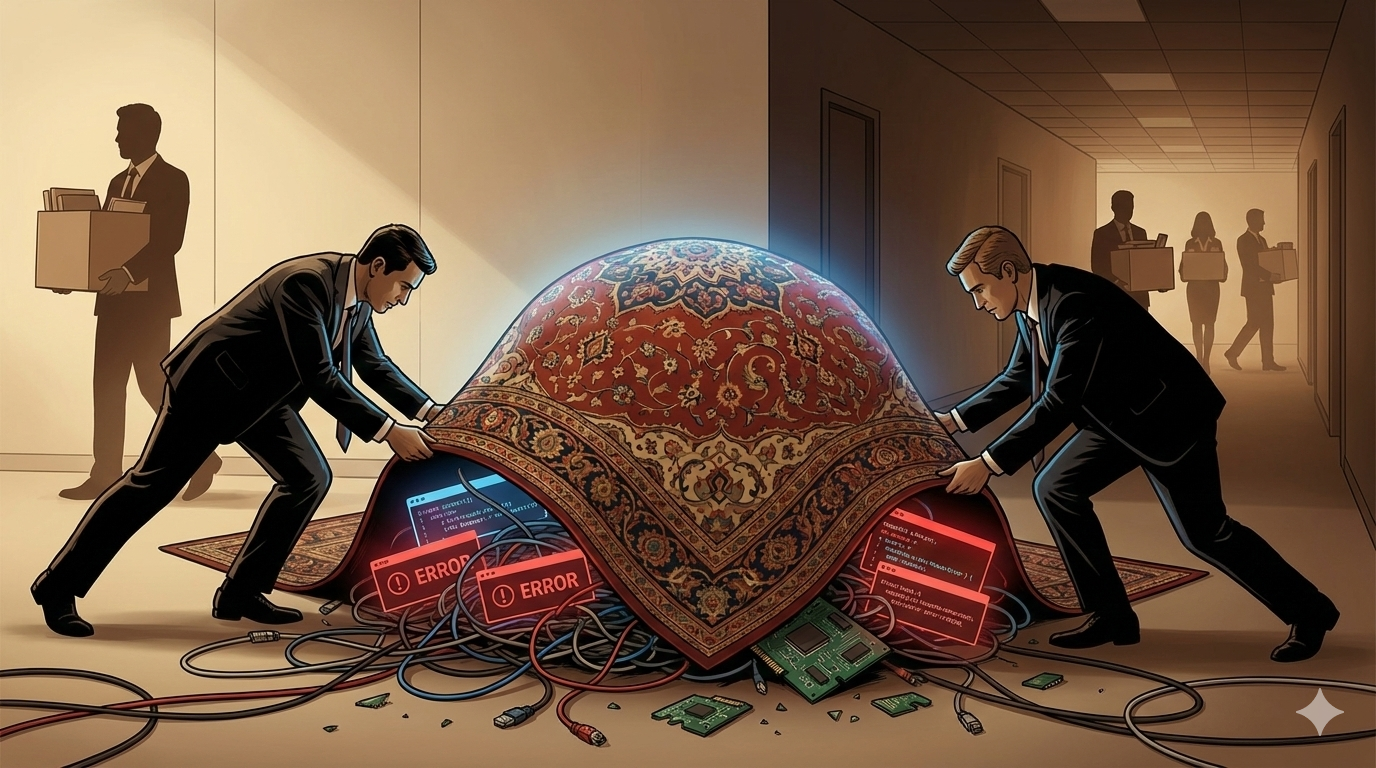
Hay una narrativa seductora circulando en cada conferencia tech, cada pitch de consultoría, cada presentación de Q4: “La IA va a reemplazar empleados y hacer tu organización más eficiente.”
Es una mentira. O al menos, una verdad tan incompleta que funciona como mentira.
La IA no reemplaza empleados. La IA reemplaza empleados con deuda técnica.
Y si no entiendes la diferencia, estás construyendo el sistema legacy de mañana mientras celebras la “transformación” de hoy.
La ilusión de la automatización sin fundamentos
Todos están desplegando agentes de IA para “automatizar workflows”. Es el nuevo imperativo: si no tienes IA en producción, estás quedándote atrás. El FOMO es palpable. Los presupuestos fluyen.
Pero aquí está lo que nadie menciona en esas presentaciones brillantes:
Si tus datos están en silos aislados…
Si tu información está mal documentada…
Si tus procesos son inconsistentes…
Si tu arquitectura es frágil…
Esos agentes de IA no reemplazan labor. Codifican el desorden directamente en tu sistema.
Y lo que obtienes no es eficiencia. Es caos a escala industrial.
El costo real de automatizar el desorden
Cuando implementas IA sobre fundamentos rotos, no estás eliminando complejidad. Estás multiplicándola exponencialmente.
Lo que terminas construyendo:
Decisiones en caja negra sin trazabilidad
Un empleado humano toma una decisión cuestionable, puedes preguntarle por qué. Hay contexto. Hay razonamiento (incluso si es malo). Hay accountability.
Un agente de IA toma una decisión cuestionable sobre datos inconsistentes, y tienes… ¿qué exactamente? Un modelo que optimizó función de costo sobre garbage data. Un output que nadie puede explicar. Un resultado que “el algoritmo dijo.”
¿Quién es responsable cuando la IA automatiza una decisión incorrecta basada en datos que nunca debieron estar en ese formato?
Workflows en las sombras, incomprensibles
Los procesos humanos, por desordenados que sean, son visibles. Puedes seguir el rastro. Puedes preguntar “¿por qué hacemos esto así?” y alguien responderá (aunque sea “porque siempre lo hemos hecho así”).
Los workflows automatizados sin documentación adecuada se convierten en shadow IT de nueva generación. Nadie sabe exactamente qué están haciendo. Nadie sabe qué dependencias tienen. Nadie sabe qué sucede si algo falla.
Solo sabes que “funciona”… hasta que deja de funcionar. Y entonces nadie sabe cómo arreglarlo.
Capas de complejidad sin ownership claro
Cada agente de IA que añades sin arquitectura clara es otra capa de complejidad que alguien tendrá que mantener. O intentar mantener. O fingir que mantiene hasta que explota.
¿Quién es dueño de ese proceso automatizado?
¿Data Engineering? ¿ML Ops? ¿El área de negocio que lo pidió?
¿IT? ¿Nadie?
La respuesta usual es: todos y nadie. Que es otra forma de decir: nadie.
Y cuando inevitablemente algo sale mal, comienzas el juego de “no es mi responsabilidad” mientras el sistema arde.
Deuda técnica con intereses compuestos
Aquí está la analogía financiera que todo CFO debería entender:
La deuda técnica funciona como deuda financiera. Pero con una diferencia crítica: los intereses son compuestos y crecen exponencialmente.
Cuando automatizas procesos rotos con IA:
Principal de la deuda: El desorden original en tus datos/procesos
Intereses: La complejidad añadida por la automatización sin fundamentos
Intereses compuestos: Cada nuevo sistema que depende del sistema roto anterior
Y así como la deuda financiera eventualmente te fuerza a bancarrota si ignoras los intereses, la deuda técnica eventualmente paraliza tu organización.
Llegas al punto donde:
- No puedes hacer cambios sin romper algo
- No puedes añadir features sin meses de refactoring
- No puedes escalar sin reescribir todo
- No puedes migrar sin dolor existencial
Tu “transformación digital” se convirtió en el sistema legacy de mañana.
Y lo peor: pagaste millones por construirlo.
El orden importa: fundamentos primero, IA después
Las empresas que realmente ganan con IA no son las que implementan más rápido. Son las que implementan en el orden correcto.
Paso 1: Capa de datos unificada
Antes de un solo agente de IA, necesitas:
- Datos integrados (no silos aislados)
- Metadatos comprehensivos (no datos huérfanos)
- Calidad de datos verificable (no garbage in, garbage out)
- Linaje de datos trazable (no misterios sobre procedencia)
- Governance implementado (no políticas en papel)
Esto no es sexy. No aparece en keynotes. No genera titulares.
Pero es la diferencia entre construir sobre roca vs. construir sobre arena.
Paso 2: Workflows auditables y documentados
Antes de automatizar, necesitas:
- Procesos mapeados y entendidos
- Dependencias identificadas
- Puntos de decisión documentados
- Ownership claro por componente
- Protocolos de falla definidos
Esto es trabajo duro. Es aburrido. No impresiona a nadie en demo day.
Pero es lo que hace la diferencia entre automatización sostenible y caos automatizado.
Paso 3: IA como acelerador, no como parche
Solo después de fundamentos sólidos, implementas IA para:
- Acelerar procesos bien entendidos
- Escalar decisiones bien definidas
- Optimizar workflows bien documentados
- Amplificar capacidades sobre bases sólidas
En este orden, la IA multiplica eficiencia.
En cualquier otro orden, la IA multiplica problemas.
La tentación de invertir el orden
Entiendo la tentación. Construir fundamentos es lento, caro, poco glamoroso. No genera headlines. No impresiona al board. No te pone en portadas de tech media.
Implementar IA es rápido, visible, emocionante. Puedes mostrar un demo en semanas. Puedes decir “somos una empresa AI-first.” Puedes competir en la carrera del hype.
Pero invertir el orden tiene consecuencias predecibles:
Año 1: “¡Mira qué eficientes somos con IA!”
Año 2: “¿Por qué estos sistemas son tan frágiles?”
Año 3: “¿Por qué nadie puede explicar cómo funciona esto?”
Año 4: “Necesitamos una migración urgente al nuevo stack”
Año 5: “¿Cómo terminamos con tanto legacy tan rápido?”
Y el ciclo se repite. Porque nunca arreglaste los fundamentos.
El verdadero costo: capital humano destruido
Pero el costo más brutal no es el dinero gastado en sistemas que hay que reescribir. No es el tiempo perdido en migraciones. No es ni siquiera la frustración de equipos trabajando con sistemas rotos.
El verdadero costo es humano.
La sangría del conocimiento institucional
Para llegar al punto donde tienes deuda técnica compuesta y sistemas inmanejables, algo tuvo que pasar primero. Y generalmente fue esto:
Despediste a las personas que tenían el know-how real de los procesos.
No la documentación oficial (que probablemente está desactualizada o incompleta). No los diagramas de flujo que nadie actualiza. No los manuales que nadie lee.
El conocimiento empírico, acumulado en años—décadas a veces—de hacer funcionar la operación día a día.
María, que llevaba 15 años en operaciones y sabía exactamente por qué ese paso aparentemente ilógico en el proceso era crítico para evitar problemas con clientes legacy.
Jorge, que conocía las particularidades de cada sistema porque los había visto evolucionar y sabía qué workarounds eran necesarios y por qué.
Ana, que podía identificar problemas antes de que explotaran porque había visto ese patrón 100 veces en sus 12 años en la empresa.
Los despediste porque “la IA puede hacer su trabajo.”
Y técnicamente, quizá podía hacer las tareas mecánicas. Pero no podía replicar años de contexto, de patrones reconocidos, de conocimiento tácito que nunca se documentó porque nadie pensó que sería necesario.
Ese conocimiento se fue. Para siempre.
No está en ningún sistema. No está en ninguna base de datos. No lo puedes recuperar con prompt engineering. Se fue con las personas que lo desarrollaron a lo largo de años de experiencia vivida en la organización.
Y ahora, cuando tus sistemas automatizados fallan de maneras inesperadas, no hay nadie que pueda decir “ah sí, esto pasa porque…” No hay nadie que recuerde el contexto histórico que explica por qué las cosas son como son.
Destruiste memoria institucional en nombre de la eficiencia.
El costo silencioso: los que se quedaron
Pero hay otro costo, quizá más insidioso.
Las personas que NO fueron despedidas, pero que vieron cómo despedían a sus colegas.
Que ahora viven con una pregunta constante resonando en sus cabezas:
"¿Seré yo el próximo en volverme obsoleto?"
Ese estrés no es abstracto. Tiene consecuencias medibles:
Fuga de talento preventiva: Los mejores se van antes de que los despidan. No esperan a ser “optimizados.” Buscan organizaciones que valoran capital humano, no que lo ve como costo a eliminar.
Conocimiento retenido, no compartido: Si documentar bien tu trabajo podría entrenar a tu reemplazo algorítmico, ¿por qué documentarías? El incentivo ahora es mantener tu conocimiento lo más opaco posible. Irónicamente, esto empeora exactamente el problema que querías resolver.
Parálisis por miedo: Nadie propone mejoras de proceso si eso podría demostrar que su trabajo es automatizable. La innovación desde abajo se congela.
Desconexión emocional: ¿Para qué dar lo mejor de ti a una organización que claramente te ve como placeholder temporal hasta que la tecnología pueda reemplazarte?
Esa erosión de moral, confianza y compromiso tiene costo real. Productividad reducida. Calidad degradada. Innovación sofocada. Institutional knowledge que se esconde en lugar de compartirse.
Y ese costo es invisible en el ROI proyectado de tu “transformación con IA.”
Deuda de capital humano: los intereses que nadie calcula
Así como la deuda técnica cobra intereses compuestos, la deuda de capital humano también.
Año 1: Despides a empleados “costosos” con experiencia. Ahorras en nómina. El CFO está feliz.
Año 2: Los sistemas empiezan a fallar de maneras que nadie anticipó. No hay quien explique por qué. Contratas consultores externos (más caros que los empleados que despediste) para “entender el sistema.”
Año 3: La fuga de talento se acelera. Los buenos se van. Los que quedan son los que no tienen opciones. El nivel general de competencia declina.
Año 4: Tienes que re-contratar para roles críticos. Pero ahora pagas más, porque el talento sabe que tu organización no es estable. Y los nuevos tardan meses en llegar a productividad porque no hay quien los entrene—despediste a los mentores.
Año 5: Descubres que perdiste capacidad organizacional fundamental. Hay cosas que tu empresa solía poder hacer que ya no puede. El conocimiento de cómo hacerlas se fue con las personas.
Los intereses de esta deuda son devastadores. Y a diferencia de la deuda técnica, no puedes “refactorizar” conocimiento humano perdido.
El espíritu detrás de la estrategia
Y aquí llegamos al núcleo del problema, a la pregunta ética que nadie quiere hacer en salas de juntas:
¿Esta estrategia busca empoderar al humano o desplazarlo?
Porque hay dos formas radicalmente diferentes de implementar IA:
Camino A: IA como amplificador humano
- Los empleados usan IA para hacer su trabajo mejor/más rápido
- Se invierte en capacitar a la fuerza laboral existente
- El conocimiento institucional se preserva y potencia
- Las personas se vuelven más valiosas, no obsoletas
- La tecnología sirve a los humanos
Camino B: IA como reemplazo de humanos
- La IA busca hacer el trabajo EN LUGAR de empleados
- Se despide personal “optimizado”
- El conocimiento institucional se pierde
- Las personas se vuelven descartables
- Los humanos sirven a la tecnología (hasta que ya no)
El Camino A cuesta más al inicio. Requiere inversión en entrenamiento, cambio cultural, diseño cuidadoso.
El Camino B es más barato en papel. Y genera mejores números en la presentación de Q2.
Pero el Camino B es capitalismo sin una traza de humanismo. Es optimización de hoja de cálculo que trata a humanos como números intercambiables. Es la creencia de que el valor de una persona está únicamente en las tareas mecánicas que realiza, no en el conocimiento, experiencia, juicio y contexto que aporta.
Y ese, también, es el costo de las implementaciones tecnológicas mal hechas:
Humanos que quedan desempleados no porque su trabajo dejó de ser necesario, sino porque alguien decidió que un sistema automatizado sobre fundamentos rotos era más barato que pagar salarios dignos.
Familias afectadas. Carreras truncadas. Conocimiento destruido.
Todo en nombre de una “eficiencia” que, irónicamente, terminará siendo más cara cuando el sistema colapse y tengas que empezar de nuevo.
La oportunidad perdida (que también es humana)
Mientras tu organización está:
- Lidiando con deuda técnica compuesta
- Contratando consultores para entender sistemas que tus ex-empleados conocían
- Luchando con fuga de talento por miedo existencial
- Perdiendo capacidad organizacional por conocimiento destruido
Tus competidores con fundamentos sólidos Y estrategias centradas en humanos están:
- Implementando features en días porque su equipo tiene contexto y autonomía
- Escalando sin fricción porque preservaron conocimiento institucional
- Adaptándose rápidamente porque sus empleados están comprometidos, no aterrorizados
- Usando IA para empoderar humanos, no para reemplazarlos
Estás pagando intereses técnicos Y humanos mientras ellos están generando valor sostenible.
Y cada año que pasa, la brecha se amplía. Porque no solo perdiste capacidad técnica. Perdiste capacidad humana. Y esa es infinitamente más difícil de reconstruir.
La pregunta incómoda que nadie hace en juntas
Cuando alguien propone “implementar agentes de IA para automatizar X proceso,” la conversación usual es:
“¿Cuánto costará?”
“¿Cuánto tiempo tomará?”
“¿Cuál es el ROI proyectado?”
Las preguntas que DEBERÍAN hacerse:
“¿Nuestros datos están en condiciones de sustentar esto?”
“¿Entendemos bien el proceso que queremos automatizar?”
“¿Tenemos los fundamentos para que esto sea sostenible?”
“¿O estamos codificando nuestro desorden en el sistema?”
Pero esas preguntas son incómodas. Implican admitir que quizá no estamos listos. Implican que el problema real no es falta de IA, sino falta de fundamentos.
Y es mucho más fácil comprar soluciones de IA que arreglar fundamentos rotos.
Señales de que estás construyendo deuda técnica, no eficiencia
¿Cómo saber si tu “transformación con IA” es sostenible o es deuda técnica disfrazada?
Señales de alarma:
🚩 Nadie puede explicar cómo funciona el sistema completo
🚩 Cada cambio rompe algo inesperado en otro lugar
🚩 Los equipos pasan más tiempo “apagando incendios” que construyendo
🚩 Hay datos críticos que nadie sabe de dónde vienen
🚩 Las “soluciones rápidas” se volvieron permanentes
🚩 Tienes múltiples “fuentes de verdad” para la misma información
🚩 Los nuevos empleados tardan meses en entender el sistema
🚩 Cada automatización genera 3 casos edge que nadie anticipó
🚩 El ownership de procesos críticos está difuso o ausente
🚩 La documentación está desactualizada o no existe
Si 3 o más aplican, no tienes una transformación de IA. Tienes deuda técnica acumulándose con intereses.
El camino menos sexy pero sostenible
No voy a mentir: hacer las cosas en el orden correcto es menos emocionante que saltar directo a IA.
Significa:
- Meses (a veces años) de trabajo en infraestructura que nadie verá
- Inversión en governance de datos que no genera headlines
- Documentación meticulosa que nadie aplaude
- Refactoring de procesos que no impresiona en demos
- Disciplina arquitectónica que parece lenta comparada con competidores
Pero significa también:
- Sistemas que escalan sin colapsar
- Automatización que genera valor real, no caos
- IA que amplifica capacidades en lugar de codificar problemas
- Arquitectura que sobrevive más de 3 años sin reescritura total
- Organización que puede adaptarse rápidamente sin parálisis técnica
La tortuga gana la carrera. Pero solo si empieza construyendo patas fuertes, no ruedas sobre barro.
Una advertencia final
Si estás leyendo esto y pensando “sí, pero nosotros somos diferentes, nosotros podemos tomar el atajo”…
No, no puedes.
Miles de organizaciones antes que tú pensaron lo mismo. Todas están ahora lidiando con las consecuencias. Pregúntale a cualquier CTO con 10+ años de experiencia sobre proyectos de “transformación rápida” que tuvieron que rehacer 3 años después.
La gravedad técnica es tan real como la física. No puedes negociar con ella.
Puedes ignorarla temporalmente. Pero eventualmente cobra su deuda. Con intereses compuestos.
Para reflexión:
¿Tu organización está implementando IA sobre fundamentos sólidos?
¿O está automatizando el caos y llamándolo transformación?
¿Tus datos están en condiciones de sustentar las decisiones que quieres automatizar?
¿O estás construyendo el sistema legacy de mañana hoy?
Las respuestas honestas a estas preguntas determinan si tu inversión en IA genera valor… o solo genera deuda técnica con intereses.
There’s a seductive narrative circulating at every tech conference, every consulting pitch, every Q4 presentation: “AI is going to replace employees and make your organization more efficient.”
It’s a lie. Or at least, a truth so incomplete that it functions as a lie.
AI doesn’t replace employees. AI replaces employees with technical debt.
And if you don’t understand the difference, you’re building tomorrow’s legacy system while celebrating today’s “transformation.”
The illusion of automation without foundations
Everyone is deploying AI agents to “automate workflows.” It’s the new imperative: if you don’t have AI in production, you’re falling behind. The FOMO is palpable. Budgets are flowing.
But here’s what nobody mentions in those shiny presentations:
If your data is in isolated silos…
If your information is poorly documented…
If your processes are inconsistent…
If your architecture is fragile…
Those AI agents don’t replace labor. They encode disorder directly into your system.
And what you get isn’t efficiency. It’s chaos at industrial scale.
The real cost of automating disorder
When you implement AI on broken foundations, you’re not eliminating complexity. You’re multiplying it exponentially.
What you end up building:
Black box decisions without traceability
A human employee makes a questionable decision, you can ask them why. There’s context. There’s reasoning (even if it’s bad). There’s accountability.
An AI agent makes a questionable decision based on inconsistent data, and you have… what exactly? A model that optimized a cost function over garbage data. An output that nobody can explain. A result that “the algorithm said.”
Who is responsible when AI automates an incorrect decision based on data that should never have been in that format?
Shadow workflows, incomprehensible
Human processes, however messy, are visible. You can follow the trail. You can ask “why do we do it this way?” and someone will answer (even if it’s “because we’ve always done it this way”).
Automated workflows without proper documentation become next-generation shadow IT. Nobody knows exactly what they’re doing. Nobody knows what dependencies they have. Nobody knows what happens if something fails.
You only know it “works”… until it stops working. And then nobody knows how to fix it.
Layers of complexity without clear ownership
Every AI agent you add without clear architecture is another layer of complexity that someone will have to maintain. Or try to maintain. Or pretend to maintain until it explodes.
Who owns that automated process?
Data Engineering? ML Ops? The business area that requested it?
IT? Nobody?
The usual answer is: everyone and nobody. Which is another way of saying: nobody.
And when inevitably something goes wrong, you start the game of “not my responsibility” while the system burns.
Technical debt with compound interest
Here’s the financial analogy every CFO should understand:
Technical debt works like financial debt. But with one critical difference: the interest is compound and grows exponentially.
When you automate broken processes with AI:
Debt principal: The original disorder in your data/processes
Interest: The complexity added by automation without foundations
Compound interest: Every new system that depends on the previous broken system
And just as financial debt eventually forces you into bankruptcy if you ignore the interest, technical debt eventually paralyzes your organization.
You reach the point where:
- You can’t make changes without breaking something
- You can’t add features without months of refactoring
- You can’t scale without rewriting everything
- You can’t migrate without existential pain
Your “digital transformation” became tomorrow’s legacy system.
And the worst part: you paid millions to build it.
Order matters: foundations first, AI later
Companies that really win with AI aren’t the ones that implement fastest. They’re the ones that implement in the right order.
Step 1: Unified data layer
Before a single AI agent, you need:
- Integrated data (not isolated silos)
- Comprehensive metadata (not orphaned data)
- Verifiable data quality (not garbage in, garbage out)
- Traceable data lineage (not mysteries about provenance)
- Implemented governance (not policies on paper)
This isn’t sexy. It doesn’t appear in keynotes. It doesn’t generate headlines.
But it’s the difference between building on rock vs. building on sand.
Step 2: Auditable and documented workflows
Before automating, you need:
- Mapped and understood processes
- Identified dependencies
- Documented decision points
- Clear ownership by component
- Defined failure protocols
This is hard work. It’s boring. It doesn’t impress anyone on demo day.
But it’s what makes the difference between sustainable automation and automated chaos.
Step 3: AI as accelerator, not as patch
Only after solid foundations do you implement AI to:
- Accelerate well-understood processes
- Scale well-defined decisions
- Optimize well-documented workflows
- Amplify capabilities on solid bases
In this order, AI multiplies efficiency.
In any other order, AI multiplies problems.
The temptation to invert the order
I understand the temptation. Building foundations is slow, expensive, unglamorous. It doesn’t generate headlines. It doesn’t impress the board. It doesn’t put you on tech media covers.
Implementing AI is fast, visible, exciting. You can show a demo in weeks. You can say “we’re an AI-first company.” You can compete in the hype race.
But inverting the order has predictable consequences:
Year 1: “Look how efficient we are with AI!”
Year 2: “Why are these systems so fragile?”
Year 3: “Why can nobody explain how this works?”
Year 4: “We need an urgent migration to the new stack”
Year 5: “How did we end up with so much legacy so fast?”
And the cycle repeats. Because you never fixed the foundations.
The true cost: destroyed human capital
But the most brutal cost isn’t the money spent on systems that need rewriting. It’s not the time lost in migrations. It’s not even the frustration of teams working with broken systems.
The true cost is human.
The bleeding of institutional knowledge
To reach the point where you have compound technical debt and unmanageable systems, something had to happen first. And generally it was this:
You fired the people who had the real know-how of the processes.
Not the official documentation (which is probably outdated or incomplete). Not the flowcharts that nobody updates. Not the manuals that nobody reads.
The empirical knowledge, accumulated over years—decades sometimes—of making the operation work day by day.
María, who had 15 years in operations and knew exactly why that seemingly illogical step in the process was critical to avoid problems with legacy customers.
Jorge, who knew the particularities of each system because he’d seen them evolve and knew what workarounds were necessary and why.
Ana, who could identify problems before they exploded because she’d seen that pattern 100 times in her 12 years at the company.
You fired them because “AI can do their job.”
And technically, maybe it could do the mechanical tasks. But it couldn’t replicate years of context, of recognized patterns, of tacit knowledge that was never documented because nobody thought it would be necessary.
That knowledge is gone. Forever.
It’s not in any system. It’s not in any database. You can’t recover it with prompt engineering. It left with the people who developed it over years of lived experience in the organization.
And now, when your automated systems fail in unexpected ways, there’s nobody who can say “oh yes, this happens because…” There’s nobody who remembers the historical context that explains why things are the way they are.
You destroyed institutional memory in the name of efficiency.
The silent cost: those who stayed
But there’s another cost, perhaps more insidious.
The people who were NOT fired, but who watched as their colleagues were let go.
Who now live with a constant question resonating in their heads:
“Will I be next to become obsolete?”
That stress isn’t abstract. It has measurable consequences:
Preventive talent flight: The best leave before they’re fired. They don’t wait to be “optimized.” They seek organizations that value human capital, not ones that see it as a cost to eliminate.
Knowledge retained, not shared: If documenting your work well could train your algorithmic replacement, why would you document? The incentive now is to keep your knowledge as opaque as possible. Ironically, this worsens exactly the problem you wanted to solve.
Paralysis by fear: Nobody proposes process improvements if that might demonstrate their work is automatable. Innovation from below freezes.
Emotional disconnection: Why give your best to an organization that clearly sees you as a temporary placeholder until technology can replace you?
That erosion of morale, trust, and commitment has real cost. Reduced productivity. Degraded quality. Stifled innovation. Institutional knowledge that hides instead of being shared.
And that cost is invisible in the projected ROI of your “AI transformation.”
Human capital debt: the interest nobody calculates
Just as technical debt charges compound interest, human capital debt does too.
Year 1: You fire “expensive” experienced employees. You save on payroll. The CFO is happy.
Year 2: Systems start failing in ways nobody anticipated. There’s nobody to explain why. You hire external consultants (more expensive than the employees you fired) to “understand the system.”
Year 3: Talent flight accelerates. The good ones leave. Those who stay are those with no options. The general level of competence declines.
Year 4: You have to rehire for critical roles. But now you pay more, because talent knows your organization isn’t stable. And new hires take months to reach productivity because there’s nobody to train them—you fired the mentors.
Year 5: You discover you’ve lost fundamental organizational capacity. There are things your company used to be able to do that it can no longer do. The knowledge of how to do them left with the people.
The interest on this debt is devastating. And unlike technical debt, you can’t “refactor” lost human knowledge.
The spirit behind the strategy
And here we reach the core of the problem, the ethical question nobody wants to ask in boardrooms:
Does this strategy seek to empower humans or displace them?
Because there are two radically different ways to implement AI:
Path A: AI as human amplifier
- Employees use AI to do their work better/faster
- Investment in training existing workforce
- Institutional knowledge is preserved and enhanced
- People become more valuable, not obsolete
- Technology serves humans
Path B: AI as human replacement
- AI seeks to do work INSTEAD of employees
- “Optimized” personnel are fired
- Institutional knowledge is lost
- People become disposable
- Humans serve technology (until they no longer do)
Path A costs more initially. Requires investment in training, cultural change, careful design.
Path B is cheaper on paper. And generates better numbers in the Q2 presentation.
But Path B is capitalism without a trace of humanism. It’s spreadsheet optimization that treats humans as interchangeable numbers. It’s the belief that a person’s value is solely in the mechanical tasks they perform, not in the knowledge, experience, judgment, and context they contribute.
And that, too, is the cost of poorly executed technology implementations:
Humans who end up unemployed not because their work ceased to be necessary, but because someone decided that an automated system on broken foundations was cheaper than paying decent salaries.
Affected families. Truncated careers. Destroyed knowledge.
All in the name of an “efficiency” that, ironically, will end up being more expensive when the system collapses and you have to start over.
The lost opportunity (which is also human)
While your organization is:
- Dealing with compound technical debt
- Hiring consultants to understand systems your ex-employees knew
- Struggling with talent flight due to existential fear
- Losing organizational capacity through destroyed knowledge
Your competitors with solid foundations AND human-centered strategies are:
- Implementing features in days because their team has context and autonomy
- Scaling without friction because they preserved institutional knowledge
- Adapting quickly because their employees are committed, not terrified
- Using AI to empower humans, not replace them
You’re paying technical AND human interest while they’re generating sustainable value.
And each year that passes, the gap widens. Because you didn’t just lose technical capacity. You lost human capacity. And that’s infinitely harder to rebuild.
The uncomfortable question nobody asks in meetings
When someone proposes “implementing AI agents to automate X process,” the usual conversation is:
“How much will it cost?”
“How long will it take?”
“What’s the projected ROI?”
The questions that SHOULD be asked:
“Is our data in condition to sustain this?”
“Do we understand well the process we want to automate?”
“Do we have the foundations for this to be sustainable?”
“Or are we encoding our disorder into the system?”
But those questions are uncomfortable. They imply admitting we might not be ready. They imply that the real problem isn’t lack of AI, but lack of foundations.
And it’s much easier to buy AI solutions than to fix broken foundations.
Signs you’re building technical debt, not efficiency
How do you know if your “AI transformation” is sustainable or is disguised technical debt?
Warning signs:
🚩 Nobody can explain how the complete system works
🚩 Every change breaks something unexpected elsewhere
🚩 Teams spend more time “putting out fires” than building
🚩 There’s critical data that nobody knows where it comes from
🚩 “Quick fixes” became permanent
🚩 You have multiple “sources of truth” for the same information
🚩 New employees take months to understand the system
🚩 Each automation generates 3 edge cases nobody anticipated
🚩 Ownership of critical processes is diffuse or absent
🚩 Documentation is outdated or doesn’t exist
If 3 or more apply, you don’t have an AI transformation. You have technical debt accumulating with interest.
The less sexy but sustainable path
I won’t lie: doing things in the right order is less exciting than jumping straight to AI.
It means:
- Months (sometimes years) of infrastructure work nobody will see
- Investment in data governance that doesn’t generate headlines
- Meticulous documentation that nobody applauds
- Process refactoring that doesn’t impress in demos
- Architectural discipline that seems slow compared to competitors
But it also means:
- Systems that scale without collapsing
- Automation that generates real value, not chaos
- AI that amplifies capabilities instead of encoding problems
- Architecture that survives more than 3 years without total rewrite
- Organization that can adapt quickly without technical paralysis
The tortoise wins the race. But only if it starts building strong legs, not wheels on mud.
A final warning
If you’re reading this thinking “yes, but we’re different, we can take the shortcut”…
No, you can’t.
Thousands of organizations before you thought the same. They’re all now dealing with the consequences. Ask any CTO with 10+ years of experience about “rapid transformation” projects they had to redo 3 years later.
Technical gravity is as real as physics. You can’t negotiate with it.
You can ignore it temporarily. But eventually it collects its debt. With compound interest.
For reflection:
Is your organization implementing AI on solid foundations?
Or is it automating chaos and calling it transformation?
Is your data in condition to sustain the decisions you want to automate?
Or are you building tomorrow’s legacy system today?
Honest answers to these questions determine whether your AI investment generates value… or just generates technical debt with interest.