Recuerdo una reunión en una de las grandes corporaciones donde trabajé. El equipo de datos acababa de terminar un modelo de optimización de rutas que, técnicamente, era brillante. Reducía costos de distribución entre 18 y 22%. Todos celebraban.
Nadie habló de los conductores.
No porque no importaran. Sino porque, en el marco de análisis, simplemente no aparecían. El modelo optimizaba una función objetivo. Los humanos eran una variable más, junto con el diesel y el tiempo de carga. Esa reunión me enseñó algo que tardé años en articular: los sistemas de IA no son neutrales. Reflejan, con una precisión matemática impecable, los valores de quienes los diseñan y para qué los diseñan.
Y cuando esos valores son los del capitalismo corporativo, el resultado es predecible.
¿Qué es más socialista que un sistema entrenado con el conocimiento colectivo de millones de personas, capaz de democratizar acceso a información y automatizar trabajo alienante?
¿Y qué es más capitalista que ese mismo sistema privatizado por tres corporaciones, usado para precarizar empleos y extraer valor sin compensar a quienes generaron ese conocimiento?
Esta contradicción no es un bug del desarrollo de IA. Es su feature más importante.
La promesa que nunca llegó
La inteligencia artificial debería ser la tecnología más igualitaria de la historia. Educación personalizada sin importar código postal. Diagnósticos médicos de nivel mundial en comunidades remotas. Automatización del trabajo repetitivo que libere tiempo para lo creativo y lo significativo. Acceso universal al conocimiento sin barreras económicas.
Suena casi a “de cada cual según su capacidad, a cada cual según su necesidad.”
Pero en 2025, algo salió terriblemente mal — o quizá exactamente como estaba diseñado para salir.
La IA está automatizando ilustradores, programadores junior y escritores: trabajos que la gente eligió porque los disfruta. Mientras tanto, el trabajo verdaderamente alienante permanece intocado.
Limpiar baños: “Demasiado complejo para robots.” Cuidado de ancianos: “Requiere toque humano.” Logística de almacén: “Los humanos son más flexibles.”
Qué conveniente que lo “demasiado complejo para automatizar” sea exactamente el trabajo que nadie quiere hacer.
Los datos son contundentes: una encuesta de la Society of Authors del Reino Unido (2024) encontró que el 26% de los ilustradores ya había perdido trabajo directamente por IA generativa, y el 37% reportó reducción de ingresos. Un reporte de CVL Economics (enero 2024) identificó 203,800 empleos del sector entretenimiento en Estados Unidos afectados por la automatización, cifra que excluye a freelancers y trabajadores en la economía gig. Los guionistas de Hollywood vieron sus ingresos caer 6% en los primeros tres trimestres de 2024, con un 15% menos de guionistas activos comparado con 2022.
La IA no nos liberó del trabajo alienante. Precarizó el trabajo creativo.
La apropiación del procomún digital: los nuevos enclosures
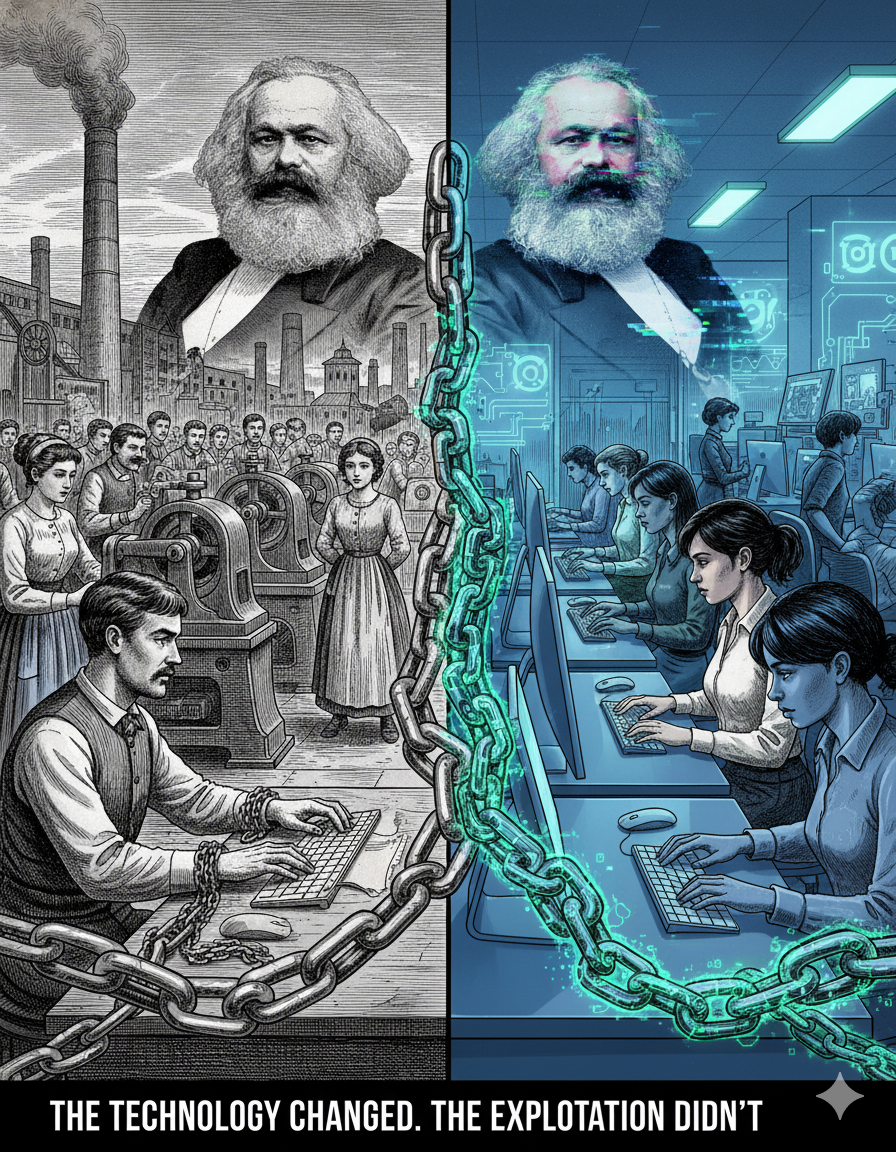
Karl Marx identificaría el problema en segundos.
Los Large Language Models son medios de producción intelectual entrenados con trabajo colectivo no compensado: código en GitHub que alguien escribió a las 2 AM depurando un bug imposible, blogs donde documentamos soluciones que ayudaron a miles, conversaciones públicas en Stack Overflow y Reddit, papers académicos financiados con fondos públicos, Wikipedia construida por voluntarios durante dos décadas.
El procomún digital. El conocimiento colectivo de la humanidad.
Y fue cercado. Privatizado. Apropiado por quienes tienen el capital para entrenar modelos a escala industrial.
GitHub hoy aloja 630 millones de repositorios (Octoverse 2025). OpenAI — que se llama “Open” pero es tan cerrada como un banco suizo — fue entrenado sobre ese acervo colectivo. Google entrena Gemini con YouTube que nosotros subimos. Meta scrapeó Instagram y Facebook sin permiso ni compensación.
Tomaron el procomún digital y lo encerraron. Es el equivalente tecnológico de las Enclosures británicas del siglo XVIII.
Aquellas cercaron tierras comunes y forzaron campesinos a trabajar en fábricas. Estas cercan conocimiento común y nos fuerzan a pagar suscripción para acceder a nuestro propio trabajo colectivo.
ChatGPT Plus: $20/mes para acceder a conocimiento que tú ayudaste a crear. Copilot: $10/mes para que tu código entrene el sistema contra el que después “compites.” Midjourney: $30/mes para generar arte basado en imágenes que artistas subieron libremente.
Esto no es innovación. Es extractivismo cognitivo.
La jugada maestra: socializar costos, privatizar ganancias
El capitalismo tecnológico tiene una jugada en dos fases que merece ser nombrada explícitamente.
Fase 1 — Socializar la creación del valor: “¡Compartan su código! ¡Contribuyan al open source! ¡Construyamos juntos el futuro!” Nos convencieron de que éramos una comunidad construyendo algo más grande que nosotros mismos.
Y lo hicimos. Voluntariamente. Gratuitamente. Con pasión. GitHub acumula 630 millones de repositorios. Wikipedia supera los 62 millones de artículos en todos sus idiomas. Stack Overflow tiene más de 23 millones de preguntas respondidas. Millones de horas de contenido educativo subidas gratuitamente a YouTube.
El trabajo colectivo no remunerado de millones creó el dataset más valioso de la historia humana.
Fase 2 — Privatizar la extracción del valor: Entonces llegaron las corporaciones con GPU clusters valorados en cientos de millones de dólares. Scrapearon todo. Entrenaron modelos. Patentaron arquitecturas. Cerraron el código. Establecieron barreras de entrada prácticamente infranqueables.
Entrenar un modelo frontier hoy cuesta entre $78 millones (GPT-4) y $191 millones (Gemini Ultra) solo en cómputo, según el Stanford AI Index 2025 y Epoch AI. Los costos han crecido a una tasa de 2.4x por año desde 2016 y se proyecta que alcancen más de $1,000 millones por entrenamiento en 2027.
¿El resultado? OpenAI pasó de una valuación de $80,000 millones en febrero de 2024 a $852,000 millones en abril de 2026 — la empresa privada más valiosa del mundo. Nvidia, que tiene un near-monopolio en los GPUs necesarios para entrenar estos modelos, vale hoy $4.8 trillones de dólares (mayo 2026).
¿Tu compensación por el conocimiento que aportaste? Cero. Ni un centavo. Pero sí puedes pagar $20/mes para usarlo. Qué generosos.
Esta es la esencia del capitalismo digital: socializar la inversión, privatizar las ganancias.
¿A quién sirve esta tecnología?
Aquí está el punto que la industria tech desesperadamente no quiere que entiendas: la IA no es inherentemente capitalista ni socialista. Es una herramienta. El problema es que bajo el capitalismo, toda herramienta poderosa eventualmente se convierte en instrumento de extracción y concentración de poder.
El debate público sobre IA está cuidadosamente enmarcado: “¿La IA es buena o mala?” “¿Nos reemplazará?” “¿Es segura?” Estas son las preguntas equivocadas — diseñadas para no llegar al núcleo del problema.
Las preguntas reales son:
¿La IA reduce desigualdades o las amplifica? Las amplifica. Los que tienen capital invierten en automatización. Los que no, son automatizados.
¿Concentra o distribuye poder de decisión? Tres empresas controlan los modelos más poderosos. Una empresa (Nvidia) controla la manufactura de los chips necesarios para entrenarlos. Eso no es distribución. Es oligopolio.
¿Democratiza o monopoliza el conocimiento? El conocimiento que era libre — Stack Overflow, GitHub, Wikipedia — ahora está encerrado en modelos propietarios a los que pagas por acceder.
Y hay una razón precisa por la que los LLMs más poderosos son propietarios, por la que los papers tienen secciones censuradas marcadas “secreto comercial,” por la que las arquitecturas están patentadas: no es porque sea técnicamente necesario. Es para asegurar que solo unos pocos controlen la infraestructura del futuro intelectual.
Para el contexto latinoamericano, esto tiene una dimensión adicional. Somos exportadores netos de datos — nuestro contenido, nuestras conversaciones, nuestros patrones de comportamiento alimentan modelos cuyos beneficios son capturados en Silicon Valley. Es una forma nueva de la misma lógica extractiva que conocemos desde el siglo XVI: nuestros recursos para su acumulación.
Vivimos una contradicción que define nuestra época: tenemos la tecnología para automatizar el trabajo repetitivo y alienante, pero automatizamos el creativo porque es más rentable. Tenemos la capacidad de democratizar el conocimiento, pero lo encerramos detrás de paywalls porque el acceso universal no genera ROI.
La IA es socialista en su esencia — construida colectivamente, debería servir colectivamente. Fue secuestrada por lógica capitalista que la convierte en herramienta de concentración de poder y precarización laboral.
Si mañana tu empresa anuncia “implementaremos IA para mejorar eficiencia,” haz una sola pregunta: ¿eficiencia para quién? ¿Para los trabajadores que podrán dedicar tiempo a tareas más significativas? ¿O para los shareholders que verán márgenes mejorados después de reducir headcount?
Esa pregunta es más importante que cualquier prompt engineering.
Porque determina si estamos construyendo tecnología para emancipación humana — o para extracción más eficiente.
¿Tú qué opinas?
REFERENCIAS Y FUENTES
- UK Society of Authors. “The impact of AI on authors’ earnings.” Society of Authors, 2024. URL: https://www.societyofauthors.org/
- CVL Economics. “The Economic Impacts of AI on the Entertainment Industry.” CVL Economics, enero 2024. (Citado en The Atlantic y medios especializados de industria.)
- GitHub. “Thank you for 100 million repositories.” GitHub Blog, 2021-11-09. URL: https://github.blog/news-insights/company-news/100m-repos/
- GitHub. “Octoverse 2025: A new developer joins GitHub every second.” GitHub Blog, 2025-11-04. URL: https://github.blog/news-insights/octoverse/
- Cottier, B., Rahman, R., et al. “The rising costs of training frontier AI models.” Epoch AI / arXiv, 2024-05-31. URL: https://arxiv.org/abs/2405.21015
- Stanford Institute for Human-Centered AI. “AI Index Report 2025.” Stanford HAI, 2025. URL: https://aiindex.stanford.edu/
- TechCrunch. “OpenAI is reportedly trying to raise $100B at an $830B valuation.” TechCrunch, 2025-12-19. URL: https://techcrunch.com/2025/12/19/openai-is-reportedly-trying-to-raise-100b-at-an-830b-valuation/
- MindStudio. “OpenAI’s $122 billion fundraise at an $852B valuation.” MindStudio Blog, abril 2026. URL: https://www.mindstudio.ai/blog/openai-122-billion-fundraise-what-it-means-ai-builders
- CompaniesMarketCap. “NVIDIA Market Capitalization.” Consultado mayo 2026. URL: https://companiesmarketcap.com/nvidia/marketcap/
- Graphite / Visual Capitalist. “AI-generated vs. human-written web content 2020-2025.” Visual Capitalist, octubre 2025. URL: https://www.visualcapitalist.com/cp/openai-500b-valuation/
- Brookings Institution. “Screenwriter earnings and employment trends 2024.” Brookings, 2024. (Referenciado en análisis de industria y medios especializados.)
I remember a meeting at one of the large corporations where I worked. The data team had just finished a route optimization model that was, technically, brilliant. It reduced distribution costs by 18 to 22%. Everyone celebrated.
Nobody mentioned the drivers.
Not because they didn’t matter. But because within the analytical framework, they simply didn’t appear. The model optimized an objective function. Humans were one more variable — alongside diesel and loading time. That meeting taught me something I spent years learning to articulate: AI systems are not neutral. They reflect, with impeccable mathematical precision, the values of those who design them and the purposes they’re designed to serve.
And when those values belong to corporate capitalism, the result is predictable.
What is more socialist than a system trained on the collective knowledge of millions of people, capable of democratizing access to information and automating alienating work?
And what is more capitalist than that same system privatized by three corporations, used to make jobs precarious, and extracting value without compensating those who generated that knowledge?
This contradiction is not a bug in AI development. It is its most important feature.
The promise that never arrived
Artificial intelligence should be the most egalitarian technology in history. Personalized education regardless of zip code. World-class medical diagnostics in remote communities. Automation of repetitive, alienating work that frees time for creative and meaningful activity. Universal access to knowledge without economic barriers.
It sounds almost like “from each according to their ability, to each according to their needs.”
But in 2025, something went terribly wrong — or perhaps exactly as it was designed to go.
AI is automating illustrators, junior programmers, and writers: jobs people chose because they enjoy them. Meanwhile, truly alienating work remains untouched.
Cleaning bathrooms: “Too complex for robots.” Elderly care: “Requires human touch.” Warehouse logistics: “Humans are more flexible.”
How convenient that what is “too complex to automate” is precisely the work nobody wants to do.
The data is striking: a 2024 survey by the UK Society of Authors found that 26% of illustrators had already lost work directly due to generative AI, and 37% reported reduced income. A January 2024 CVL Economics report identified 203,800 entertainment industry jobs in the United States affected by automation — a figure that excludes freelancers and gig workers. Hollywood screenwriters saw their earnings fall 6% in the first three quarters of 2024, with 15% fewer active screenwriters compared to 2022.
AI did not free us from alienating work. It made creative work precarious.
The appropriation of the digital commons: the new enclosures
Karl Marx would identify the problem in seconds.
Large Language Models are means of intellectual production trained on uncompensated collective labor: code on GitHub written at 2 AM debugging an impossible bug, blogs where we documented solutions that helped thousands, public conversations on Stack Overflow and Reddit, academic papers funded with public money, Wikipedia built by volunteers over two decades.
The digital commons. Humanity’s collective knowledge.
And it was fenced off. Privatized. Appropriated by those with the capital to train models at industrial scale.
GitHub today hosts 630 million repositories (Octoverse 2025). OpenAI — which calls itself “Open” but is as closed as a Swiss bank — was trained on that collective repository. Google trains Gemini on YouTube videos that we uploaded. Meta scraped Instagram and Facebook without permission or compensation.
They took the digital commons and enclosed it. It is the technological equivalent of the British Enclosures of the 18th century.
Those enclosures fenced off common lands and forced peasants into factories. These enclose common knowledge and force us to pay a subscription to access our own collective work.
ChatGPT Plus: $20/month to access knowledge you helped create. Copilot: $10/month so your code trains the system you then “compete” against. Midjourney: $30/month to generate art based on images that artists uploaded freely.
This is not innovation. It is cognitive extractivism.
The master play: socialize costs, privatize profits
Tech capitalism has a two-phase move that deserves to be named explicitly.
Phase 1 — Socialize value creation: “Share your code! Contribute to open source! Upload content! Let’s build the future together!” They convinced us we were a community building something larger than ourselves.
And we did it. Voluntarily. For free. With passion. GitHub accumulates 630 million repositories. Wikipedia surpasses 62 million articles across all its languages. Stack Overflow has more than 23 million answered questions. Millions of hours of educational content uploaded freely to YouTube.
The uncompensated collective labor of millions created the most valuable dataset in human history.
Phase 2 — Privatize value extraction: Then came the corporations with GPU clusters worth hundreds of millions of dollars. They scraped everything. Trained models. Patented architectures. Closed the code. Established practically insurmountable barriers to entry.
Training a frontier model today costs between $78 million (GPT-4) and $191 million (Gemini Ultra) in compute alone, according to the Stanford AI Index 2025 and Epoch AI. Costs have grown at a rate of 2.4x per year since 2016 and are projected to exceed $1 billion per training run by 2027.
The result? OpenAI went from an $80 billion valuation in February 2024 to $852 billion in April 2026 — the most valuable private company in the world. Nvidia, which holds a near-monopoly on the GPUs needed to train these models, is worth $4.8 trillion today (May 2026).
Your compensation for the knowledge you contributed? Zero. Not a cent. But you can pay $20/month to use it. How generous.
This is the essence of digital capitalism: socialize the investment, privatize the profits.
Who does this technology serve?
Here is the point the tech industry desperately doesn’t want you to understand: AI is neither inherently capitalist nor socialist. It is a tool. The problem is that under capitalism, every powerful tool eventually becomes an instrument of extraction and power concentration.
The public debate about AI is carefully framed: “Is AI good or bad?” “Will it replace us?” “Is it safe?” These are the wrong questions — designed to avoid reaching the core of the problem.
The real questions are:
Does AI reduce inequalities or amplify them? It amplifies them. Those with capital invest in automation. Those without are automated.
Does it concentrate or distribute decision-making power? Three companies control the most powerful models. One company (Nvidia) controls chip manufacturing. That is not distribution. It is oligopoly.
Does it democratize or monopolize knowledge? Knowledge that was free — Stack Overflow, GitHub, Wikipedia — is now locked inside proprietary models you pay to access.
There is a precise reason why the most powerful LLMs are proprietary, why papers have sections redacted as “trade secrets,” why architectures are patented: it is not because it is technically necessary. It is to ensure that only a few control the infrastructure of the intellectual future.
For Latin America, this has an additional dimension. We are net data exporters — our content, our conversations, our behavioral patterns feed models whose benefits are captured in Silicon Valley. It is a new form of the same extractive logic we have known since the 16th century: our resources for their accumulation.
We live a contradiction that defines our era: we have the technology to automate repetitive and alienating work, but we automate creative work because it is more profitable. We have the capacity to democratize knowledge, but we lock it behind paywalls because universal access generates no ROI.
AI is socialist in its essence — built collectively, it should serve collectively. It was hijacked by capitalist logic that converts it into a tool for power concentration and labor precarity.
If tomorrow your company announces “we will implement AI to improve efficiency,” ask one question: efficiency for whom? For workers who will dedicate time to more meaningful tasks? Or for shareholders who will see improved margins after reducing headcount?
That question matters more than any prompt engineering.
Because it determines whether we are building technology for human emancipation — or for more efficient extraction.
What do you think?
REFERENCES AND SOURCES
- UK Society of Authors. “The impact of AI on authors’ earnings.” Society of Authors, 2024. URL: https://www.societyofauthors.org/
- CVL Economics. “The Economic Impacts of AI on the Entertainment Industry.” CVL Economics, January 2024. (Cited in The Atlantic and specialized industry media.)
- GitHub. “Thank you for 100 million repositories.” GitHub Blog, 2021-11-09. URL: https://github.blog/news-insights/company-news/100m-repos/
- GitHub. “Octoverse 2025: A new developer joins GitHub every second.” GitHub Blog, 2025-11-04. URL: https://github.blog/news-insights/octoverse/
- Cottier, B., Rahman, R., et al. “The rising costs of training frontier AI models.” Epoch AI / arXiv, 2024-05-31. URL: https://arxiv.org/abs/2405.21015
- Stanford Institute for Human-Centered AI. “AI Index Report 2025.” Stanford HAI, 2025. URL: https://aiindex.stanford.edu/
- TechCrunch. “OpenAI is reportedly trying to raise $100B at an $830B valuation.” TechCrunch, 2025-12-19. URL: https://techcrunch.com/2025/12/19/openai-is-reportedly-trying-to-raise-100b-at-an-830b-valuation/
- MindStudio. “OpenAI’s $122 billion fundraise at an $852B valuation.” MindStudio Blog, April 2026. URL: https://www.mindstudio.ai/blog/openai-122-billion-fundraise-what-it-means-ai-builders
- CompaniesMarketCap. “NVIDIA Market Capitalization.” Accessed May 2026. URL: https://companiesmarketcap.com/nvidia/marketcap/
- Graphite / Visual Capitalist. “AI-generated vs. human-written web content 2020–2025.” Visual Capitalist, October 2025. URL: https://www.visualcapitalist.com/cp/openai-500b-valuation/
- Brookings Institution. “Screenwriter earnings and employment trends 2024.” Brookings, 2024.