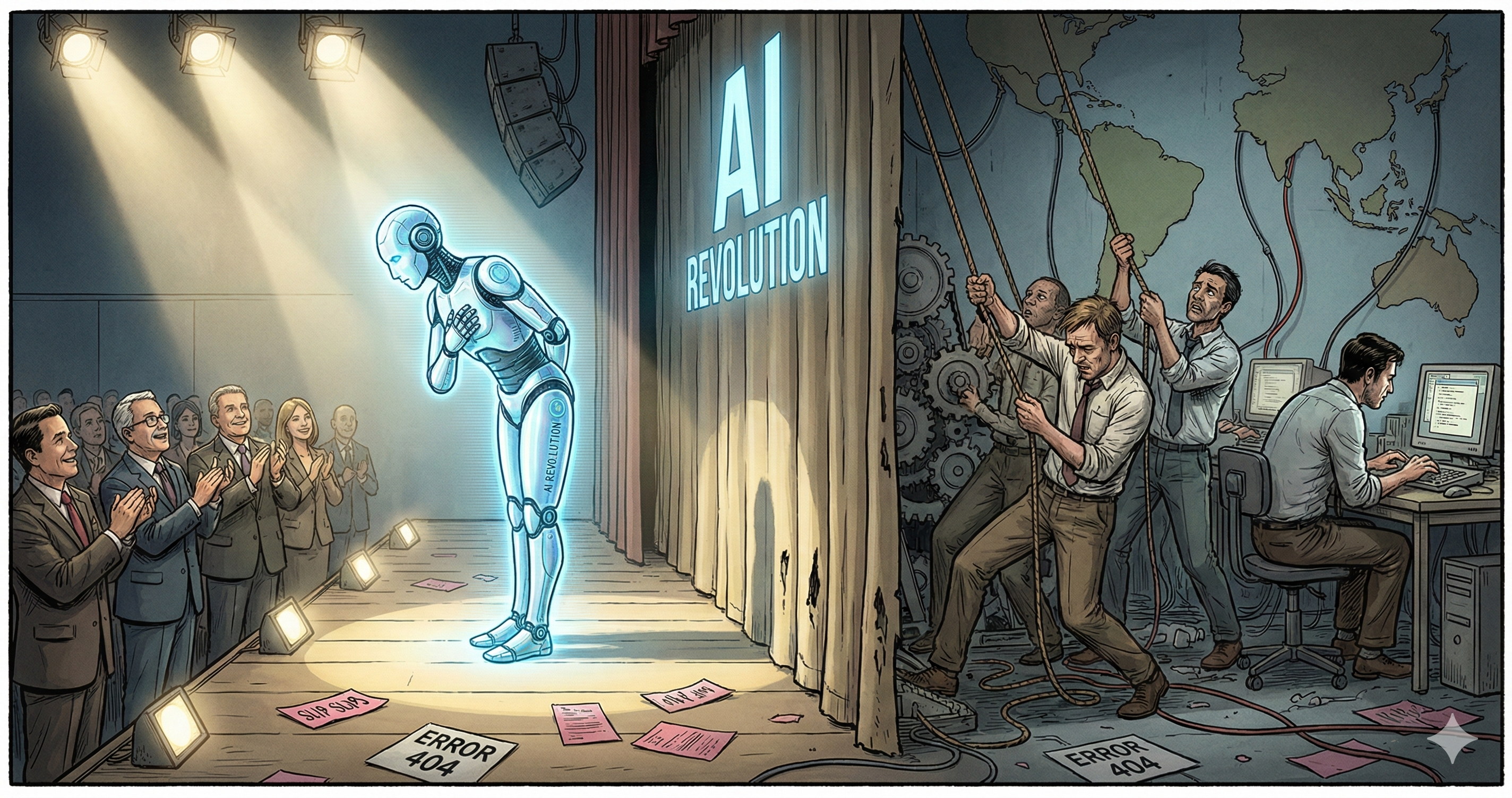
2025 será recordado como el año en que Silicon Valley apostó miles de empleos a una tecnología que no funciona. Cuando Salesforce anunció que “la IA ahora hace el 50% del trabajo”, despidió a 4,000 personas. Amazon eliminó 14,000 posiciones “para invertir en IA”. Microsoft, 15,000 más. El mensaje corporativo era inequívoco: la automatización había llegado, los humanos sobraban.
Hay un pequeño problema: la IA no funciona. Al menos no en el modo que los accionistas creyeron o desearían que fuera, ni que las empresas que le apostaron a ello esperaban.
El Rey Está Desnudo (Pero Todos Fingen Ver Ropa)
Un estudio del MIT Sloan reveló que el 95% de las iniciativas de IA empresariales tienen retorno de inversión cero. Cero. Ni negativo, ni bajo: inexistente. Mientras tanto, 55,000 trabajadores fueron despedidos en 2025 bajo la promesa de que la automatización los reemplazaría.
¿El resultado? El 55% de los empleadores admite—en privado—que se arrepiente de haber despedido. Más de la mitad. No es un error marginal: es un fracaso sistémico disfrazado de “transformación digital”.
Klarna es el caso más revelador. La empresa despidió 700 empleados prometiendo que su asistente de IA manejaría todo. La calidad del servicio cayó en picada. Los clientes se quejaron. Silenciosamente, Klarna tuvo que re-contratar. Pero no admitió el error. No hubo comunicado de prensa. No hubo disculpas públicas. Solo contratos offshore a salarios menores.
El Teatro Corporativo Para Wall Street
Forrester predice que el 50% de los trabajadores despedidos “por IA” serán re-contratados—pero no en Silicon Valley. Serán contratados offshore, en mercados emergentes, a una fracción del costo original. El narrative cambia: ya no es “la IA nos hace más eficientes”, es “optimizamos costos operativos mediante deslocalización estratégica”.
Es un truco contable brillante. Despides 14,000 personas en Estados Unidos con salarios de $120,000 anuales, contratas 8,000 en América Latina o Asia del Sur a $30,000, y reportas “reducción de headcount” junto con “inversión en IA”. Los accionistas aplauden. Los analistas suben la calificación. Nadie pregunta si la IA realmente funciona porque la ecuación financiera cierra.
El problema es que solo el 23% de las empresas ofrece entrenamiento real en IA a sus equipos. Despiden personas por “falta de adaptación tecnológica” pero no invierten en capacitación. No es transformación: es precarización con buzzwords.
LATAM: El Plan B Cuando el Hype Falla
Aquí está la ironía devastadora para América Latina: cuando Silicon Valley despide “por IA” y la IA falla, nosotros somos el respaldo silencioso. Las posiciones offshore no son “nuevas oportunidades”—son los mismos trabajos, con los mismos requisitos, a un tercio del precio.
Pero hay una trampa dentro de la trampa. Las empresas latinoamericanas están perdiendo su mejor talento ante estas ofertas internacionales. Un desarrollador senior en México que ganaba $40,000 USD anuales en empresa local, ahora recibe $65,000 de una corporación estadounidense trabajando remoto. La empresa mexicana no puede competir. El talento se va. La capacidad intelectual regional es apropiada por corporaciones extranjeras que nunca invertirán en desarrollo local.
Mientras CEOs latinoamericanos copian el playbook de Silicon Valley—despedir personal y prometer “transformación IA”—las compañías internacionales están contratando exactamente a los mismos profesionales que las empresas locales están dejando ir. Es un drenaje de talento disfrazado de “oportunidad global”.
El Costo Real de una Mentira Corporativa
Este no es solo un problema de honestidad empresarial. Cuando 55,000 personas pierden su trabajo bajo una premisa falsa, cuando el 95% de las iniciativas fracasan pero nadie lo admite, cuando la mitad de los empleadores se arrepiente en privado pero celebra en público, estamos normalizando el engaño como estrategia de negocio.
No estamos en medio de una revolución de IA. Estamos en medio de una burbuja especulativa donde admitir la verdad—que la tecnología no está lista, que los modelos no entregan valor, que los despidos fueron prematuros—sería demasiado costoso para las reputaciones corporativas y las valuaciones bursátiles.
¿Y 2026?
La pregunta que nadie en Wall Street quiere hacer: ¿continuará esta tendencia o las empresas revertirán a tiempo antes de que el daño sea catastrófico?
Quizá Amazon, Microsoft y Salesforce pueden permitirse este experimento en tiempo real con sus operaciones. Tienen reservas de efectivo multimillonarias, márgenes de error amplios, y departamentos enteros dedicados a “gestionar crisis de talento”. Pueden despedir hoy, re-contratar mañana offshore, ajustar narrativas, y absorber el impacto.
Pero las pequeñas y medianas empresas no tienen ese privilegio. Una startup que despida a su equipo de soporte apostando a que un chatbot lo resolverá todo no sobrevivirá al fracaso. Una empresa mediana en LATAM que imite el playbook de Silicon Valley sin los recursos para corregir el error se quedará sin talento—porque el bueno ya lo contrató una corporación internacional, y el resto ya no confiará en la compañía.
El experimento de 2025 les costó 55,000 empleos a los gigantes tecnológicos. ¿Cuántos empleos le costará a las empresas que no pueden permitirse equivocarse?
Referencias
- MIT Sloan Management Review (2024). “The AI Implementation Gap: Why 95% of Projects Fail to Deliver ROI”
- Forrester Research (2025). “The Great Rehiring: 2025 Workforce Predictions”
- Revelio Labs (2024-2025). “Corporate AI Adoption and Workforce Displacement Analysis”
- Klarna Annual Report (2024). “Customer Service Transformation Outcomes”
- Salesforce Q4 2024 Earnings Call Transcript
2025 will be remembered as the year Silicon Valley bet thousands of jobs on technology that doesn’t work. When Salesforce announced that “AI now does 50% of the work,” it laid off 4,000 people. Amazon eliminated 14,000 positions “to invest in AI.” Microsoft, 15,000 more. The corporate message was unequivocal: automation had arrived, humans were surplus.
There’s one small problem: AI doesn’t work. At least not in the way shareholders believed or wished it would, nor in the way companies betting on it expected.
The Emperor Has No Clothes (But Everyone Pretends to See Them)
An MIT Sloan study revealed that 95% of enterprise AI initiatives have zero return on investment. Zero. Not negative, not low: nonexistent. Meanwhile, 55,000 workers were laid off in 2025 under the promise that automation would replace them.
The result? 55% of employers admit—privately—that they regret having laid off workers. More than half. This isn’t a marginal error: it’s a systemic failure disguised as “digital transformation.”
Klarna is the most revealing case. The company laid off 700 employees promising its AI assistant would handle everything. Service quality plummeted. Customers complained. Quietly, Klarna had to rehire. But it didn’t admit the mistake. No press release. No public apology. Just offshore contracts at lower salaries.
Corporate Theater for Wall Street
Forrester predicts that 50% of workers laid off “for AI” will be rehired—but not in Silicon Valley. They’ll be hired offshore, in emerging markets, at a fraction of the original cost. The narrative shifts: it’s no longer “AI makes us more efficient,” it’s “we’re optimizing operational costs through strategic offshoring.”
It’s a brilliant accounting trick. Lay off 14,000 people in the United States with $120,000 annual salaries, hire 8,000 in Latin America or South Asia at $30,000, and report “headcount reduction” alongside “AI investment.” Shareholders applaud. Analysts upgrade ratings. Nobody asks if AI actually works because the financial equation closes.
The problem is that only 23% of companies offer real AI training to their teams. They fire people for “lack of technological adaptation” but don’t invest in training. This isn’t transformation: it’s precariousness with buzzwords.
LATAM: Plan B When the Hype Fails
Here’s the devastating irony for Latin America: when Silicon Valley fires “for AI” and AI fails, we’re the silent backup. Offshore positions aren’t “new opportunities”—they’re the same jobs, with the same requirements, at a third of the price.
But there’s a trap within the trap. Latin American companies are losing their best talent to these international offers. A senior developer in Mexico earning $40,000 USD annually at a local company now receives $65,000 from a U.S. corporation working remotely. The Mexican company can’t compete. The talent leaves. Regional intellectual capacity is appropriated by foreign corporations that will never invest in local development.
While Latin American CEOs copy the Silicon Valley playbook—firing staff and promising “AI transformation”—international companies are hiring exactly the same professionals that local companies are letting go. It’s a brain drain disguised as “global opportunity.”
The Real Cost of a Corporate Lie
This isn’t just a problem of corporate honesty. When 55,000 people lose their jobs under a false premise, when 95% of initiatives fail but nobody admits it, when half of employers regret privately but celebrate publicly, we’re normalizing deception as a business strategy.
We’re not in the middle of an AI revolution. We’re in the middle of a speculative bubble where admitting the truth—that the technology isn’t ready, that models don’t deliver value, that layoffs were premature—would be too costly for corporate reputations and stock valuations.
What About 2026?
The question nobody on Wall Street wants to ask: will this trend continue or will companies reverse course in time before the damage becomes catastrophic?
Perhaps Amazon, Microsoft, and Salesforce can afford this real-time experiment with their operations. They have multibillion-dollar cash reserves, wide error margins, and entire departments dedicated to “managing talent crises.” They can fire today, rehire offshore tomorrow, adjust narratives, and absorb the impact.
But small and medium-sized businesses don’t have that privilege. A startup that fires its support team betting that a chatbot will solve everything won’t survive the failure. A medium-sized company in LATAM that imitates the Silicon Valley playbook without the resources to correct the mistake will be left without talent—because the good ones were already hired by an international corporation, and the rest won’t trust the company anymore.
The 2025 experiment cost tech giants 55,000 jobs. How many jobs will it cost companies that can’t afford to make mistakes?
References
- MIT Sloan Management Review (2024). “The AI Implementation Gap: Why 95% of Projects Fail to Deliver ROI”
- Forrester Research (2025). “The Great Rehiring: 2025 Workforce Predictions”
- Revelio Labs (2024-2025). “Corporate AI Adoption and Workforce Displacement Analysis”
- Klarna Annual Report (2024). “Customer Service Transformation Outcomes”
- Salesforce Q4 2024 Earnings Call Transcript