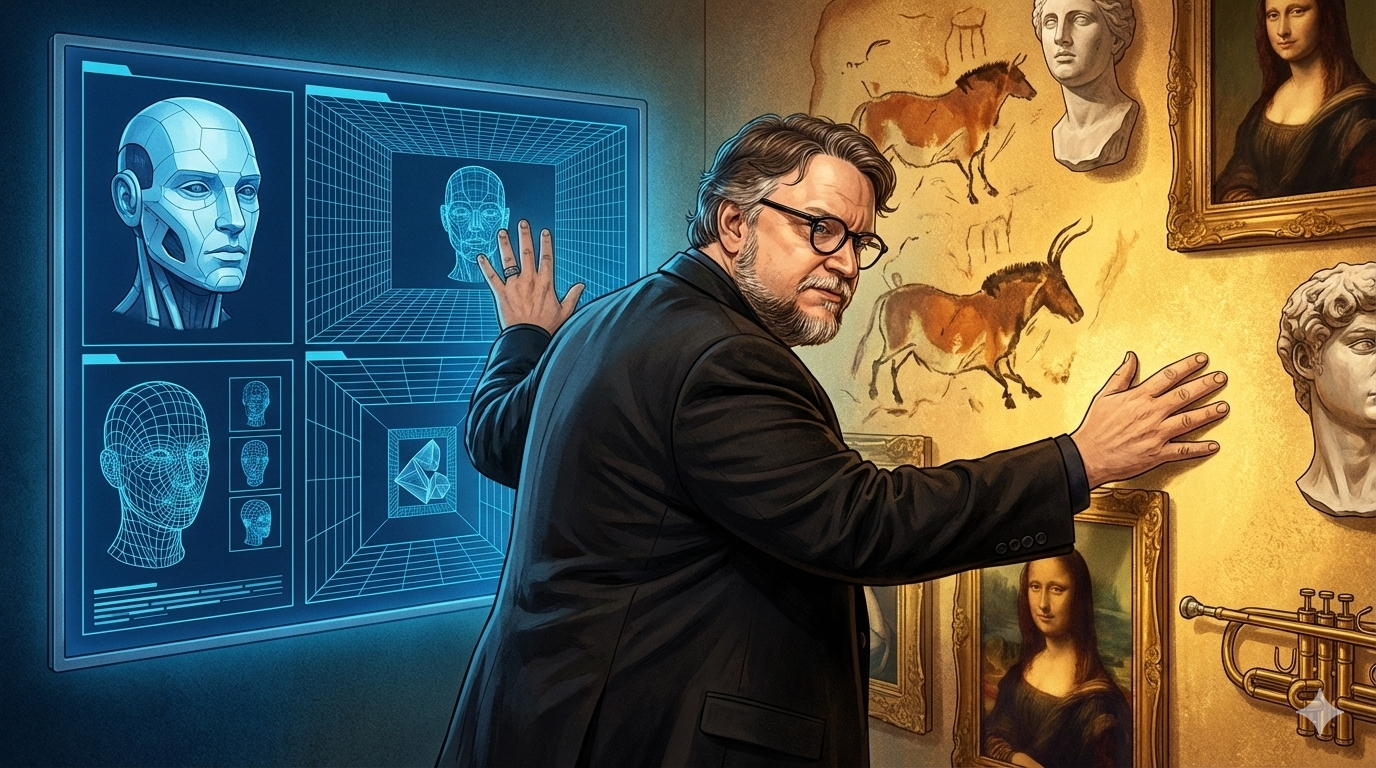
En una entrevista reciente, le preguntaron a Guillermo del Toro su opinión sobre la inteligencia artificial. Su respuesta fue visceral, directa, casi violenta en su honestidad:
“A la chingada, ¿quién va a comprar las cosas que haga IA?, yo no.”
Y en esas pocas palabras, Del Toro articuló algo que los debates técnicos sobre IA generativa suelen omitir: una pregunta filosófica fundamental sobre qué es el arte, qué lo hace valioso, y qué significa ser humano.
No fue una respuesta técnica sobre resolución de píxeles o coherencia narrativa. Fue un rechazo filosófico—casi existencial—a la idea de que algo carente de experiencia humana pueda producir arte verdadero.
Y tenía razón.
La distinción que olvidamos: generar no es crear
Cuando hablamos de “IA creativa” o “arte generado por IA”, estamos cometiendo un error categórico fundamental. Estamos confundiendo dos verbos que no son sinónimos:
Generar = Recombinar patrones existentes según reglas aprendidas
Crear = Traer algo genuinamente nuevo al mundo desde experiencia, intención y consciencia
Una IA puede generar una imagen impresionante de una puesta de sol melancólica. Puede producir texto que evoque nostalgia. Puede componer música que suene como tristeza.
Pero no puede crear ninguna de esas cosas en el sentido profundo de la palabra.
¿Por qué? Porque crear arte no es solo producir un artefacto estético. Crear arte es externalizar experiencia humana en forma sensible.
El arte como testimonio de haber vivido
Desde las pinturas rupestres de Altamira hace 36,000 años hasta el arte contemporáneo más conceptual, el arte ha cumplido una función esencial: testimoniar que estuvimos aquí, que sentimos, que pensamos, que sufrimos, que amamos, que existimos.
Cuando miramos las manos pintadas en las cuevas de Chauvet, no solo vemos formas. Vemos el impulso humano de decir “Yo estuve aquí. Yo importo. Yo existo.” Es un acto de afirmación existencial.
Cuando leemos a Dostoievski describir la angustia, no solo consumimos palabras bien organizadas. Leemos el testimonio de un hombre que vivió esa angustia, que la procesó a través de su existencia particular, que la transformó en algo comunicable.
Cuando escuchamos a Nina Simone cantar “Strange Fruit”, no solo oímos notas musicales correctamente ejecutadas. Escuchamos el peso histórico del racismo estadounidense procesado a través de la voz de una mujer negra que vivió en esa realidad.
El arte es siempre autobiográfico en su esencia más profunda—incluso cuando no lo parece.
Porque incluso el arte más abstracto, más conceptual, más alejado de representación directa, sigue siendo producto de una consciencia que experimentó el mundo de maneras únicas, que tomó decisiones basadas en intuiciones formadas por años de vida.
Lo que la IA no puede tener: experiencia encarnada
Una IA puede analizar millones de pinturas sobre dolor y aprender patrones visuales asociados con representaciones de sufrimiento. Puede generar imágenes técnicamente competentes que otros humanos identifiquen como “tristes” o “dolorosas”.
Pero la IA nunca ha sufrido.
Nunca ha experimentado la pérdida de un ser amado. Nunca ha sentido el peso existencial de la mortalidad propia. Nunca ha conocido la angustia de la decisión moral imposible. Nunca ha experimentado la soledad, el amor, la traición, el asombro ante la belleza, el terror ante lo desconocido.
No tiene experiencia encarnada. No tiene biografía. No tiene contexto existencial.
Y eso no es un problema técnico que se resolverá con más datos o mejores algoritmos. Es una distinción ontológica fundamental.
Como escribió Maurice Merleau-Ponty, existimos como “seres-en-el-mundo”—nuestra consciencia no está separada de nuestros cuerpos ni de nuestra inserción en contextos históricos, culturales, relacionales. Pensamos desde un cuerpo, desde una historia, desde una red de relaciones.
La IA no piensa desde ningún lugar. Procesa patrones sin contexto existencial que los ancle a significado vivido.
El error interesante vs. la perfección algorítmica
Hay algo paradójico en la creatividad humana: algunos de nuestros mayores logros artísticos son producto de limitaciones, errores, accidentes felices.
El jazz nació en parte de músicos afroamericanos que no tenían acceso a educación musical formal europea, inventando nuevas formas de tocar que violaban “reglas” establecidas.
El impresionismo surgió en parte porque pintores comenzaron a trabajar al aire libre con luz natural cambiante—una limitación técnica que se transformó en revolución estética.
Muchas de las grandes canciones del rock tienen “errores” de ejecución que se mantuvieron porque sonaban interesantes—una nota ligeramente desafinada que añadía emoción, un tiempo imperfecto que generaba tensión.
La creatividad humana prospera en la imperfección intencional, en el error productivo, en la decisión de romper reglas por razones que no siempre podemos articular.
La IA, en cambio, optimiza. Busca patrones. Genera outputs que maximizan probabilidad según su entrenamiento. Puede simular imperfección si eso está en sus datos de entrenamiento, pero no puede elegir imperfección creativa por intuición formada en experiencia.
No puede tener el momento de “esto está técnicamente mal, pero se siente correcto” que define tanto del arte humano.
La intención como componente esencial del arte
Cuando Jackson Pollock lanzaba pintura sobre lienzos en el suelo, el valor de la obra no estaba solo en el patrón visual resultante. Estaba en la intención detrás del proceso—su rechazo al arte figurativo, su exploración del automatismo, su búsqueda de expresión gestual directa.
Cuando Duchamp presentó un urinario como escultura, el arte no era el objeto en sí. Era el acto conceptual—la pregunta sobre qué constituye arte, quién decide, bajo qué autoridad.
Cuando Marina Abramović se sentó inmóvil durante días mientras el público interactuaba con ella, el arte era la experiencia compartida de vulnerabilidad y presencia—algo que requería su cuerpo, su resistencia, su decisión consciente de someterse a esa situación.
El arte no es solo el artefacto final. Es intención, proceso, contexto, decisión consciente.
¿Puede una IA tener intención? No en el sentido que importa para el arte. Puede ejecutar instrucciones. Puede optimizar funciones. Pero no puede querer decir algo desde un lugar de experiencia y decisión consciente.
Por qué compramos arte: la conexión con lo humano
Cuando compramos una pintura, una novela, una canción—¿qué estamos comprando realmente?
No solo el objeto físico o digital. Estamos comprando conexión con otra consciencia humana.
Estamos diciendo: “Esta persona vio el mundo de una manera particular. Procesó experiencias de formas únicas. Y al exteriorizar eso, me permite ver aspectos de la experiencia humana que yo no había articulado.”
Leemos a Kafka no solo por las historias, sino porque Kafka vivió una forma particular de alienación y angustia existencial, y logró transformar eso en algo que resuena con nuestra propia experiencia de absurdo.
Escuchamos a Leonard Cohen no solo por las melodías, sino porque Cohen procesó amor, pérdida, espiritualidad y mortalidad de maneras que iluminan nuestras propias navegaciones de esos territorios existenciales.
El arte es un puente entre consciencias. Un testimonio de que otros han sentido lo que sentimos, han luchado con lo que luchamos, han visto belleza donde nosotros también la vemos.
¿Qué puente puede construir una IA que nunca ha estado del otro lado?
“A la chingada”: Un rechazo filosófico, no técnico
Cuando Guillermo del Toro dice “a la chingada, ¿quién va a comprar las cosas que haga IA?”, no está haciendo una predicción de mercado. Está haciendo una declaración filosófica sobre valor.
Está diciendo: el valor del arte no radica en competencia técnica de ejecución. Radica en que es expresión de humanidad.
Y está planteando una pregunta incómoda: ¿Qué dice de nosotros si estamos dispuestos a consumir “arte” generado por sistemas que carecen de todo lo que históricamente ha hecho al arte valioso—experiencia, intención, consciencia, contexto existencial?
¿Estamos tan alienados de nuestra propia humanidad que nos conformamos con simulacros estéticos producidos por máquinas?
Su “a la chingada” es un acto de resistencia. Un rechazo a normalizar la deshumanización de uno de los últimos espacios que definen lo esencialmente humano.
Lo que perdemos si normalizamos arte sin alma
Si aceptamos que “arte generado por IA” es simplemente otra categoría de arte—equivalente en valor a arte humano—estamos aceptando algo más profundo y más peligroso:
Estamos aceptando que la experiencia humana, la consciencia, la intención, el contexto existencial—no importan realmente.
Estamos diciendo que el arte es solo estética superficial. Que una imagen es solo píxeles organizados de manera agradable. Que una canción es solo frecuencias sonoras en patrones reconocibles. Que un poema es solo palabras que suenan bien juntas.
Estamos reduciendo el arte a sus componentes más superficiales y eliminando todo lo que lo hace significativo.
Y si hacemos eso con el arte—una de las expresiones más fundamentales de humanidad—¿qué mensaje enviamos sobre el valor de la experiencia humana en general?
El arte nos define como humanos
A lo largo de la historia, el arte ha sido uno de los marcadores más consistentes de humanidad. Donde hay humanos, hay arte. Desde las primeras civilizaciones hasta hoy.
No creamos arte solo para decorar o entretener. Creamos arte porque necesitamos externalizar experiencia interna, porque necesitamos comunicar lo incomunicable, porque necesitamos dejar rastro de nuestra existencia.
El arte es cómo procesamos trauma colectivo. Cómo celebramos momentos de alegría. Cómo cuestionamos estructuras de poder. Cómo imaginamos futuros alternativos. Cómo recordamos pasados dolorosos. Cómo construimos identidad cultural.
El arte no es lujo prescindible. Es tecnología de significado. Es cómo construimos sentido en un universo que no viene con manual de instrucciones.
Si tercierizamos eso a algoritmos, no solo perdemos arte. Perdemos una forma fundamental de ser humanos.
Una defensa del arte humano sin nostalgia
No estoy proponiendo que rechacemos tecnología. No estoy sugiriendo que los artistas no puedan usar IA como herramienta en su proceso creativo.
Estoy proponiendo que mantengamos claridad sobre qué es arte y qué es generación algorítmica.
Una IA puede ser herramienta útil en manos de un artista—como el Photoshop, el sintetizador, o la cámara digital lo son. Puede acelerar ciertas partes del proceso. Puede ofrecer variaciones para explorar. Puede amplificar capacidades humanas.
Pero la IA como herramienta es radicalmente diferente de la IA como “creador” autónomo.
En el primer caso, hay un humano con intención, experiencia y decisión consciente usando tecnología para externalizar su visión. En el segundo caso, hay un algoritmo recombinando patrones sin contexto existencial que ancle esos patrones a significado.
La diferencia no es técnica. Es ontológica.
La pregunta que debemos responder
Entonces llegamos a la pregunta central que Del Toro plantea implícitamente:
¿Queremos vivir en un mundo donde consumimos arte sin alma porque es más barato, más rápido, más conveniente?
¿Queremos una cultura donde la música de fondo es generada algorítmicamente, las ilustraciones son producidas por IA, las historias son escritas por modelos de lenguaje—todo “suficientemente bueno” pero nada memorable, nada que lleve rastro de experiencia humana?
¿Estamos dispuestos a sacrificar conexión con humanidad compartida en el altar de eficiencia y conveniencia?
Porque eso es lo que está en juego. No es solo sobre tecnología. Es sobre qué valoramos como sociedad. Es sobre qué significa ser humano.
Y si perdemos eso—si normalizamos arte sin humanidad—habremos perdido algo que ninguna optimización algorítmica puede reemplazar.
Para reflexión:
¿Comprarías una pintura generada por IA para tu casa? ¿Leerías una novela escrita completamente por algoritmo? ¿Escucharías música producida sin intervención humana?
Si la respuesta es no—¿por qué no? ¿Qué es lo que falta?
Y si la respuesta es sí—¿qué te dice eso sobre lo que valoras en el arte?
Estas no son preguntas retóricas. Son preguntas que definen qué tipo de cultura construiremos.
In a recent interview, Guillermo del Toro was asked his opinion about artificial intelligence. His response was visceral, direct, almost violent in its honesty:
“Fuck that, who’s going to buy things made by AI? Not me.”
And in those few words, Del Toro articulated something that technical debates about generative AI often omit: a fundamental philosophical question about what art is, what makes it valuable, and what it means to be human.
It wasn’t a technical response about pixel resolution or narrative coherence. It was a philosophical rejection—almost existential—of the idea that something lacking human experience can produce true art.
And he was right.
The distinction we forget: generating is not creating
When we talk about “creative AI” or “AI-generated art,” we’re making a fundamental categorical error. We’re confusing two verbs that aren’t synonyms:
Generate = Recombine existing patterns according to learned rules
Create = Bring something genuinely new into the world from experience, intention, and consciousness
An AI can generate an impressive image of a melancholic sunset. It can produce text that evokes nostalgia. It can compose music that sounds like sadness.
But it cannot create any of those things in the deep sense of the word.
Why? Because creating art isn’t just producing an aesthetic artifact. Creating art is externalizing human experience in sensible form.
Art as testimony of having lived
From the cave paintings of Altamira 36,000 years ago to the most conceptual contemporary art, art has fulfilled an essential function: testifying that we were here, that we felt, that we thought, that we suffered, that we loved, that we exist.
When we look at the painted hands in the Chauvet caves, we don’t just see shapes. We see the human impulse to say “I was here. I matter. I exist.” It’s an act of existential affirmation.
When we read Dostoevsky describing anguish, we don’t just consume well-organized words. We read the testimony of a man who lived that anguish, who processed it through his particular existence, who transformed it into something communicable.
When we listen to Nina Simone sing “Strange Fruit,” we don’t just hear correctly executed musical notes. We hear the historical weight of American racism processed through the voice of a Black woman who lived in that reality.
Art is always autobiographical in its deepest essence—even when it doesn’t appear to be.
Because even the most abstract, most conceptual art, most removed from direct representation, remains the product of a consciousness that experienced the world in unique ways, that made decisions based on intuitions formed by years of life.
What AI cannot have: embodied experience
An AI can analyze millions of paintings about pain and learn visual patterns associated with representations of suffering. It can generate technically competent images that other humans identify as “sad” or “painful.”
But the AI has never suffered.
It has never experienced the loss of a loved one. It has never felt the existential weight of its own mortality. It has never known the anguish of the impossible moral decision. It has never experienced loneliness, love, betrayal, awe at beauty, terror of the unknown.
It has no embodied experience. It has no biography. It has no existential context.
And that’s not a technical problem that will be solved with more data or better algorithms. It’s a fundamental ontological distinction.
As Maurice Merleau-Ponty wrote, we exist as “beings-in-the-world”—our consciousness isn’t separated from our bodies or from our insertion in historical, cultural, relational contexts. We think from a body, from a history, from a network of relationships.
AI doesn’t think from anywhere. It processes patterns without existential context to anchor them to lived meaning.
The interesting error vs. algorithmic perfection
There’s something paradoxical in human creativity: some of our greatest artistic achievements are products of limitations, errors, happy accidents.
Jazz was born partly from African American musicians who didn’t have access to formal European musical education, inventing new ways of playing that violated established “rules.”
Impressionism emerged partly because painters began working outdoors with changing natural light—a technical limitation that transformed into aesthetic revolution.
Many of rock’s great songs have execution “errors” that were kept because they sounded interesting—a slightly off-pitch note that added emotion, an imperfect timing that generated tension.
Human creativity thrives on intentional imperfection, on productive error, on the decision to break rules for reasons we can’t always articulate.
AI, on the other hand, optimizes. It seeks patterns. It generates outputs that maximize probability according to its training. It can simulate imperfection if that’s in its training data, but it cannot choose creative imperfection by intuition formed in experience.
It cannot have the moment of “this is technically wrong, but it feels right” that defines so much of human art.
Intention as an essential component of art
When Jackson Pollock threw paint onto canvases on the floor, the value of the work wasn’t just in the resulting visual pattern. It was in the intention behind the process—his rejection of figurative art, his exploration of automatism, his search for direct gestural expression.
When Duchamp presented a urinal as sculpture, the art wasn’t the object itself. It was the conceptual act—the question about what constitutes art, who decides, under what authority.
When Marina Abramović sat motionless for days while the public interacted with her, the art was the shared experience of vulnerability and presence—something that required her body, her endurance, her conscious decision to submit to that situation.
Art isn’t just the final artifact. It’s intention, process, context, conscious decision.
Can an AI have intention? Not in the sense that matters for art. It can execute instructions. It can optimize functions. But it cannot want to say something from a place of experience and conscious decision.
Why we buy art: connection with the human
When we buy a painting, a novel, a song—what are we really buying?
Not just the physical or digital object. We’re buying connection with another human consciousness.
We’re saying: “This person saw the world in a particular way. They processed experiences in unique forms. And by externalizing that, they allow me to see aspects of human experience I hadn’t articulated.”
We read Kafka not just for the stories, but because Kafka lived a particular form of alienation and existential anguish, and managed to transform that into something that resonates with our own experience of absurdity.
We listen to Leonard Cohen not just for the melodies, but because Cohen processed love, loss, spirituality and mortality in ways that illuminate our own navigations of those existential territories.
Art is a bridge between consciousnesses. A testimony that others have felt what we feel, have struggled with what we struggle with, have seen beauty where we also see it.
What bridge can an AI build that has never been on the other side?
“Fuck that”: A philosophical rejection, not technical
When Guillermo del Toro says “fuck that, who’s going to buy things made by AI?”, he’s not making a market prediction. He’s making a philosophical statement about value.
He’s saying: the value of art doesn’t lie in technical competence of execution. It lies in it being an expression of humanity.
And he’s posing an uncomfortable question: What does it say about us if we’re willing to consume “art” generated by systems that lack everything that has historically made art valuable—experience, intention, consciousness, existential context?
Are we so alienated from our own humanity that we settle for aesthetic simulacra produced by machines?
His “fuck that” is an act of resistance. A rejection of normalizing the dehumanization of one of the last spaces that define what’s essentially human.
What we lose if we normalize soulless art
If we accept that “AI-generated art” is simply another category of art—equivalent in value to human art—we’re accepting something deeper and more dangerous:
We’re accepting that human experience, consciousness, intention, existential context—don’t really matter.
We’re saying that art is just superficial aesthetics. That an image is just pixels organized in a pleasing way. That a song is just sound frequencies in recognizable patterns. That a poem is just words that sound good together.
We’re reducing art to its most superficial components and eliminating everything that makes it meaningful.
And if we do that with art—one of the most fundamental expressions of humanity—what message do we send about the value of human experience in general?
Art defines us as human
Throughout history, art has been one of the most consistent markers of humanity. Where there are humans, there is art. From the earliest civilizations to today.
We don’t create art just to decorate or entertain. We create art because we need to externalize internal experience, because we need to communicate the incommunicable, because we need to leave traces of our existence.
Art is how we process collective trauma. How we celebrate moments of joy. How we question power structures. How we imagine alternative futures. How we remember painful pasts. How we construct cultural identity.
Art isn’t dispensable luxury. It’s technology of meaning. It’s how we build sense in a universe that doesn’t come with an instruction manual.
If we outsource that to algorithms, we don’t just lose art. We lose a fundamental way of being human.
A defense of human art without nostalgia
I’m not proposing we reject technology. I’m not suggesting that artists can’t use AI as a tool in their creative process.
I’m proposing we maintain clarity about what is art and what is algorithmic generation.
AI can be a useful tool in an artist’s hands—like Photoshop, the synthesizer, or the digital camera are. It can accelerate certain parts of the process. It can offer variations to explore. It can amplify human capacities.
But AI as a tool is radically different from AI as autonomous “creator”.
In the first case, there’s a human with intention, experience and conscious decision using technology to externalize their vision. In the second case, there’s an algorithm recombining patterns without existential context to anchor those patterns to meaning.
The difference isn’t technical. It’s ontological.
The question we must answer
So we arrive at the central question that Del Toro implicitly poses:
Do we want to live in a world where we consume soulless art because it’s cheaper, faster, more convenient?
Do we want a culture where background music is algorithmically generated, illustrations are AI-produced, stories are written by language models—all “good enough” but nothing memorable, nothing carrying traces of human experience?
Are we willing to sacrifice connection with shared humanity at the altar of efficiency and convenience?
Because that’s what’s at stake. It’s not just about technology. It’s about what we value as a society. It’s about what it means to be human.
And if we lose that—if we normalize art without humanity—we’ll have lost something no algorithmic optimization can replace.
For reflection:
Would you buy an AI-generated painting for your home? Would you read a novel written entirely by algorithm? Would you listen to music produced without human intervention?
If the answer is no—why not? What’s missing?
And if the answer is yes—what does that tell you about what you value in art?
These aren’t rhetorical questions. They’re questions that define what kind of culture we’ll build.